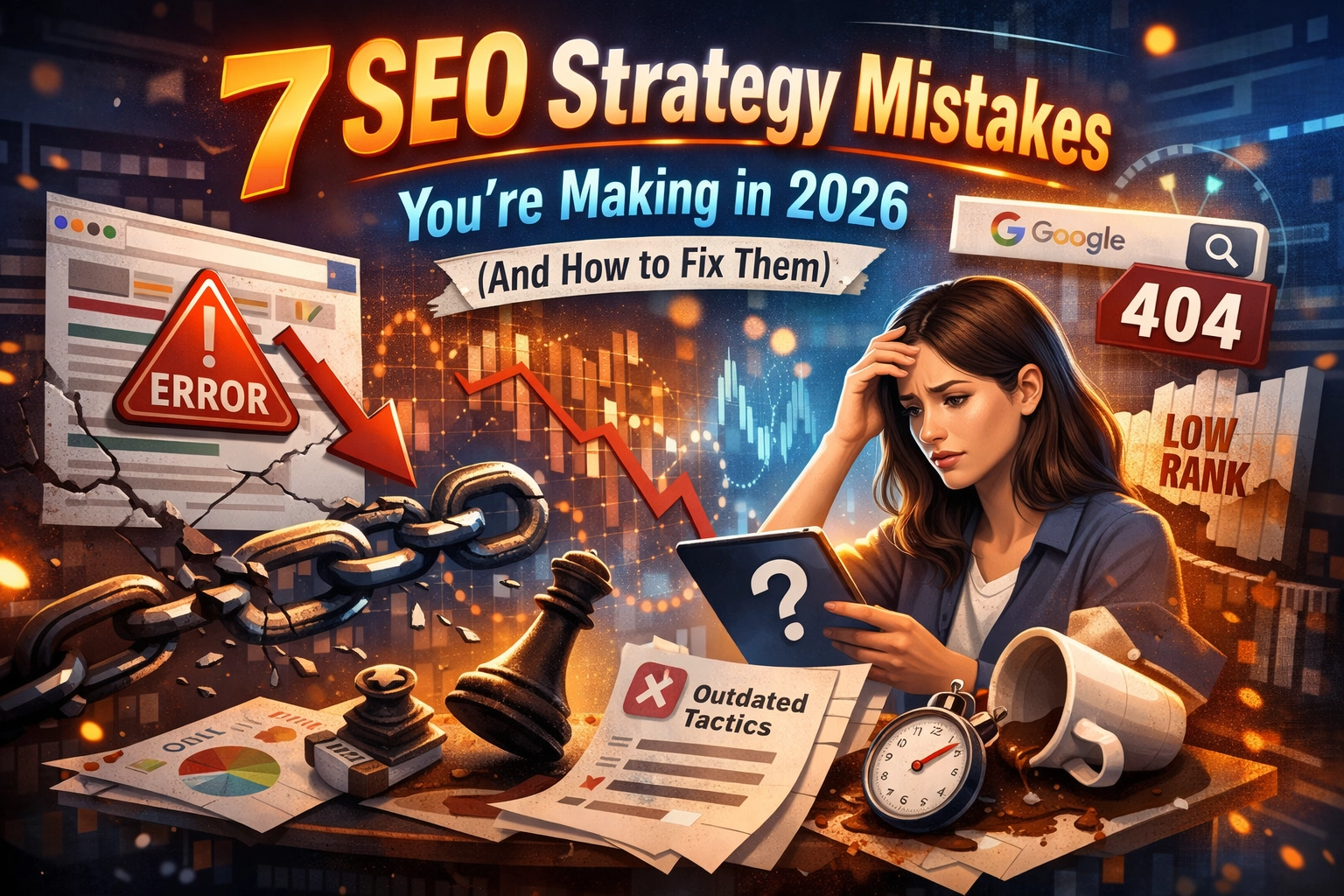
Search engine optimization isn't what it used to be. If you’re still clinging to the tactics that worked in 2022 or even 2024, you’re likely seeing your rankings slide into the abyss. By 2026, Google’s algorithms have moved far beyond simple word matching. They now prioritize user psychology, technical precision, and genuine authority.
Building effective SEO strategies in 2026 requires a shift from "gaming the system" to "becoming the best answer on the internet." Here are the seven biggest mistakes we're seeing right now and exactly how you can pivot to save your traffic.
1. Keyword Stuffing and Over-Optimization
The days of repeating your target phrase every 100 words are long gone. In 2026, Google uses advanced Natural Language Processing (NLP) that understands context better than most humans do. If your content sounds like a robot wrote it to please another robot, you're going to get penalized.
The Mistake: Forcing phrases like "best SEO strategies 2026" into every heading and paragraph until the text becomes unreadable. This signals to search engines that you are trying to manipulate the results rather than provide value.
The Fix: Write for the human reader first. Use your primary keyword in the title and maybe once in the first few paragraphs, then let the rest happen naturally. Google’s algorithm now looks for semantic relationships. This means if you’re writing about "SEO strategies," Google expects to see related terms like "search intent," "backlink profile," "E-A-T," and "organic reach" without you forcing them.
| Old SEO Approach | SEO Strategies 2026 Approach |
|---|---|
| Focus on "Exact Match" keywords | Focus on "Topics" and "Entities" |
| Keyword density percentages | Natural flow and contextual relevance |
| Repetitive phrasing | Use of synonyms and related concepts |
2. Ignoring Search Intent (The "Why" Behind the Click)
You can write the most beautiful, 5,000-word guide in the world, but if it doesn't match what the user actually wanted to find, it will never rank on page one.
The Mistake: Targeting high-volume keywords without looking at the SERP (Search Engine Results Page). For example, if you try to rank a sales page for the keyword "how to fix a leaky faucet," you will fail. Why? Because people searching that phrase want a tutorial, not a plumber’s invoice.
The Fix: Before you write a single word, type your target keyword into Google. Look at the top three results. Are they listicles? In-depth guides? Product pages?
- Informational Intent: Users want to learn (Guides, Blogs).
- Navigational Intent: Users want to find a specific site.
- Commercial Intent: Users are researching before they buy (Reviews, "Top 10" lists).
- Transactional Intent: Users are ready to buy right now (Product pages).
Align your content type with what the data shows people are looking for.

3. Neglecting the Mobile Experience
By 2026, mobile-first indexing isn't just a suggestion; it is the law of the land. Over 60% of global searches now happen on mobile devices. If your site looks great on a MacBook but falls apart on an iPhone, Google will bury you.
The Mistake: Having "heavy" elements that don't scale, tiny buttons that are impossible to click, or pop-ups that cover the entire screen and can't be closed on a smartphone.
The Fix: Adopt a responsive design that prioritizes "thumb-friendliness." Ensure your font size is large enough to read without zooming and that your navigation menu is intuitive on a small screen. Test your site using Google’s Search Console to identify specific mobile usability errors.
4. Ignoring Page Speed and Core Web Vitals
User patience is at an all-time low. In 2026, a delay of even two seconds in page load time can increase your bounce rate by over 50%. Google uses Core Web Vitals: a set of specific metrics related to speed, responsiveness, and visual stability: as a direct ranking factor.
The Mistake: Using massive, unoptimized images, excessive third-party scripts, and cheap hosting that causes the page to "jump around" as it loads (known as Cumulative Layout Shift or CLS).
The Fix:
- Compress everything: Use WebP or Avif formats for images.
- Clean up your code: Minify CSS and Javascript.
- Upgrade your hosting: If you’re on a $5/month shared plan, you're likely hurting your SEO.
- Monitor CLS: Ensure your buttons and text don't move after the page starts loading, as this leads to accidental clicks and frustrated users.
5. Creating Thin, Low-Value Content
The "content is king" mantra was misinterpreted by many to mean "quantity is king." This led to a flood of 300-word blog posts that say nothing new. In 2026, Google’s "Helpful Content" updates are specifically designed to demote this kind of filler.
The Mistake: Publishing generic advice that can be found on a thousand other sites, or creating "doorway pages" that only exist to target a specific keyword without offering real insight.
The Fix: Aim for Topical Authority. Instead of writing 10 short posts, write one "Ultimate Guide" that covers every aspect of a subject. Use data, unique case studies, and original perspectives. If you can't add something new to the conversation, don't publish it. Google rewards depth and expertise.

6. Building or Buying Low-Quality Backlinks
Backlinks remain one of the most powerful ranking signals, but the quality bar has never been higher. The algorithm is now incredibly good at spotting "link schemes."
The Mistake: Buying packages of 5,000 links from Fiverr, participating in "link farms," or guest posting on low-quality sites that exist only to sell links. This won't just fail to help; it will likely result in a manual penalty that wipes your site from the index.
The Fix: Focus on earned links. Create content that is so good, people want to reference it. This includes:
- Original research and data.
- Infographics and visual aids.
- Controversial (but backed-up) opinions.
- High-quality tools or calculators.
A single link from a high-authority, relevant site (like a major news outlet or a top-tier industry blog) is worth more than 10,000 spammy links.
7. Duplicate Content and "Template" SEO
This is a massive issue for local businesses and e-commerce sites.
The Mistake: Creating 50 different pages for 50 different cities (e.g., "Plumber in Johannesburg," "Plumber in Cape Town") but using the exact same text for every page, only swapping the city name. Google sees this as duplicate content and will usually only rank one of those pages: or none at all.
The Fix: If you have multiple location or service pages, they must be unique. Include local testimonials, mention local landmarks, and tailor the advice to that specific area. If you can’t make the content unique, it’s better to have one strong "Service Area" page than 50 weak, identical ones.
Conclusion: The Future of Search
SEO in 2026 is about more than just keywords; it's about the user experience. When you fix these seven common mistakes, you aren't just pleasing an algorithm: you're building a better resource for your audience. Focus on speed, intent, and high-quality, original depth. The rankings will follow.
About the Author
Malibongwe Gcwabaza is the CEO of blog and youtube. With over a decade of experience in the digital landscape, Malibongwe specializes in scaling content platforms and helping businesses navigate the ever-changing world of search engine algorithms. His "simple-first" approach to marketing has helped dozens of brands turn their blogs into high-revenue engines. When he's not deep-diving into SEO data, he's exploring the latest trends in video content and digital storytelling.
About the Author