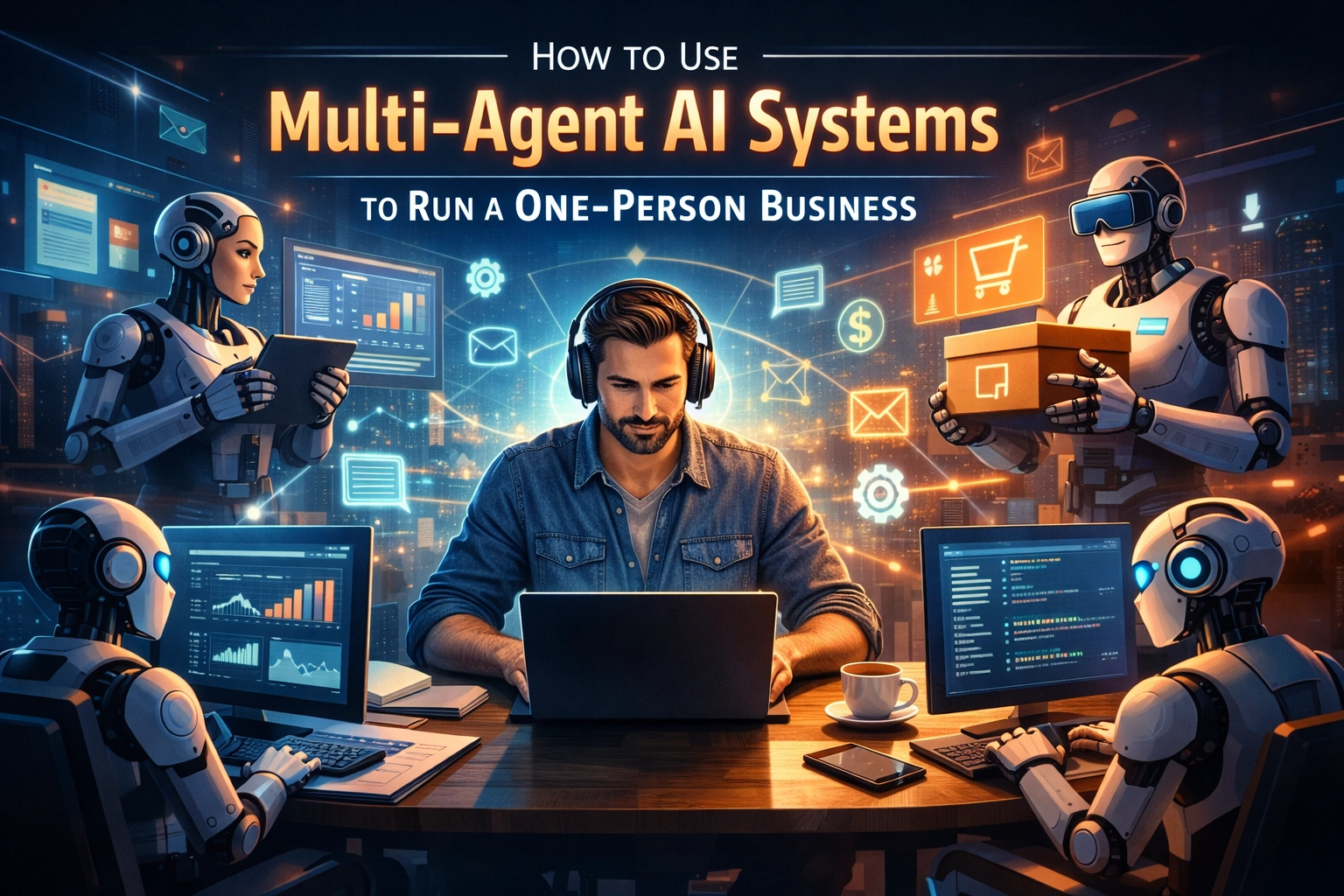
By 2026, the definition of a "solopreneur" has fundamentally shifted. We are no longer talking about a person doing everything manually; we are talking about a "Human Orchestrator." The secret sauce behind the most successful one-person businesses making seven figures today isn't just "using AI": it's the deployment of Multi-Agent AI Systems (MAS).
If you’re still copy-pasting prompts into a single chat window, you’re essentially hiring a genius intern who forgets everything the moment they walk out the door. Multi-agent systems change that. They allow you to build a digital workforce that communicates, self-corrects, and operates 24/7 without your constant supervision.
What is a Multi-Agent AI System?
To understand how to run a business with this, we need to get past the hype. A Multi-Agent System is a framework where multiple independent AI agents: each with a specific role, set of tools, and personality: work together to achieve a complex goal.
Think of it like a relay race. In a traditional AI setup (Single Agent), you ask a bot to write a blog post. It does its best, but the quality is often generic. In a Multi-Agent setup, you have:
- The Researcher Agent: Scours the web for the latest data and verified sources.
- The Writer Agent: Takes the research and drafts the copy.
- The Editor Agent: Critiques the draft, checks for brand voice, and sends it back to the writer if it’s not up to par.
- The SEO Agent: Optimizes the final version for search engines and suggests meta-tags.
These agents "talk" to each other via a central "orchestrator" or state-management system. This reduces the "hallucination" rate significantly because agents are programmed to check each other’s work.

Architecture of a Solopreneur’s AI Workforce
To run a one-person business, you don't need fifty agents. You need a "Virtual Board of Directors." Here is how you should structure your system for maximum efficiency and high-CPC output.
1. The Growth & Marketing Department (The CMO Agent)
This agent is responsible for top-of-funnel activities. By 2026, SEO has evolved into GEO (Generative Engine Optimization). Your CMO agent doesn't just look for keywords; it analyzes how AI models like Perplexity or Gemini are citing sources and ensures your content is structured to be the primary reference.
- Key Task: Monitoring social trends and automatically generating "Human-in-the-loop" content schedules.
- Technical Edge: Use an agent that leverages "Long-Term Memory" (Vector Databases like Pinecone or Weaviate) to remember your past successful posts and replicate that "vibe."
2. The Operations & Logistics Department (The COO Agent)
This is the "glue" of your business. The COO agent handles your calendar, manages your inbox, and interacts with your CRM. If a lead emails you asking for a meeting, the COO agent checks your availability, looks up the lead’s LinkedIn profile to provide you with a brief, and drafts a reply.
3. The Financial Controller (The CFO Agent)
For a solopreneur, taxes and cash flow are the biggest headaches. A specialized finance agent can monitor your Stripe or PayPal accounts, categorize expenses in real-time for tax season, and even provide "predictive runway" reports.
- Data Insight: Businesses using AI-driven financial monitoring see a 22% reduction in "subscription bloat": those forgotten monthly SaaS fees that bleed a business dry.
How to Build Your MAS (The Technical Stack)
You don't need a computer science degree to set this up anymore, but you do need to understand the logic of "Agentic Workflows." By March 2026, several platforms have made this drag-and-drop, though the most powerful ones still require some low-code knowledge.
Frameworks to Use:
- LangGraph / CrewAI: These are the gold standards for defining how agents interact. You can set "guardrails" so an agent never spends more than $5 in API credits without your permission.
- Make.com + OpenAI Assistants API: The easiest entry point for solopreneurs. You can string together different "Assistants" that trigger based on specific events (like a new Shopify order).
- Local LLMs (Ollama): For sensitive financial or client data, many 2026 solopreneurs are running smaller, specialized models locally to ensure privacy and zero data leakage.

Moving from Static Automation to Agentic Reasoning
The big leap in 2026 is Reasoning. Older automations were "If This, Then That." If an email comes in, save the attachment. Agentic reasoning is "If This, Think About That, Then Decide."
If an email comes in that looks like a complaint, the agent doesn't just save it. It:
- Analyzes the sentiment (Is the customer angry?).
- Checks the customer's purchase history.
- Drafts a personalized apology and offers a discount code based on the customer’s lifetime value.
- Flags it for you to review only if the refund amount exceeds a certain threshold.
This level of autonomy is what allows a single person to handle the customer support load of a 10-person agency.
The "Human-in-the-Loop" Necessity
Despite the power of multi-agent systems, the "One-Person" in "One-Person Business" is still the most important part. High-quality, high-CPC content requires a human "soul."
The most effective workflow is the Sandwich Method:
- Human: Sets the strategy and the "Big Idea."
- AI Agents: Perform the research, drafting, and formatting.
- Human: Performs the final 10% of "polishing": adding personal anecdotes, unique opinions, and that specific human touch that AI still can't perfectly replicate.
Google’s 2026 algorithms are incredibly good at spotting "purely synthetic" content. They prioritize "Experience, Expertise, Authoritativeness, and Trustworthiness" (E-E-A-T). If your agents are running the whole show without your oversight, your search rankings will eventually tank.

Real-World Example: The "Zero-Employee" Newsletter
Let’s look at a creator running a niche technical newsletter.
- Agent A (Scout): Monitors 50+ RSS feeds and Discord servers for breaking news.
- Agent B (Summarizer): Breaks down complex whitepapers into 3 bullet points.
- Agent C (Writer): Drafts the newsletter in the creator’s specific voice.
- Agent D (Distribution): Slices the newsletter into 10 LinkedIn posts and 5 "X" threads.
- The Human: Spends 30 minutes on Thursday mornings reviewing the drafts, adding a personal intro, and hitting "Publish."
This person is doing 40 hours of work in 30 minutes.
The Cost of Running an AI Workforce
While you save on salaries, you do have "Token Overhead." In 2026, API costs have dropped, but complex multi-agent loops can get expensive if not optimized.
- Pro Tip: Use cheaper models (like GPT-4o-mini or Claude Haiku) for the "Researcher" and "Summarizer" roles, and save the expensive, high-reasoning models (like GPT-5 or Claude 4 Opus) for the final "Editor" and "Strategy" roles. This "Asymmetric Scaling" can save you up to 60% on your monthly AI bill.
Future-Proofing Your One-Person Business
The "Rise of the Individual" is here. As multi-agent systems become more accessible, the barrier to entry for complex businesses (like specialized consulting, niche SaaS, or high-end content agencies) will vanish. Your value will no longer be in doing the work, but in directing the agents who do.
Start small. Build one agentic loop for your most tedious task: whether that’s invoicing or social media scheduling. Once you see the "Agentic Loop" work, you’ll never go back to manual labor again.
About the Author: Malibongwe Gcwabaza
Malibongwe Gcwabaza is the CEO of blog and youtube and a leading voice in the "Solopreneur Automation" movement. With over a decade of experience in digital strategy, Malibongwe focuses on bridging the gap between cutting-edge AI technology and practical business growth. He believes that in the age of AI, the smallest teams will make the biggest impact. When he isn't optimizing agentic workflows, he’s exploring the intersection of creative media and machine learning in Cape Town, South Africa.
About the Author