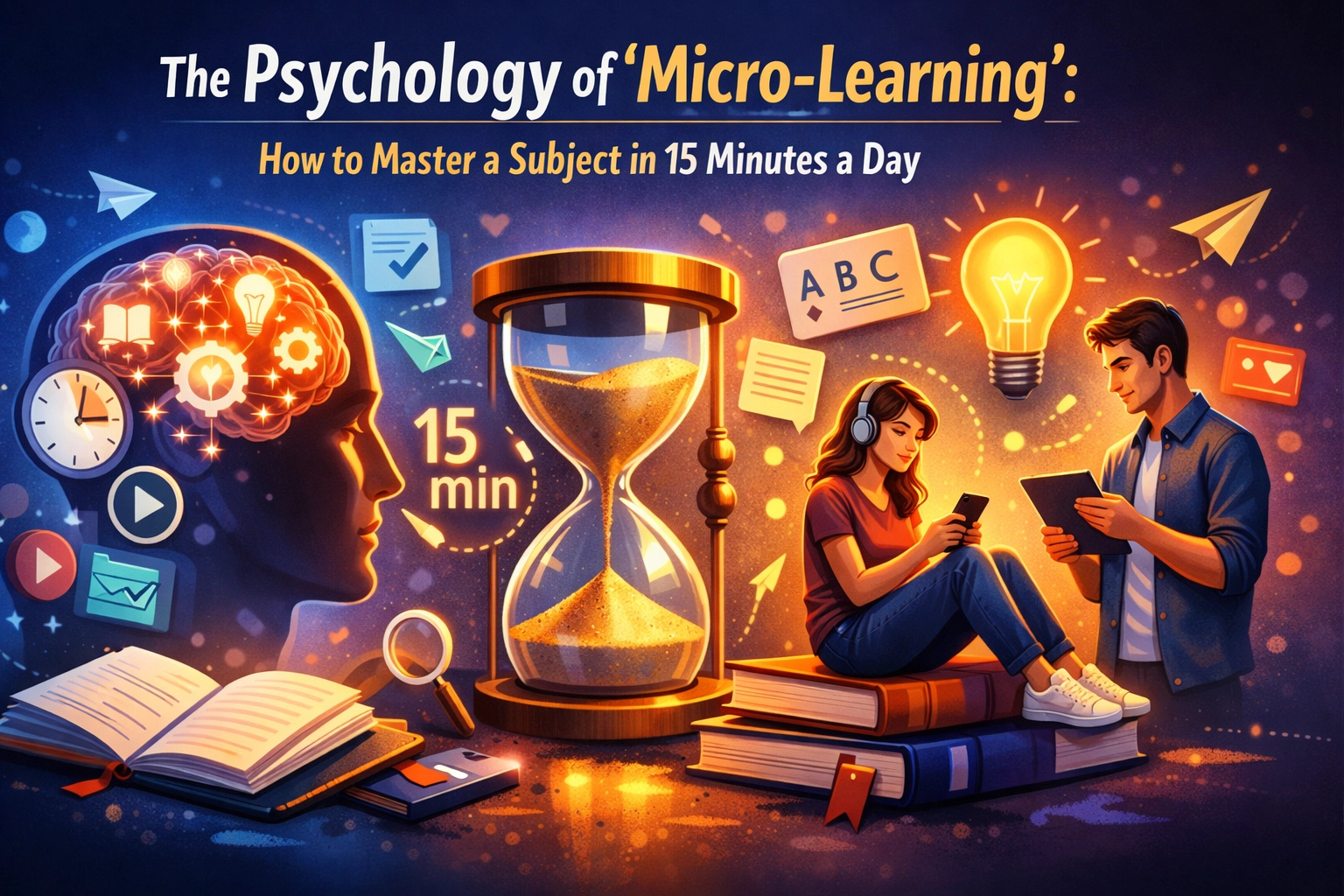
By 2026, the traditional four-hour study session has become a relic of a slower era. In a world where generative AI updates every few weeks and the "half-life" of a technical skill has shrunk to less than five years, the way we acquire knowledge had to evolve. Enter the era of Micro-Learning: a science-backed methodology that prioritizes "cognitive nibbling" over information "binging."
While it sounds like a productivity hack for the time-poor, the psychology behind 15-minute learning intervals is grounded in how the human brain actually encodes long-term memory. It isn't just about saving time; it’s about aligning with our neurological architecture to maximize retention and minimize burnout.
The Cognitive Threshold: Why Your Brain Hates "Cramming"
The primary reason traditional education fails many adult learners is Cognitive Load Theory, a concept pioneered by educational psychologist John Sweller. Our working memory is surprisingly small: it can typically hold only about four to seven "chunks" of information at any given time. When you sit down for a two-hour lecture, your working memory hits a bottleneck within the first twenty minutes. Anything forced in after that point usually pushes out what came before it.
Micro-learning solves this by respecting the Cognitive Threshold. By limiting a session to 15 minutes, you ensure that the brain stays within its optimal processing range. This prevents "mental fatigue," a state where the prefrontal cortex begins to shut down, making it nearly impossible to synthesize complex new ideas.
The Spacing Effect: Making Memory "Stick" in 2026
One of the most powerful tools in the micro-learner’s arsenal is the Spacing Effect. Discovered by Hermann Ebbinghaus in the late 19th century but only fully utilized with today's AI-driven scheduling algorithms, this principle proves that we learn better when information is repeated over increasing intervals of time.
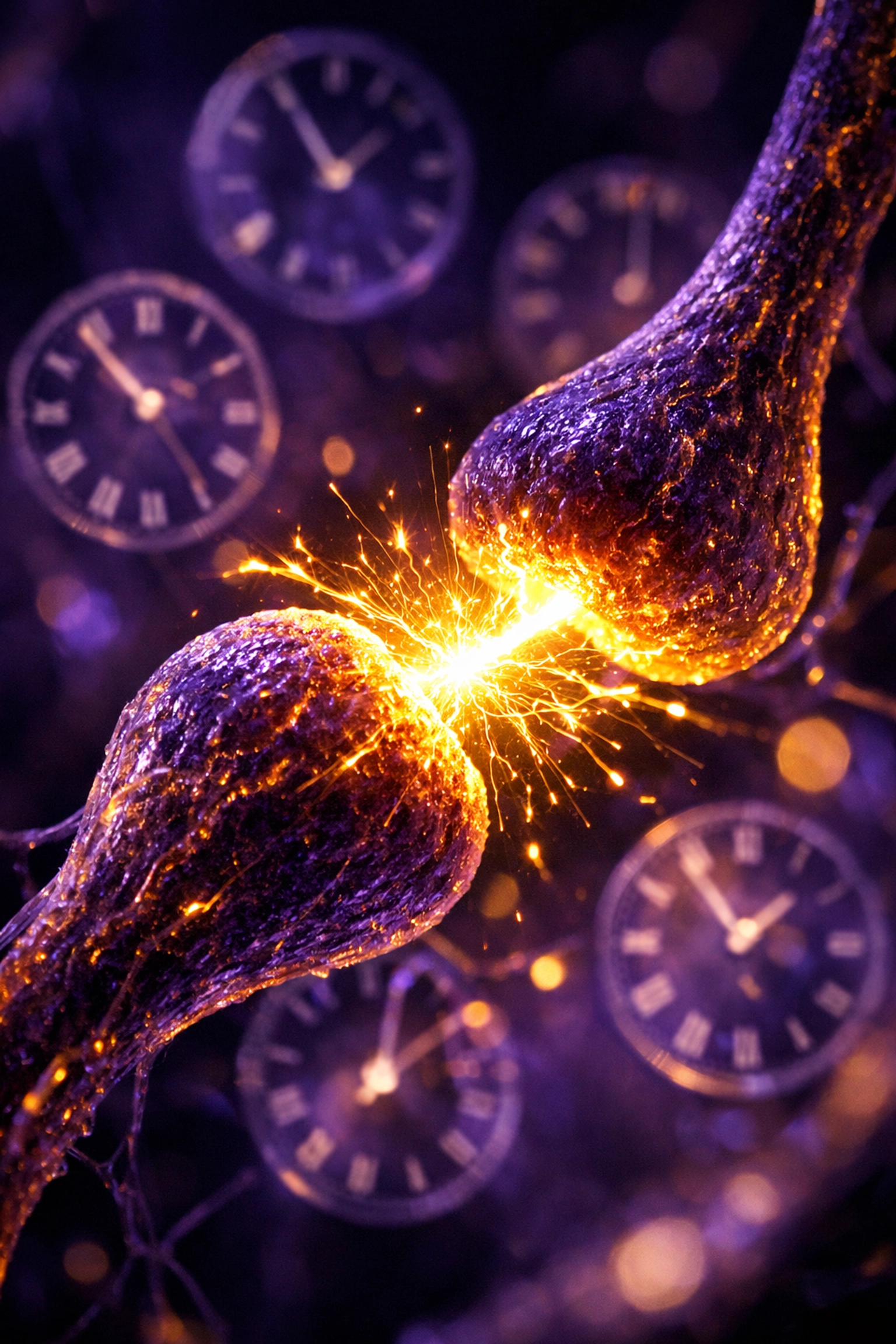
When you learn a new concept: say, a specific prompt engineering strategy or a new coding syntax: your brain forms a fragile neural pathway. If you don't revisit that info, the pathway withers. However, if you spend 15 minutes learning it today, 5 minutes reviewing it tomorrow, and 2 minutes next week, you trigger Long-Term Potentiation (LTP). This is the physical strengthening of synapses.
In 2026, the most successful professionals aren't the ones who spent a weekend at a boot camp; they are the ones who use 15-minute "pulses" of learning to keep their neural pathways in a constant state of reinforcement. Data shows that micro-learning can improve knowledge retention by up to 80% compared to traditional methods because it effectively "tricks" the brain into thinking the information is vital for daily survival.
The Dopamine Loop: Hacking Your Motivation
There is a distinct psychological barrier to starting a massive task. If you tell yourself you need to "learn Python," your brain perceives a mountain, triggers a cortisol response, and leads you straight to procrastination.
Micro-learning leverages the Dopamine Loop. By breaking a massive subject into 15-minute "micro-wins," you provide your brain with frequent hits of dopamine: the "reward" chemical. Each completed module feels like a victory. This creates a positive feedback loop that transforms learning from a chore into a habit.
In the current 2026 job market, where "skill-stacking" is the only way to remain competitive, this psychological momentum is a superpower. You aren't just learning a subject; you are training your brain to enjoy the process of acquisition.
The 5-5-5 Framework: A Technical Blueprint for 15 Minutes
To master a subject in 15 minutes, you can't just read aimlessly. You need a structured, high-intensity architecture. Many top-tier "solopreneurs" and creative directors now use what we call the 5-5-5 Framework:
- 5 Minutes of Retrieval (The Warm-up): Don't start with new info. Spend the first five minutes trying to remember what you learned yesterday without looking at your notes. This "Active Recall" forces the brain to rebuild the neural path, making it permanent.
- 5 Minutes of High-Density Input: This is where you engage with the new material. Whether it's a short video, an AI-generated summary, or a technical diagram, focus on one single concept. In 2026, we call this "Atomic Learning."
- 5 Minutes of Application (The Output): Knowledge without application is just noise. Spend the final five minutes doing. If you're learning a language, speak three sentences. If you're learning coding, write five lines of code. If you're learning management, draft a mock feedback email.
AI as the "Micro-Learning" Architect
In 2026, we no longer have to manually curate our 15-minute lessons. Agentic AI workflows now act as personal tutors. These systems analyze your current skill gaps and generate custom "micro-curriculums" that adapt in real-time.
If you struggle with a specific concept in an AI Ethics course, your tutor doesn't just repeat the information; it pivot to a different "Dual Coding" approach: perhaps using a visual infographic instead of text: to engage a different part of your brain. This personalized micro-learning ensures that not a single second of your 15-minute window is wasted on redundant information.

The Compounding Interest of Knowledge
The most overlooked aspect of the psychology of micro-learning is the Compounding Effect.
If you learn for 15 minutes a day, every day, you will have clocked over 91 hours of focused, high-retention learning by the end of the year. Because micro-learning has an 80% retention rate compared to the 20% retention rate of a standard college lecture, those 91 hours are functionally equivalent to over 350 hours of traditional classroom time.
In the 2026 economy, time is the ultimate currency. By shifting from a "macro" to a "micro" mindset, you aren't just learning faster; you are building a "Portfolio Career" founded on a bedrock of diverse, deeply-encoded skills that AI cannot easily replicate.
Conclusion: Start the Clock
Mastery is no longer about the "Big Effort." It’s about the "Small Consistency." By understanding the psychology of cognitive load, the power of the spacing effect, and the mechanics of the dopamine loop, you can dismantle the barriers to any subject.
Stop waiting for a "free weekend" to start your next certification or career pivot. You don't need a weekend. You need 15 minutes and a timer.
About the Author: Malibongwe Gcwabaza
CEO of blog and youtube
Malibongwe Gcwabaza is a forward-thinking leader in the digital education and AI implementation space. As the CEO of blog and youtube, he focuses on bridging the gap between emerging technologies and human potential. With a background in strategic systems and a passion for "Education 3.0," Malibongwe advocates for skill-based hiring and micro-learning as the primary drivers of the 2026 workforce. When he’s not refining AI workflows, he’s likely spending his own 15-minute windows mastering the nuances of sovereign cloud infrastructure.
About the Author