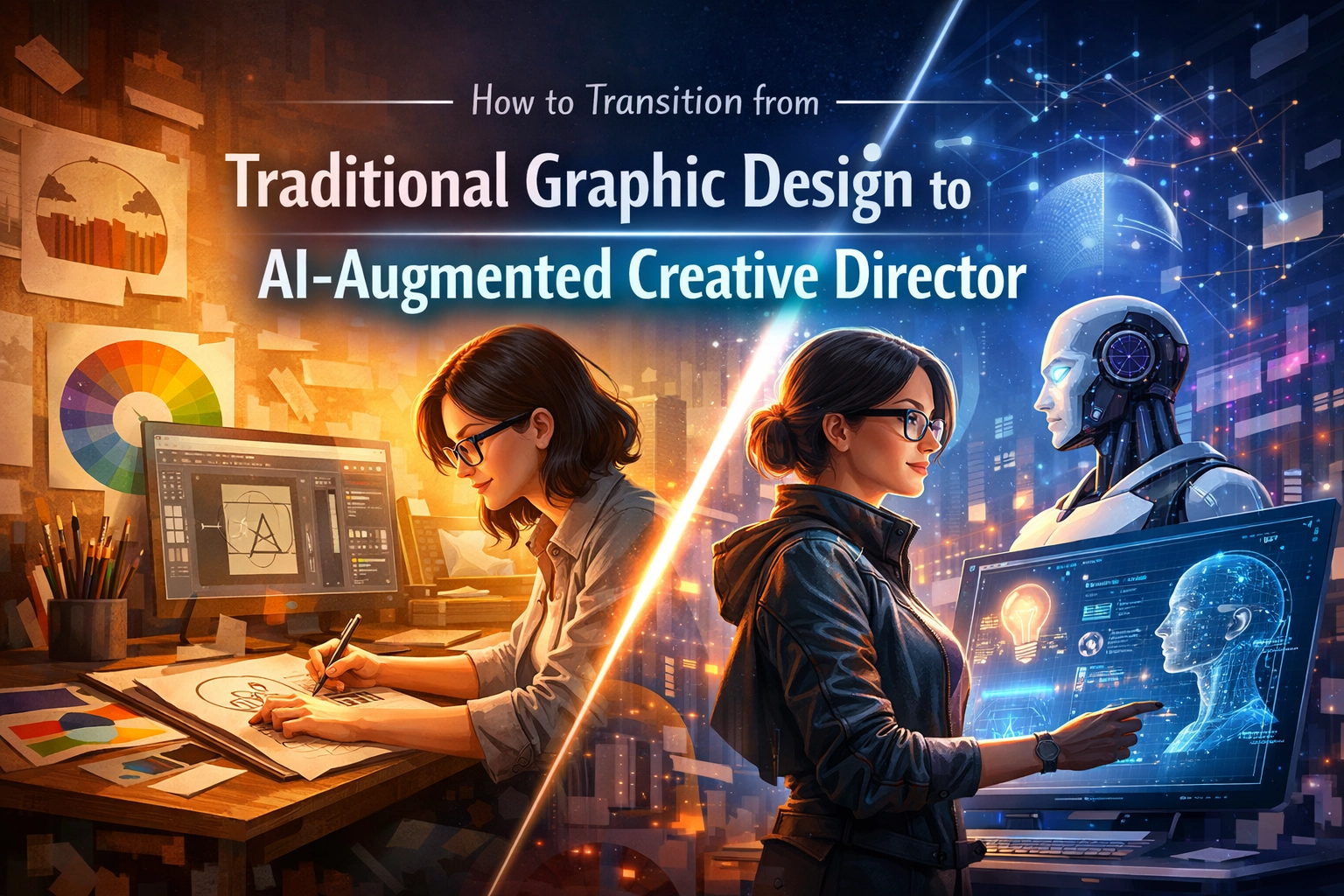
By March 2026, the debate over whether AI will "replace" designers has effectively ended. It didn’t replace the designer; it replaced the process. If you are still spending four hours masking a high-res image or manually adjusting kerning for a billboard, you aren’t just behind: you’re expensive.
The real money and career longevity in 2026 lie in the transition from a traditional graphic designer to an AI-Augmented Creative Director (ACD). This isn't just a fancy title change. It’s a fundamental shift from being a "maker of assets" to a "curator of systems."
In this guide, we’re going to break down the technical roadmap, the leadership shift, and the strategic framework you need to move from the pixel level to the architectural level.
The Paradigm Shift: From Pixels to Patterns
In the old world, a Creative Director managed people who pushed pixels. In the 2026 landscape, an ACD manages Agentic Workflows. You are no longer just looking at a finished JPG; you are looking at the "Latent Space" of a brand.
The traditional designer’s value was linked to their mastery of software: Photoshop, Illustrator, After Effects. The ACD’s value is linked to their Strategic Taste and their ability to encode that taste into AI models.
Why this is a High-CPC Career Move
From an economic standpoint, companies are aggressively hiring for this role. According to 2025 industry data, firms that integrated AI-augmented leadership saw a 40% reduction in production timelines while increasing creative output by 300%. For an agency, this translates to massive profit margins, which is why the salary ceiling for an ACD is currently 25-30% higher than a traditional Creative Director.

Step 1: Mastery of the "Generative Stack"
You can’t direct what you don’t understand. Transitioning requires moving beyond basic prompting into high-level model manipulation. In 2026, the "Generative Stack" for a Creative Director includes:
- Custom LoRAs (Low-Rank Adaptation): You shouldn't be using generic Midjourney prompts. An ACD knows how to train a LoRA on a brand’s specific historical assets so the AI generates images that automatically look like the brand.
- ControlNet & IP-Adapter: These are the "steering wheels" of AI. They allow you to maintain structural integrity: ensuring a character's pose or a product's geometry stays consistent across 1,000 variations.
- Multi-Modal Orchestration: This is the ability to use an LLM (like GPT-5 or Claude 4) to write the "Creative Strategy," which then triggers a diffusion model for visuals, and a generative audio tool for the soundtrack.
The Technical Goal: You want to reach a point where you are designing the workflow, not the work.
Step 2: Architecting the Brand DNA
Traditional brand guidelines are static PDFs. In 2026, brand guidelines are Generative Systems.
As an ACD, your job is to define the "Style DNA." This involves:
- Prompt Libraries: Curating a master database of verified prompts that produce brand-consistent results.
- Negative Embeddings: Defining what the brand is not. This prevents the AI from veering into "uncanny valley" territory or using banned visual tropes.
- Ethical Sourcing Logs: High-value clients now demand "Clean AI" (models trained on licensed data like Adobe Firefly or Getty AI). An ACD ensures the entire creative pipeline is legally sound and copyright-protectable.

Step 3: The 12-Week Transformation Roadmap
If you’re serious about making the jump, you need a structured approach. Here is how you should spend the next three months:
Weeks 1-4: The Technical Deep-Dive
Stop using "Web UIs" and start looking at node-based tools like ComfyUI. Understanding how data flows from a "Checkpoint" to a "Sampler" is what separates the amateurs from the pros. Learn to automate the "boring stuff": background removal, upscaling, and color grading.
Weeks 5-8: System Design
Start building a "Personal Design Agent." Use "low-code" tools to create a bot that takes a client brief and automatically generates a mood board, a color palette, and three initial conceptual directions. This is your "Creative Junior" that never sleeps.
Weeks 9-12: Strategic Leadership
Shift your portfolio. Remove the individual logos and flyers. Instead, showcase Case Studies of Scale. Show how you used AI to generate 5,000 personalized social media ads for a campaign that maintained perfect brand consistency.
Step 4: Soft Skills: The Human Bottleneck
Here’s the secret: The more "perfect" AI-generated content becomes, the more valuable human friction becomes. AI is great at averages; it is terrible at "weirdness" that connects on an emotional level.
As an ACD, your value lies in:
- Curation: Picking the one "hallucination" that actually looks like a stroke of genius.
- Empathy: Understanding the client’s underlying fear that a machine can’t feel.
- Cultural Context: Knowing why a specific color palette might be offensive in a specific subculture: something AI still struggles to parse in real-time.
Step 5: Measuring ROI (The Business Logic)
To land the Creative Director role, you have to speak the language of the C-Suite. Traditional designers talk about "balance" and "white space." ACDs talk about Creative Throughput and Version Velocity.
When interviewing or pitching, use data-backed insights:
- "By implementing a custom diffusion workflow, I reduced the conceptual phase from 10 days to 48 hours."
- "We achieved a 15% increase in CTR by using AI to A/B test 50 different visual hooks in real-time."
- "I reduced asset production costs by 60%, allowing us to reallocate budget toward high-level strategy and media spend."
The Bottom Line
The "Graphic Designer" of 2020 was a specialist in tools. The "AI-Augmented Creative Director" of 2026 is a specialist in Vision.
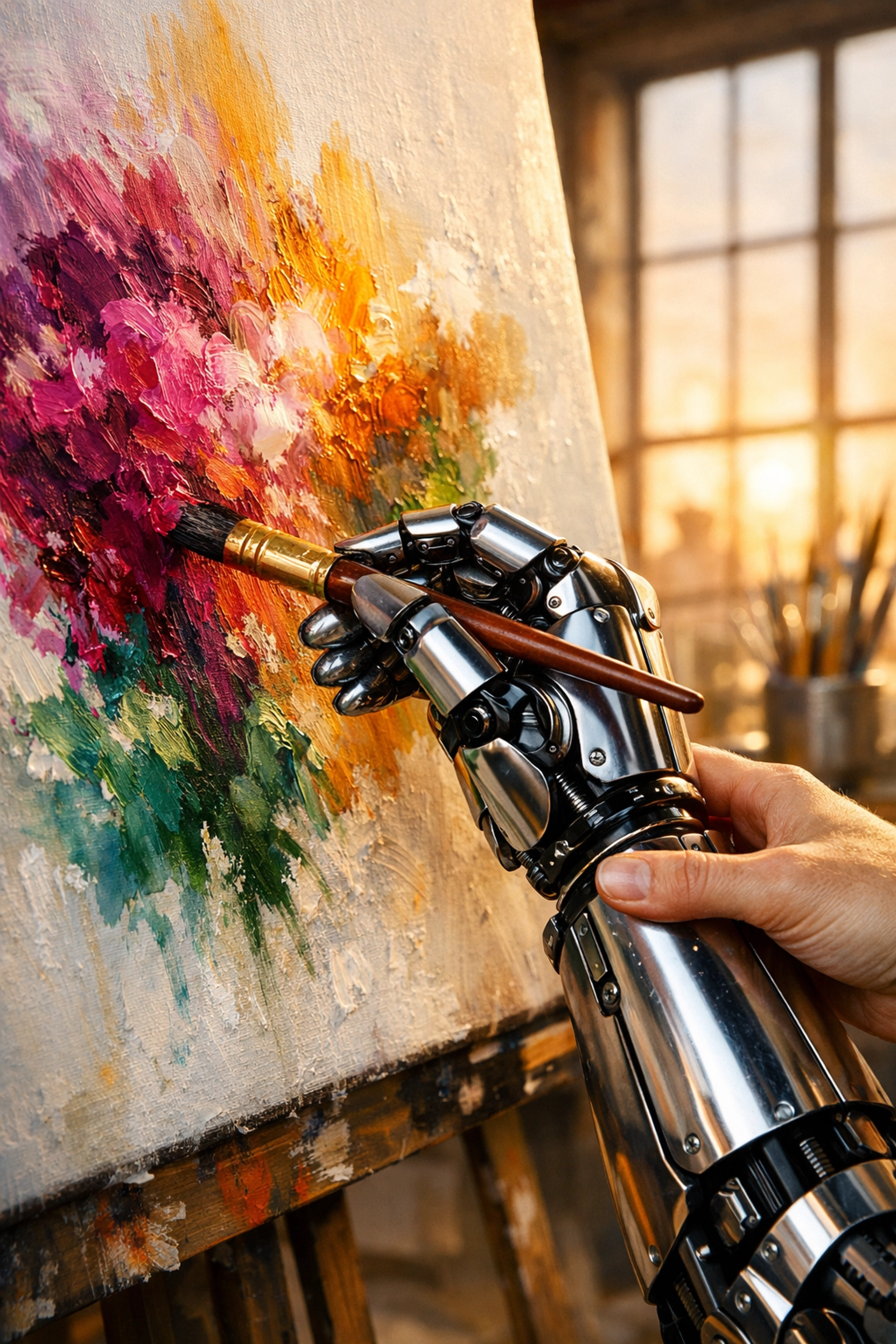
You are moving from the person holding the brush to the person owning the gallery. The transition is uncomfortable because it requires letting go of the "craft" of manual execution. But in return, you gain the power to execute ideas at a scale that was physically impossible just three years ago.
Don't wait for your agency to buy you a subscription. Build your own stack. Train your own models. Become the person who knows how to whisper to the machine.
About the Author: Malibongwe Gcwabaza
Malibongwe Gcwabaza is the CEO of blog and youtube, a media tech firm specializing in the intersection of generative AI and digital strategy. With over a decade of experience in creative leadership, Malibongwe now focuses on helping traditional creatives pivot into high-leverage AI roles. He believes that technology shouldn't replace the human heart of design: it should just get the repetitive work out of the way. When he’s not optimizing agentic workflows, he’s exploring the future of decentralized content ecosystems.
About the Author