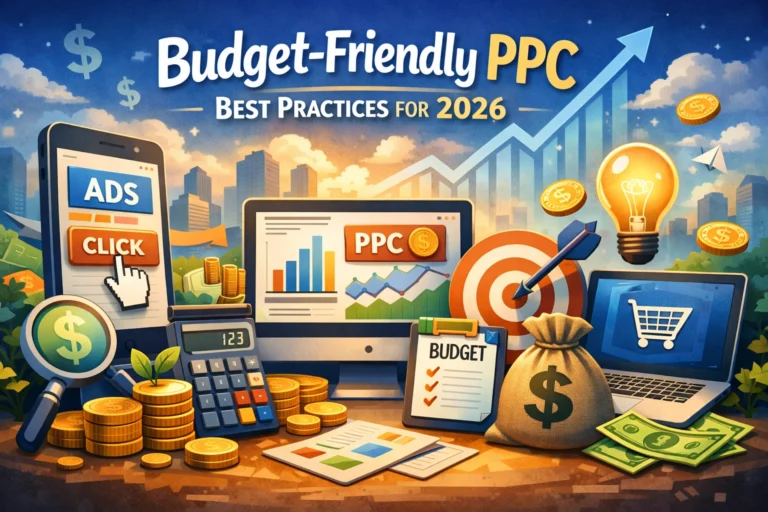
If you’re still hovering over your Google Ads dashboard every morning, manually adjusting bids by $0.05 or obsessing over keyword match types, I have some news that might be hard to swallow: the PPC world you knew is officially gone.
By March 2026, the game has shifted completely. We aren't just "managing" ads anymore; we are training algorithms. The machines have taken over the heavy lifting of bidding and placement, which sounds like it should make our lives easier, but it actually raises the stakes. When everyone has access to the same powerful AI, the winner isn't the person with the best "hacks": it’s the person who provides the best data and the most cohesive strategy.
In this guide, we’re breaking down the essential PPC best practices for 2026 and why your current approach might be costing you more than you realize.
The Shift from Tactical Micromanagement to Strategic Oversight
For a decade, the "PPC Expert" was someone who was really good at spreadsheets. They knew how to navigate the complex UI, set up negative keyword lists 5,000 lines long, and manage Alpha-Beta account structures.
In 2026, that skill set is almost entirely obsolete. Google and Meta’s AI models are now so advanced that they can predict user intent better than any human can. If you try to fight the machine by restricting it with too many manual "guardrails," you’re actually hurting your performance.
The new PPC best practices for 2026 reward clarity and signal design. Instead of asking "What keyword should I bid on?", the question is now "What signal am I sending the algorithm?" If you feed the AI bad information: like tracking "Page Views" as a primary conversion: it will spend your entire budget finding people who like to click but never buy.

Data Quality: Your Only Real Competitive Advantage
In a world where the AI handles the targeting, your only lever for better performance is the quality of the data you feed it. We call this "Garbage In, Garbage Out." If your conversion tracking is messy, the AI is essentially flying blind.
Cleaning Up Your Signal Design
Most accounts are cluttered with "noise." If you're tracking newsletter signups, "Add to Cart" events, and actual purchases all as "conversions," the AI gets confused. It treats a $0 lead the same as a $500 sale.
To thrive in 2026, you must:
- Filter out soft conversions: Stop optimizing for vanity metrics. Focus the AI on the events that actually put money in the bank.
- Import offline revenue: If you’re in B2B or high-ticket sales, you need to feed your CRM data back into the ad platform. Tell the AI which leads actually turned into signed contracts.
- Use Enhanced Conversions: With the death of the third-party cookie, using hashed first-party data is the only way to maintain accurate attribution.
First-Party Audience Lists
Broad targeting is back, but only if it’s anchored by your own data. By uploading your customer lists (segments like "High LTV Customers" or "Frequent Buyers"), you give the AI a "seed" to find people with similar behavioral patterns. This is far more effective in 2026 than trying to manually pick interests or demographics.
Moving Beyond Proxy Metrics: ROAS is No Longer Enough
We’ve lived and died by ROAS (Return on Ad Spend) for years. But in 2026, savvy marketers realize that ROAS can be a trap. A high ROAS might just mean you’re targeting people who were going to buy anyway (capturing existing demand) rather than finding new customers (creating new demand).
The Rise of Contribution Margin and LTV
The best PPC practices for 2026 focus on Business Outcomes rather than Platform Metrics.
| Metric | Why it’s outdated | The 2026 Alternative |
|---|---|---|
| CPA (Cost Per Acquisition) | Doesn't account for lead quality. | CPLV (Cost Per Lifetime Value) |
| ROAS | Can be inflated by brand traffic. | POAS (Profit on Ad Spend / Contribution Margin) |
| CTR | High clicks don't equal high intent. | Qualified Lead Rate |
If you know your customer's Lifetime Value (LTV) is $1,000, you can afford to pay much more for that first click than a competitor who is only looking at the initial $50 sale. 2026 is the year of the "math-heavy" marketer.
The Full-Funnel Ecosystem: Performance Max and Beyond
Gone are the days when you could run a "Search Only" campaign and call it a day. The modern consumer journey is a zig-zag across YouTube, Search, Gmail, and Social feeds.
The PPC best practices for 2026 demand a Full-Funnel Architecture. This means using Performance Max (PMax) not as a standalone tool, but as the engine that connects all these touchpoints.
Integrating Search and Social
Search captures the "I want it now" intent. YouTube and Display build the "I didn't know I wanted this" awareness. In 2026, these are no longer separate silos. High-performing teams are using Search to identify high-intent keywords, then immediately feeding those themes into their creative assets for YouTube and Meta.
When your search ads and video ads work together, your customer acquisition cost (CAC) naturally drops because you aren't introducing your brand for the first time at the bottom of the funnel.
Creative is the New Targeting
Since we can no longer "tweak" our way to success with manual bids, Creative Assets have become the primary way we communicate with the algorithm.
In 2026, the AI analyzes your images, videos, and headlines to understand who the ad is for. If your creative looks like a "Buy Now" sales pitch, the AI will find "deal hunters." If your creative looks like a high-end lifestyle video, the AI will find a different audience entirely.
Systematic Creative Testing
You can’t just throw one video into a campaign and hope for the best. You need a structured testing framework:
- Hook Testing: Test the first 3 seconds of a video to see what stops the scroll.
- Angle Testing: Test different psychological triggers (e.g., "Save Time" vs. "Make Money").
- Static vs. Motion: Determine which format resonates with specific audience segments.

Incrementality: The Great "Is This Actually Working?" Test
Platform attribution is, quite frankly, a mess in 2026. Privacy regulations have made it harder to track users perfectly. Because of this, Incrementality Testing has become a core best practice.
Incrementality asks a simple question: "If I turned off my ads today, how many of these sales would I lose?"
If you spend $10,000 on brand search terms (bidding on your own company name), your ROAS will look amazing. But if those people were going to click your organic link anyway, you’ve just spent $10,000 to buy something you already owned. In 2026, we focus our budget on incremental growth: finding the customers who wouldn't have found us otherwise.
Why Diversification is No Longer Optional
Relying solely on Google Search in 2026 is like building a house on a cliffside. Cost-per-click (CPC) is rising as more players enter the space, and algorithm updates can shift your performance overnight.
Mature PPC programs are diversifying into:
- Retail Media Networks: (Amazon, Walmart, Target) for direct e-commerce.
- Programmatic Display: For massive reach at the top of the funnel.
- Niche Social Platforms: Platforms like Reddit and LinkedIn, where intent is high but competition might be lower than the "Big Two."
Diversification isn't just about safety; it’s about insulation against market fluctuations.

Summary of PPC Best Practices for 2026
To wrap it up, if you want to win in the current landscape, stop acting like a media buyer and start acting like a data scientist and a creative director.
- Prioritize Clean Data: Fix your tracking. If the data is messy, the AI will fail.
- Focus on Business Economics: Optimize for profit and LTV, not just ROAS.
- Embrace the Machine: Use PMax and automated bidding, but guide them with high-quality audience seeds and creative.
- Test for Incrementality: Make sure your spend is actually driving new growth.
- Invest in Creative: Creative is now your strongest lever for targeting.
The "set it and forget it" era is over, but the "strategy and scale" era is just beginning. If you can master these shifts, 2026 will be your most profitable year yet.
About the Author: Malibongwe Gcwabaza
Malibongwe Gcwabaza is the CEO of blog and youtube, a leading digital growth agency dedicated to simplifying complex marketing strategies for the modern age. With over a decade of experience in the digital trenches, Malibongwe specializes in bridging the gap between high-level business goals and the evolving world of AI-driven advertising. When he's not refining full-funnel architectures, he’s helping brands tell better stories through data-backed content.
About the Author