![[HERO] Mastering Email Marketing Automation: A 2026 Guide for Scaling Fast](https://cdn.marblism.com/cYIYuj9zRDw.webp)
By 2026, the “batch and blast” method of email marketing isn’t just old-fashioned, it’s a fast track to the spam folder. If you’re trying to scale a business today, your email strategy can’t rely on a marketing manager hitting “send” on a weekly newsletter. Scaling requires a system that works while you sleep, reacting in real-time to every click, scroll, and purchase.
Email marketing automation tools have evolved from simple “if-this-then-that” sequences into sophisticated AI-driven engines. To truly master automation this year, you need to stop thinking about “sending emails” and start thinking about “architecting experiences.”
The Foundation: Why Automation is Your Scaling Engine
Scaling a business is essentially a race against human limitations. You can only hire so many account managers or customer success reps. Automation bridges that gap. It allows you to maintain a 1-to-1 relationship with 100,000 customers as easily as you would with ten.
In 2026, the goal isn’t just to save time; it’s to increase the relevance of every touchpoint. Highly relevant emails generate up to 18x more revenue than generic broadcasts. When you automate, you aren’t just being “efficient”, you’re being more effective by delivering the right message exactly when the lead is most likely to convert.
1. Mapping the Customer Lifecycle
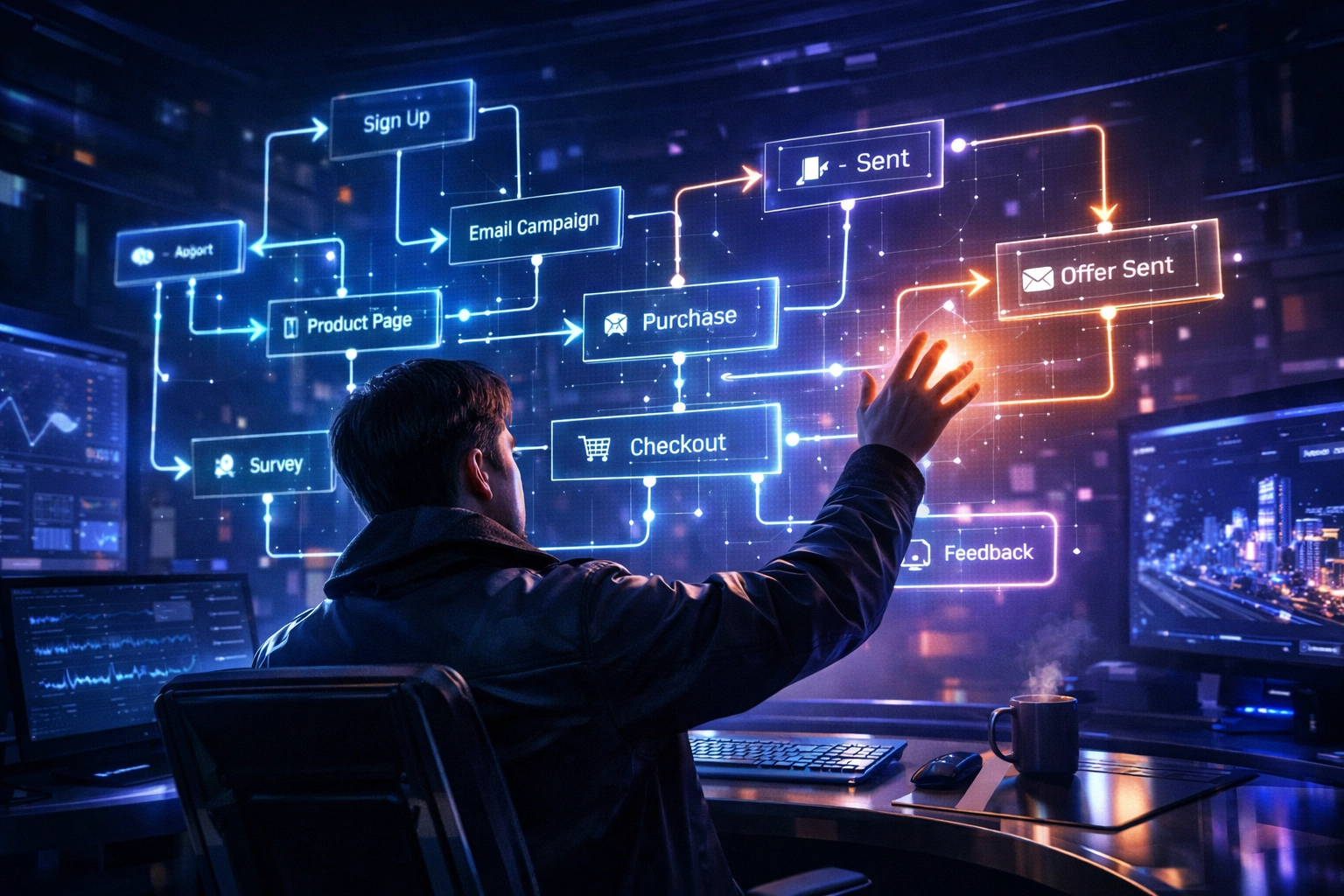
Before you touch any software, you need to map out the journey. Automation only works if the logic behind it is sound. We categorize these into five major lifecycle stages:
The Welcome and Onboarding Series
This is your first impression. In 2026, a single “Thanks for signing up” email isn’t enough. Your automated welcome flow should be a multi-step sequence that:
- Delivers the promised value (lead magnet or discount).
- Sets expectations for future content.
- Uses a “Preference Center” to ask users what they actually want to hear about.
- Introduces the brand voice and mission.
Browse and Cart Abandonment
These are your highest ROI flows. When someone leaves an item in their cart or lingers on a specific product page, your automation tool should trigger a nudge. In 2026, this nudge shouldn’t just be a “You forgot this” reminder. It should include dynamic social proof, reviews specifically for that item, and perhaps a limited-time AI-generated offer tailored to that user’s purchase history.
Post-Purchase Education and Upselling
The sale isn’t the end; it’s the beginning of the next cycle. Automate educational content that helps the customer get the most out of their purchase. This reduces returns and builds the trust necessary for the next step: the automated upsell. If they bought a camera, the system should wait two weeks and then suggest the perfect lens.
Reactivation and Win-Back Programs
It costs five times more to acquire a new customer than to keep an existing one. Use predictive analytics to identify “at-risk” customers, those who haven’t opened an email or logged in for 30 days, and trigger an automated “We miss you” sequence with a high-value incentive to return.
2. The 2026 Edge: AI-Powered Personalization
If you’re still using “Hi [First_Name]” as your primary personalization tactic, you’re behind. Modern email marketing automation tools now leverage machine learning to handle the heavy lifting of relevance.
Predictive Send-Time Optimization (STO)
Don’t send your blast at 10 AM on a Tuesday just because a blog post told you to. AI now analyzes the historical behavior of every individual subscriber. If Jane typically checks her emails at 9 PM after putting the kids to bed, the system will hold her email and deliver it then. This significantly boosts open rates without any manual effort from your team.
Dynamic Content Blocks
Instead of creating ten different emails for ten different segments, you create one email with dynamic blocks. A male subscriber in London sees winter coats, while a female subscriber in Sydney sees swimwear, all within the same automated campaign. This level of granularity is what allows businesses to scale without their content production costs exploding.
AI-Driven Product Recommendations
Integrating your e-commerce data with your email tool allows for “Amazon-style” recommendations. The AI looks at what the user bought, what they looked at, and what people like them bought, then injects those products directly into the email body.

3. Choosing the Right Email Marketing Automation Tools
The market is flooded with options, but for scaling fast in 2026, your tech stack needs to meet specific criteria. You aren’t just looking for an “email sender”; you’re looking for a data platform.
Key Features to Look For:
- Deep Integrations: Your tool must talk to your CRM, your e-commerce platform (Shopify, WooCommerce), and your customer support software (Zendesk). Data silos are the enemy of scaling.
- Behavioral Triggering: Can the tool send an email based on a specific API call or a custom event on your website?
- Visual Workflow Builder: You need to be able to see the logic. A “drag-and-drop” canvas for building sequences is non-negotiable for complex scaling.
- Robust A/B Testing: Look for tools that allow for “automated winner” testing, where the system sends two versions to a small percentage of the list and automatically sends the winning version to the rest.
Popular choices in 2026 include Klaviyo for e-commerce, ActiveCampaign for B2B/Sales-heavy operations, and HubSpot for all-in-one enterprise scaling. For those focused on newsletters with heavy automation logic, Beehiiv and ConvertKit (now Seva) remain top-tier.
4. Technical Foundations: Deliverability is Everything
You can have the most beautiful, AI-optimized automation in the world, but if it lands in the “Promotions” tab or, heaven forbid, the Spam folder, your ROI is zero.
As you scale, your “sender reputation” becomes your most valuable asset. In 2026, Gmail and Yahoo have tightened the screws on bulk senders. Here is your technical checklist:
- Authentication (SPF, DKIM, DMARC): These are no longer optional. They are the digital passports that prove you are who you say you are. If these aren’t set up, large providers will simply block your emails.
- BIMI (Brand Indicators for Message Identification): This allows your brand logo to show up next to your email in the inbox, increasing trust and click-through rates.
- List Hygiene: Automate your cleaning. Set up a workflow that automatically unsubscribes users who haven’t engaged in over six months. Sending to unengaged users signals to ISPs that your content isn’t wanted, which hurts your overall deliverability.
5. Measuring Success: The Metrics That Actually Matter
When you’re scaling, vanity metrics like “Open Rate” can be misleading (especially with Apple’s Mail Privacy Protection skewing the data). To master automation, you need to track:
- Revenue Per Email (RPE): This tells you exactly how much money each automated flow is putting in the bank.
- Conversion Rate by Workflow: Which sequences are actually moving the needle? If your welcome flow has a 10% conversion rate but your win-back is at 0.5%, you know where to focus your optimization efforts.
- Customer Lifetime Value (CLV) Increase: Does a subscriber who goes through your automated “Education” sequence have a higher long-term value than one who doesn’t? This proves the worth of non-sales automation.
- Unsubscribe Rate per Sequence: If a specific automation is causing a spike in unsubscribes, your logic is likely too aggressive or irrelevant.
6. The Human Element: Balancing Logic with Empathy
The biggest mistake companies make when scaling with email marketing automation tools is forgetting that there is a human on the other end. “Automated” shouldn’t mean “robotic.”
Maintain your brand voice. Use the data you have to be helpful, not creepy. If a customer just had a bad experience with support, your automated “Rate your purchase!” email should be paused. This requires a “Global Suppression” logic, a master rule that ensures automated sales emails are turned off while a customer has an open support ticket.
Conclusion: Start Small, Scale Fast
Mastering email automation isn’t about building a 50-step sequence on day one. It’s about building the core “Money Flows” (Welcome, Abandoned Cart, Post-Purchase) and then layered-in AI-driven optimizations as your data grows.
In 2026, the companies that win are the ones that use automation to be more human, not less. By handling the repetitive tasks through software, you free up your team to focus on the high-level strategy and creative storytelling that truly builds a brand.
About the Author