![[HERO] Content Marketing for Small Business: A 2026 Roadmap to Success](https://cdn.marblism.com/5xoyiUntW8y.webp)
By 2026, the digital landscape has shifted. If you’re still treating content marketing like a billboard: one-way, static, and generic: you’re essentially invisible. The internet is currently saturated with mediocre, AI-generated “slop” that provides zero value. For a small business, this is actually your greatest opportunity.
When everyone else is mass-producing generic fluff, your path to winning is through radical relevance and human-centricity. Content marketing for small business in 2026 isn’t just about “posting”; it’s about building a searchable repository of trust.
In this deep dive, we’re going to map out exactly how to build a content engine that drives revenue, utilizes AI without sounding like a robot, and ranks where your customers are actually looking.
1. The 2026 Reality: Social Discovery vs. Traditional SEO
For years, “content marketing” meant “write a blog post for Google.” While Google still matters, the game has changed. Gen Z and Millennials now use TikTok, Instagram, and even YouTube as their primary search engines.
When someone searches for “best plumbing tips for old houses,” they aren’t just looking for a list of bullet points; they want to see a human showing them the pipes.
The Multi-Channel Search Approach
To succeed in 2026, your content must be discoverable across three main pillars:
- Traditional Search (Google/Bing): For deep-dive, long-form intent.
- Social Search (TikTok/Reels): For quick answers and visual proof.
- AI Search (Perplexity/ChatGPT/Gemini): For being the “cited source” when AI summarizes an answer for a user.
To rank in AI search results, your content needs to be authoritative and data-backed. Generic advice gets ignored by LLMs; unique insights and “first-hand experience” (the second ‘E’ in E-E-A-T) get cited.

2. Defining Your Content Pillars (The “Expertise” Frame)
Stop trying to talk about everything. A small business wins by owning a tiny corner of the internet.
Identify three Content Pillars. If you run a boutique coffee roastery, your pillars might be:
- The Science of Sourcing: Deep dives into soil, altitude, and farmer equity.
- The Home Barista Guide: Technical “how-to” content for high-end gear.
- Coffee Culture & Community: Behind-the-scenes at the shop and local event highlights.
By sticking to these pillars, you train both your audience and the search algorithms to view you as a “Topical Authority.”
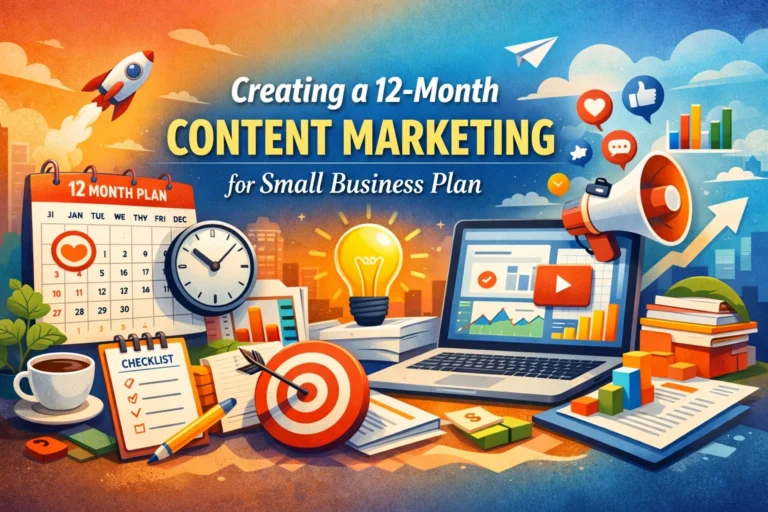
3. The 2026 Roadmap: A 30-Day Content Calendar Strategy
Consistency is the hardest part of content marketing for small business. Without a roadmap, you’ll burn out by week three. Here is a technical breakdown of how to structure a month of content:
Week 1: The Pillar Asset (The “Big Rock”)
Spend your first week creating one massive, high-value piece of content. This could be a 1,500-word blog post or a 10-minute YouTube video.
- Goal: Solve a major pain point for your customer.
- Example: “The Ultimate Guide to Choosing Sustainable Materials for Your Home Renovation.”
Week 2: The Splintering Phase
Take that “Big Rock” and splinter it into smaller pieces:
- Create 3-5 short-form videos (Reels/TikToks) covering specific tips from the guide.
- Draft 2 LinkedIn posts focusing on the “opinion” or “controversial” takes within your guide.
- Create an infographic for Pinterest or Instagram Stories.
Week 3: The Engagement & Community Phase
This week is about two-way conversations.
- Q&A Session: Answer the most common questions from the Week 1 comments.
- User-Generated Content (UGC): Share a customer’s story or a photo of them using your product.
- Polls: Ask your audience what they want to learn about next month.
Week 4: The Analysis & Optimization Phase
Check your metrics. Which video got the most saves? Which paragraph in your blog post had the most “dwell time”?
- Update old posts with new links.
- Repurpose the “winner” of the month into an email newsletter blast.
4. Scaling with AI: The “Human-in-the-Loop” Framework
You cannot compete in 2026 without AI, but you will fail if you let AI do the whole job. The “Human-in-the-Loop” (HITL) framework ensures your content stays unique.
Where to Use AI:
- Ideation & Outlining: Use tools like ChatGPT or Claude to brainstorm 50 headlines or create a logical flow for a technical article.
- Transcription: Use AI to turn a 5-minute voice memo of you talking into a structured first draft. This preserves your voice.
- Formatting: Let AI handle the meta-descriptions, alt-text for images, and basic SEO tagging.
- Distribution: Use AI tools to schedule posts at optimal times based on your specific audience data.
Where to Keep it Human:
- The “Secret Sauce”: AI can’t provide your personal anecdotes, your specific business failures, or your unique “hot takes.”
- Fact-Checking: AI still hallucinates. If you’re a small business owner, your reputation is your currency. Verify every stat.
- The Emotional Hook: AI is great at logic, but terrible at empathy. Only a human can write a caption that truly resonates with a customer’s frustration.

5. Technical SEO for 2026: Beyond Keywords
Keywords aren’t dead, but “Entities” have taken over. Google’s algorithms now look for the relationship between concepts.
If you are writing about “content marketing for small business,” the search engine expects to see related entities like “customer acquisition cost (CAC),” “conversion rate optimization,” “brand voice,” and “content distribution.”
2026 SEO Checklist:
6. Measuring Success (KPIs That Actually Matter)
Stop looking at “Likes.” They are vanity metrics that don’t pay the bills. In 2026, focus on these three tiers of data:
Tier 1: Consumption Metrics
- Average Session Duration: Are people actually reading your 1,200-word guides?
- Scroll Depth: Where are they dropping off? (Use tools like Hotjar to see this).
Tier 2: Engagement Metrics
- Saves/Shares: On social media, a “Save” is worth 100 “Likes.” It means your content is valuable enough to refer back to.
- Comments: Real questions from real people indicate you’ve built a community.
Tier 3: Conversion Metrics (The Goal)
- Email Signups: Turning “rented” social media audiences into “owned” email lists.
- Assisted Conversions: How many people read a blog post and then bought something 3 days later?
7. The 2026 Small Business Content Stack
You don’t need a $10k/month budget. Here is the lean stack for 2026:
- Content Management: WordPress (with a focus on high-performance themes).
- Writing/Editing: Claude 3.5 (for better “human” nuance) and Grammarly.
- Visuals: Canva (for graphics) and CapCut (for mobile video editing).
- SEO/Research: AnswerThePublic or Google Trends to see what’s trending right now.
- Analytics: Google Analytics 4 and Search Console.

Final Thoughts
Content marketing for small business in 2026 isn’t about being the loudest; it’s about being the most helpful. If you can consistently show up and solve one small problem for your customer every single week, you will build a moat that no AI-generated competitor can cross.
Start with one “Big Rock” asset this week. Be technical, be thorough, and most importantly, be human.
About the Author