By 2026, the era of "throwing spaghetti at the wall" is officially dead. If you’re still posting random updates to Facebook whenever you remember or writing a blog post once a quarter because someone told you it’s good for SEO, you aren’t just behind, you’re invisible.
For small business owners, the digital landscape has shifted. We aren't just competing with the shop down the street; we’re competing with AI-generated search results, algorithmic fatigue, and a consumer base that has the attention span of a caffeinated squirrel. To survive, you need more than a "strategy." You need a Content Engine.
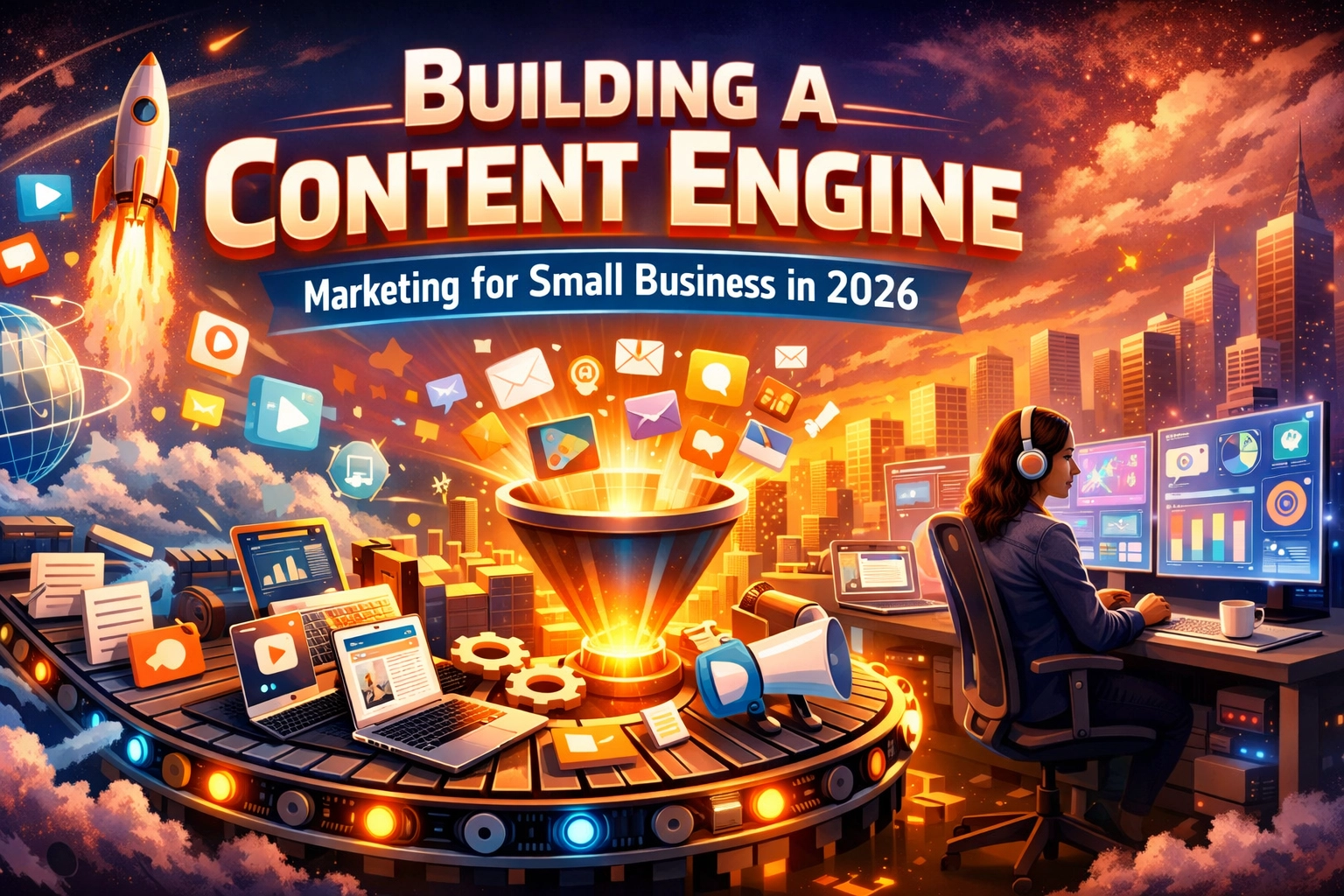
A content engine is a repeatable, scalable system that turns raw ideas into high-value assets across multiple platforms. It’s about moving away from manual labor and moving toward automated efficiency. In this guide, we’re going to break down exactly how to build a content marketing engine for small business that actually moves the needle in 2026.
1. The 2026 Mindset: Directness and AI-Native Content
The first thing we need to address is how people actually find information today. In 2026, "Position Zero" on Google isn't just a featured snippet; it’s an AI agent (like ChatGPT or Gemini) summarizing your content for the user.
If your content is buried under 500 words of "fluff" or "introductory storytelling," the AI will ignore you. To win at content marketing for small business right now, you must practice Extreme Directness.
The First-Two-Sentences Rule:
Every piece of content, whether it’s a blog post, a LinkedIn update, or a video script, must answer the primary question in the first two sentences. This increases your "Citability Score" for AI search engines. When an AI summarizes a topic, it looks for the most direct, authoritative answer. If you provide it, you become the cited source, driving high-intent traffic back to your site.
2. Defining Your Fuel: Strategic Goals for 2026
You can’t build an engine without knowing where you’re driving. Small businesses often fail because they try to do everything at once. In 2026, your content goals should fall into three distinct buckets:
- Brand Awareness (Top of Funnel): Getting people to know you exist. Metrics: Social reach, organic impressions, video views.
- Lead Generation (Middle of Funnel): Getting people to trust you. Metrics: Newsletter sign-ups, whitepaper downloads, webinar registrations.
- Sales & Conversions (Bottom of Funnel): Getting people to pay you. Metrics: Click-through rates (CTR) on product pages, revenue attributed to content, demo requests.
For most small businesses, a 50/30/20 split is the sweet spot. Spend 50% of your energy on awareness, 30% on leads, and 20% on hard conversions.
3. High-Octane Formats: What’s Working Now?
In 2026, not all content is created equal. If you’re a small business with limited resources, you need to focus on formats that offer the highest ROI.
Short-Form Video (The Discovery Driver)
TikTok, YouTube Shorts, and Instagram Reels remain the king of discovery. But in 2026, the "viral dance" era is over. Small businesses are winning by posting Educational Micro-Lessons. If you’re a plumber, show a 15-second clip on how to reset a garbage disposal. If you’re a consultant, give one tip on managing remote teams. These videos act as "entry points" into your ecosystem.
LinkedIn Carousels (The Authority Builder)
For B2B small businesses, LinkedIn is still the place to be. Document carousels are currently outperforming standard text posts by 3x in terms of engagement. They allow you to break down complex ideas into swipeable, bite-sized slides that position you as an expert without requiring the user to leave the platform.
Comparison Guides (The Conversion Closer)
When someone is ready to buy, they are searching for "Your Product vs. Competitor." If you don’t write that article, your competitor will. Be honest, highlight your unique value proposition (UVP), and help the customer make an informed decision.
4. Efficiency Through AI: The 70% ROI Boost
Resource shortage is the #1 challenge for small business marketing. In 2026, if you aren't using AI to augment your content production, you're working 10x harder for 10x less results.
Current data shows that small businesses adopting AI-driven workflows report an average 70% increase in ROI. But here’s the secret: don’t use AI to write the whole thing. Use it to build the engine parts.
- Ideation: Feed your AI your customer personas and ask for 30 pain-point-driven headlines.
- Outlining: Use AI to create a logical flow for a 1,500-word deep dive.
- Repurposing: This is the big one. One long-form blog post should be turned into:
- 3 LinkedIn posts.
- 2 Short-form video scripts.
- 1 Email newsletter blast.
- 5 Twitter (X) threads.

5. Building the Content Calendar: Your Maintenance Schedule
Consistency is the "oil" that keeps your content engine from seizing up. A content engine without a calendar is just a series of expensive accidents.
Your 2026 content calendar needs to be more than just a list of dates. It needs to be a functional database. Whether you use Notion, Trello, or a dedicated marketing tool, every entry should include:
- Target Keyword: What is the SEO focus? (e.g., content marketing for small business).
- Target Persona: Who are we talking to?
- The "Big Ask": What do we want them to do next?
- Distribution Status: Has this been turned into a video? An email?
The "Batching" Method
Small business owners don't have time to create content every day. Instead, use "Batching." Spend one day a month filming all your videos. Spend one day a month writing all your blog posts. This allows you to stay in the "creative zone" and prevents the daily stress of "What should I post today?"
6. Distribution: Don’t Build a Ghost Town
A common mistake in content marketing for small business is spending 90% of the time on creation and 10% on distribution. In 2026, that ratio should be closer to 50/50.
The Email-First Strategy:
Algorithms are fickle. Your email list is yours. In 2026, the most successful small businesses publish a piece of content and immediately send it to their email subscribers. This creates an initial surge of traffic that tells Google’s algorithms, "Hey, people actually like this!" This signal helps your organic SEO ranking faster than almost anything else.
7. Measuring What Matters
If you can’t measure it, you can’t fix it. Stop looking at "vanity metrics" like Likes or Follows unless they lead to a business outcome. Here is a simple framework for tracking your engine’s performance:
| Business Goal | Key Metrics to Track (KPIs) |
|---|---|
| Brand Awareness | Organic Traffic, Social Reach, Share of Voice |
| Lead Generation | New Email Subscribers, Lead Magnet Downloads |
| Sales & Conversions | CTR to Checkout, Revenue per Blog Post, CAC |
Customer Acquisition Cost (CAC) vs. LTV:
In 2026, focus on the Lifetime Value (LTV) of the customers your content brings in. Content-driven leads often have a 25% higher LTV because they’ve already been "educated" by your brand before they ever talk to sales.
8. Retention: The Final Gear
Growth in 2026 isn't just about finding new customers; it’s about keeping the ones you have. Your content engine should include a "Retention Loop."
Create content specifically for existing customers:
- "How to get the most out of [Your Product]"
- "Advanced tips for [Your Service]"
- Exclusive "insider" updates.
When customers feel like they are part of a community that provides ongoing value, they don't churn. They become advocates who fuel your engine through word-of-mouth.
Conclusion: Start Small, Scale Fast
Building a content engine feels overwhelming when you look at the whole machine. But you don't build an engine all at once; you assemble it piece by piece.
Start with one high-quality blog post per week. Repurpose it into three social posts. Send it to your email list. Once that feels easy, add video. Then add automation.
The goal isn't to be everywhere at once. The goal is to be consistently valuable in the places your customers actually spend their time. In 2026, the small businesses that win will be the ones that stop "marketing" and start building systems.
About the Author
Malibongwe Gcwabaza is the CEO of LearnRise and a specialist in digital growth strategies for small businesses. With over a decade of experience in content marketing and SEO, Malibongwe focuses on helping entrepreneurs build sustainable, AI-enhanced systems that drive long-term revenue. When he’s not dissecting the latest Google algorithm update, he’s usually exploring new ways to simplify complex tech for the everyday business owner.
About the Author