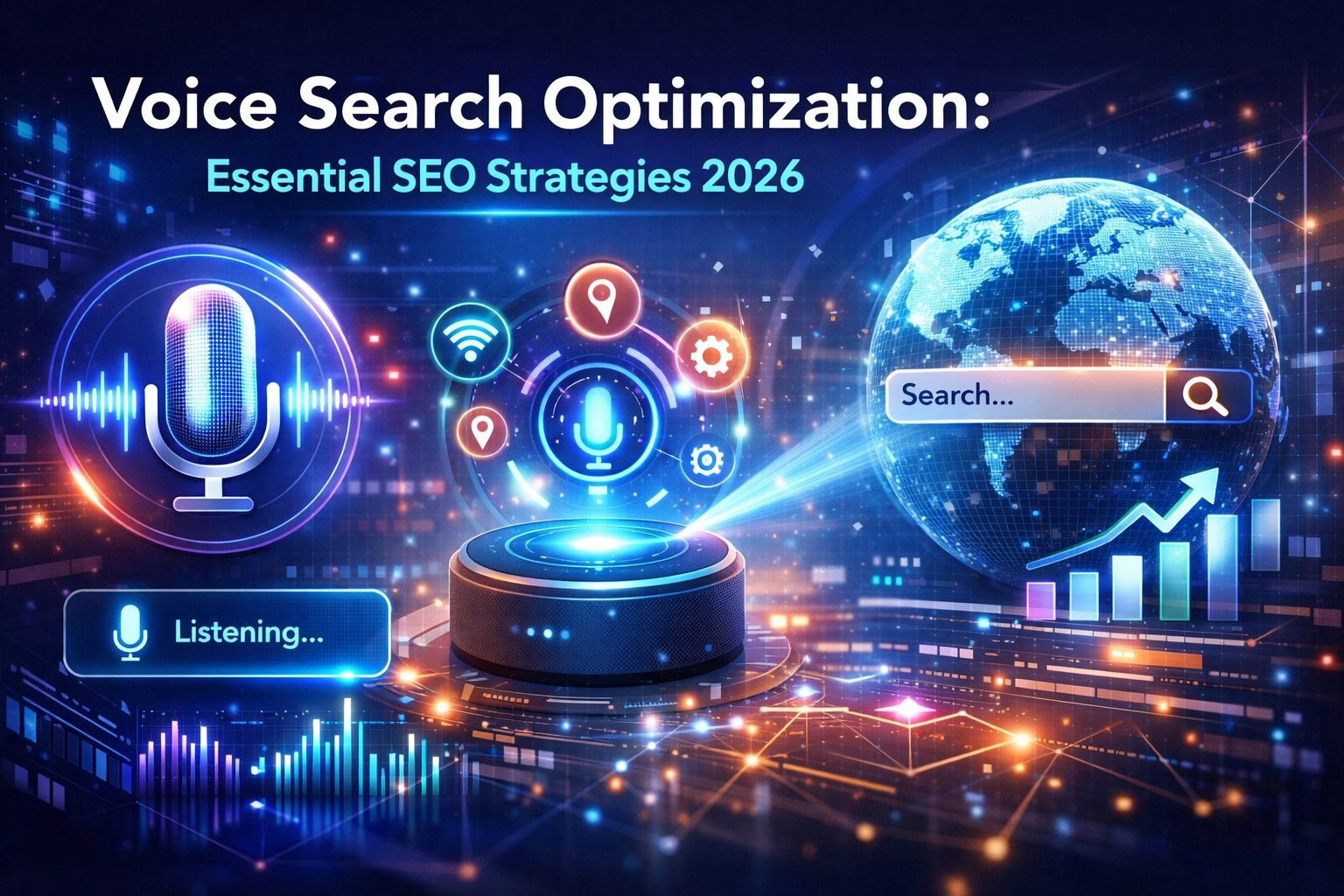
By 2026, the way we interact with the internet has fundamentally shifted. We aren't just typing fragments into a search bar anymore; we’re having full-blown conversations with our glasses, our cars, and our home hubs. If your SEO strategy is still stuck in the "keyword-plus-backlink" era of 2022, you’re essentially invisible to a massive chunk of your audience.
Voice search isn't a "nice-to-have" feature anymore. It is the primary interface for over half of all local searches and a dominant force in top-of-funnel information gathering. To win in this landscape, your SEO strategies 2026 need to prioritize conversational intent, technical precision, and what we call "Position Zero."
The Death of the Fragment: Why Conversational Queries Rule
Remember when we used to type "best pizza Cape Town"? In 2026, nobody talks like that. Instead, we ask, "Hey, where can I get the best gluten-free pizza near me that’s open until midnight?"
This shift from short-tail fragments to long-tail, natural language queries is the biggest hurdle for traditional SEO. Google’s algorithms, now deeply integrated with advanced Neural Language Processing (NLP), are looking for direct answers to specific questions.
Transitioning to Question-Based Content
To rank, you need to stop optimizing for "SEO tips" and start optimizing for "What are the most effective SEO strategies for voice search in 2026?" This means your content needs to be built around the 5 Ws (and 1 H):
- Who is the expert behind this?
- What is the immediate solution?
- Where can I find this service?
- When does this apply?
- Why is this better than the alternative?
- How do I implement this right now?

Dominating Position Zero: The Featured Snippet Game
In a visual search, a user might browse the top three results. In a voice search, the AI assistant usually reads only one result. That result is almost always the "Featured Snippet" or "Position Zero" content.
Research shows that roughly 50% of all voice search answers are pulled directly from featured snippets. If you aren't in that box, you don't exist in the ears of your customers.
How to Capture the Snippet
- The "Snippet Paragraph": At the beginning of your sections, include a 40–60 word summary that directly answers a specific question.
- Use H2 and H3 as Questions: Instead of a header like "Local SEO Benefits," use "Why is Local SEO important for small businesses in 2026?"
- Data Tables and Lists: AI assistants love structured data. If a user asks for a "comparison of SEO tools," the voice engine will scrape your table and read the top results.
Technical Excellence: Speed is the Currency of Voice
If a user asks their phone a question while walking down a busy street, they expect an answer in milliseconds. They won't wait for a heavy site to load.
Statistically, voice search results load about 52% faster than the average web page. If your site is sluggish, Google’s "Voice Bot" will skip you in favor of a faster competitor, even if your content is slightly better.
Core Web Vitals in 2026
Your technical SEO needs to be flawless. Focus on these three metrics:
- LCP (Largest Contentful Paint): Aim for under 2.5 seconds.
- FID (First Input Delay): Needs to be under 100 milliseconds.
- CLS (Cumulative Layout Shift): Keep it under 0.1 to ensure a stable reading experience for the crawlers.
Security is also non-negotiable. Voice assistants prioritize HTTPS sites exclusively. If you’re still running on HTTP, you’re locked out of the voice ecosystem entirely.

Structured Data: Giving the AI a Roadmap
Think of structured data (Schema Markup) as the "CliffNotes" for search engines. It tells the AI exactly what your content is about without it having to guess.
For voice search, specific types of Schema are your best friends:
- FAQ Schema: This is the gold standard. By marking up your FAQ sections, you make it incredibly easy for Google to pull your answers into a voice response.
- How-To Schema: If you provide tutorials, this markup helps voice assistants guide users through steps one by one.
- LocalBusiness Schema: Essential for showing up in "near me" queries. It provides your hours, location, and price range in a format the AI can digest instantly.
The "Near Me" Revolution: Local SEO is Voice SEO
Over 55% of consumers use voice search to find local businesses. This is where the money is. When someone says, "Find a digital marketing agency in Johannesburg," they are usually ready to buy or book.
Optimizing Your Google Business Profile (GBP)
Your GBP is now as important as your website. To rank in 2026:
- Weekly Updates: Post updates, photos, and offers every week.
- Review Management: It’s not just about the number of stars. The text in the reviews matters. If customers mention "best SEO strategies 2026" in their reviews, it signals to Google that you are a relevant authority for that specific query.
- Attribute Accuracy: Ensure your "Open Now" status, wheelchair accessibility, and service areas are 100% accurate.

Topic Clusters and Semantic Authority
The old way of SEO was creating one page for one keyword. The 2026 way is building Topic Clusters. This involves a "Pillar Page" (like this one) that covers a broad topic, linked to several "Cluster Pages" that dive deep into specific subtopics.
This structure tells search engines that you have "Topical Authority." When a voice search query comes in that is slightly nuanced, Google will trust your site because you’ve covered every possible angle of the subject.
| Feature | Traditional SEO | Voice SEO 2026 |
|---|---|---|
| Keyword Focus | Short-tail (2-3 words) | Conversational phrases (7+ words) |
| Content Goal | Clicks to website | Direct answer delivery |
| Primary Metric | Ranking position | Featured Snippet ownership |
| Structure | Linear articles | Topic clusters and FAQs |
| Tech Priority | Mobile-friendliness | Instant load speed & Schema |
E-E-A-T: Trust is the Final Filter
With the explosion of AI-generated content, search engines in 2026 are obsessed with E-E-A-T (Experience, Expertise, Authoritativeness, and Trustworthiness).
Voice assistants don't want to read out advice from an anonymous source. They want to quote experts.
- Author Bios: Every post should have a detailed bio explaining why the author is qualified.
- Evidence-Based Claims: Back up your strategies with data, case studies, and external links to high-authority sites.
- Originality: If your content is just a rewrite of what's already out there, you won't rank. You need a unique "angle" or proprietary data.

Actionable Checklist for 2026 Voice Dominance
If you want to start ranking for voice queries today, follow this roadmap:
- Audit for Speed: Use PageSpeed Insights and fix every "Red" metric.
- Build an FAQ Hub: Create a page that answers the 20 most common questions in your industry.
- Claim Your Local Space: Clean up your Google Business Profile and ask for reviews that use natural language.
- Implement Schema: Add FAQPage and LocalBusiness schema to your site immediately.
- Write Like You Speak: Read your content out loud. If it sounds robotic, rewrite it until it sounds like a conversation.
Conclusion
Voice search isn't just a trend; it's the evolution of how humans interact with technology. By shifting your focus to long-tail queries, structured data, and lightning-fast performance, you aren't just "doing SEO": you’re future-proofing your business. The goal for 2026 is simple: be the clearest, fastest, and most trusted answer in the room. Or, more accurately, the clearest answer in the smart speaker.
About the Author: Malibongwe Gcwabaza
Malibongwe Gcwabaza is the CEO and lead strategist at blog and youtube. With over a decade of experience in the shifting digital landscape, Malibongwe specializes in helping businesses navigate the complexities of AI-driven search and modern content marketing. His focus is on making high-level SEO strategies accessible and actionable for growth-oriented brands. When he's not dissecting algorithm updates, he's exploring the intersection of technology and human behavior in the African tech ecosystem.
About the Author