If you’re running an online business, you’re essentially a scientist in a digital laboratory. Every email you send is an experiment, and every subscriber is a data point. But most people treat their email marketing like a slot machine: they pull the lever, hope for a jackpot (a sale), and walk away frustrated when it doesn't hit.
The most successful marketers don't rely on luck. They use A/B testing (or split testing) to systematically eliminate what doesn't work and double down on what does. When you apply this "optimization mindset" to your email marketing automation tools, you aren't just sending messages; you’re engineering a growth engine.
In this guide, we’re going deep into the mechanics of A/B testing within automation frameworks. We’ll look at what to test, how to interpret the data, and which tools will give you the biggest edge in 2026.
The Psychology of the Split: Why Guess When You Can Know?
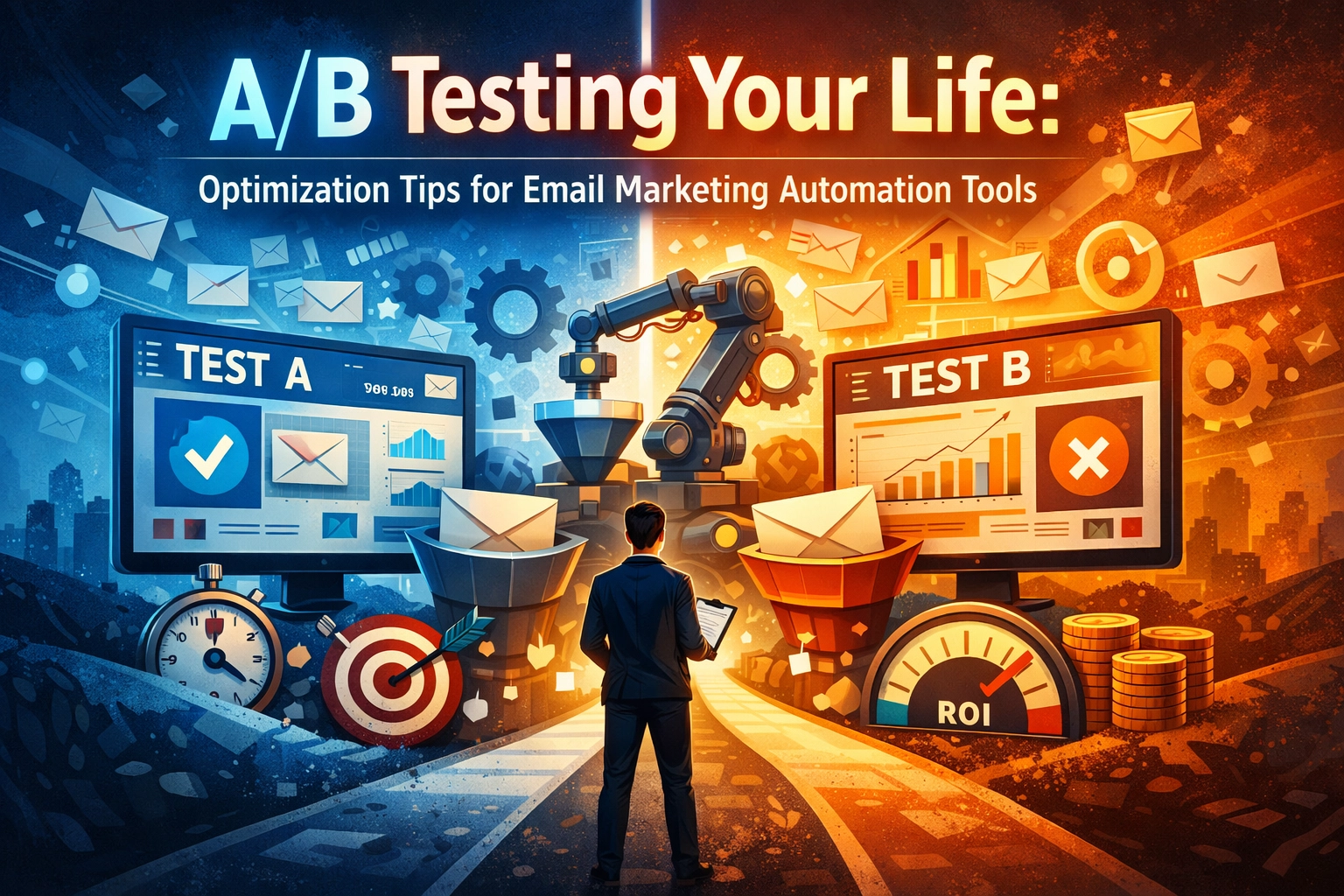
At its core, A/B testing is the process of comparing two versions of an email to see which one performs better. You send Version A to one group and Version B to another. The winner gets sent to the rest of your list.
It sounds simple, but the psychology behind it is profound. We often think we know what our audience wants. We might think a "Professional" tone is best, while our audience actually craves "Authentic and Raw." A/B testing removes the ego from the decision-making process. It forces you to listen to what your customers are actually doing, rather than what you think they should be doing.
The Metrics That Matter
When testing with email marketing automation tools, you need to know which lever you're trying to pull:
- Open Rate: This tests your Subject Line, "From" Name, and Preheader text.
- Click-Through Rate (CTR): This tests your email body, images, layout, and Call to Action (CTA).
- Conversion Rate: This tests the alignment between your email content and your landing page.

1. Mastering the Fundamentals: What to Test First
Don't try to test everything at once. If you change the subject line, the hero image, and the CTA button all at the same time, you won't know which change caused the result. This is the golden rule of A/B testing: test one variable at a time.
Subject Lines: The Gatekeeper
The subject line is the most common element to test because if the email isn't opened, nothing else matters.
- Short vs. Long: Does your audience prefer a punchy "Hey!" or a descriptive "5 Ways to Save Time Today"?
- Personalization: Does including their first name in the subject line actually increase opens, or has it become too "salesy" for your niche?
- Emojis: Research shows emojis can increase engagement, but they can also trigger spam filters if overused. Test them.
The "From" Name
People buy from people, not corporations. Testing your "From" name is a low-hanging fruit. Try "Malibongwe Gcwabaza" vs. "Malibongwe from Learnrise" vs. just "Learnrise." Often, a personal name combined with a company name performs best because it establishes both rapport and brand recognition.
Call to Action (CTA)
The CTA is where the money is made.
- Button vs. Link: Some audiences respond better to a big, bright button, while others prefer a "naked" text link that feels more like a personal recommendation.
- Urgency vs. Benefit: Compare "Buy Now (Offer Ends in 2 Hours)" with "Start Growing Your Business Today."
2. Advanced Optimization: Testing within Automated Workflows
One-off campaign tests are great, but the real power lies in optimizing your automated sequences. These are the "always-on" emails like your Welcome Series, Abandoned Cart reminders, or Post-Purchase follow-ups.
The Welcome Series Split
Your welcome email usually has the highest open rate of any email you’ll ever send. If you aren't A/B testing this, you’re leaving money on the table. Test the delivery time: does an immediate welcome work better, or should you wait 30 minutes so it feels less robotic?
Abandoned Cart Optimization
For e-commerce, the abandoned cart flow is critical. Use your email marketing automation tools to test different incentive structures.
- Test A: A simple reminder that they left items in the bag.
- Test B: A 10% discount code.
If Test A performs nearly as well as Test B, you’ve just saved yourself 10% on every future sale by realizing you didn't need the discount to convert those users.

3. The Math of Success: Statistical Significance
This is where many marketers "fuck around" and get bad results. You cannot declare a winner after sending an email to 50 people. If 5 people click Version A and 3 people click Version B, that isn't a trend: it’s a coincidence.
To make informed decisions, you need statistical significance. Most high-end email marketing automation tools have this built-in. Ideally, you want a 95% confidence level. This means there is only a 5% chance that the results happened by accident.
If your list is small, you might need to run your tests over a longer period or focus on "Always-On" automations where the sample size grows over time.
4. Comparing the Top Email Marketing Automation Tools for Testing
Not all tools are created equal when it comes to optimization. Here is how the big players stack up in 2026:
| Tool | Best For | Key A/B Testing Feature |
|---|---|---|
| ActiveCampaign | Advanced Marketers | Multivariate testing (up to 5 variations) and split-testing within automated workflows. |
| Mailchimp | Small Businesses | Very intuitive interface; great for testing subject lines and send times on a budget. |
| GetResponse | All-in-One Users | Excellent AI-driven insights that suggest winners based on historical data. |
| Brevo (formerly Sendinblue) | Budget-Conscious | Reliable A/B testing for basic variables at a very competitive price point. |
Multivariate Testing vs. A/B Testing
While A/B testing compares two versions (A and B), multivariate testing allows you to test multiple variables simultaneously (A, B, C, D, and E). Tools like ActiveCampaign allow for this, which is incredibly powerful for high-volume senders. It helps you understand how the subject line and the header image interact with each other to drive the final click.

5. Implementation Strategy: A Step-by-Step Checklist
Ready to start optimizing? Follow this workflow:
- Identify the Goal: Are you trying to get more opens or more clicks?
- Form a Hypothesis: "I believe that using a 'curiosity-based' subject line will increase opens by 10%."
- Select Your Sample: Decide what percentage of your list will receive the test (e.g., 20% get the test, the winning 80% get the winner).
- Set the Duration: Let the test run long enough to gather data (usually 4–24 hours for a broadcast).
- Analyze and Document: Once a winner is picked, write down why you think it won. This builds your internal knowledge base.
6. Common Pitfalls to Avoid
- Testing at the Wrong Time: If you send Version A on Tuesday and Version B on Friday, you aren't testing the email; you're testing the day of the week. Send them at the same time.
- Ignoring the Mobile Experience: A subject line might look great on a desktop but get cut off on a smartphone. Always preview both.
- Giving Up Too Soon: Optimization is a marathon. A 1% increase in CTR might not seem like much today, but compounded over a year of automated emails, it represents a massive shift in revenue.
Conclusion: The Culture of Continuous Improvement
Optimization isn't a task you finish; it's a way of doing business. By leveraging the full power of email marketing automation tools, you transform your marketing from a series of "best guesses" into a data-backed strategy.
Stop wondering if your emails are working. Start testing, start measuring, and start winning. Whether it's a simple subject line swap or a complex multivariate automation sequence, every test brings you one step closer to mastering the digital landscape.
About the Author: Malibongwe Gcwabaza
Malibongwe is the CEO of blog and youtube, a forward-thinking media company dedicated to helping creators and businesses scale through high-performance content and automation. With over a decade of experience in the digital marketing space, Malibongwe focuses on bridging the gap between complex technology and simple, actionable growth strategies. When he isn't diving into data analytics, he’s exploring the latest trends in AI and microlearning to keep the Learnrise community ahead of the curve.
About the Author