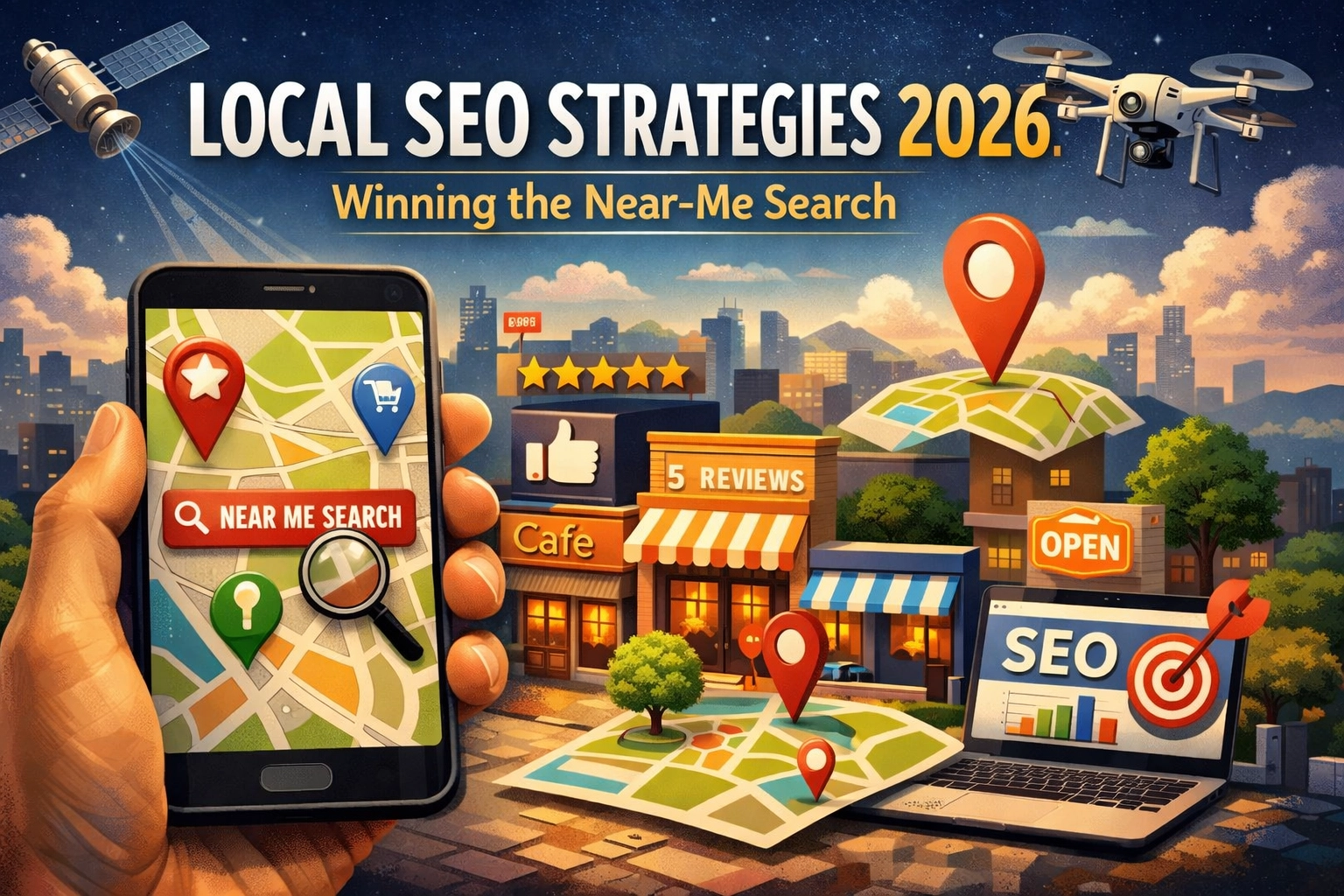
If you aren’t visible within three blocks of your customer’s current GPS coordinate in 2026, you might as well be invisible. The "near-me" search has evolved from a simple convenience into a complex, AI-driven ecosystem where Google (and its AI counterparts) predicts what a user needs before they’ve even finished typing.
Winning at local SEO used to be about stuffing your city name into a footer and hoping for the best. Today, it’s about hyper-relevance, real-time data, and building a digital footprint so localized that search engines view you as a pillar of the community. If you’re still playing by the 2022 rulebook, you’re losing customers to the shop around the corner that figured out how to talk to AI agents.
The AI Shift: How "Near-Me" Changed
By 2026, the traditional "10 blue links" are mostly a memory for local queries. Most users are interacting with AI Overviews (formerly SGE) or voice-activated assistants that summarize the best options nearby. These AI models don't just look at who has the most backlinks; they look for entities that satisfy a specific "vibe" or nuanced requirement.
When someone searches for "quiet coffee shop with fast Wi-Fi near me," the AI isn't just looking for the keyword "coffee." It’s scanning your reviews for mentions of "quiet," checking your Google Business Profile (GBP) photos for power outlets, and analyzing your "About" page to see if you mention high-speed internet. Local SEO in 2026 is about providing enough context for AI to trust you as the specific solution to a specific problem.
Your Google Business Profile is Your New Homepage
Forget your website for a second. For a local business, your Google Business Profile (GBP) is where 80% of the "buying" decisions happen. In 2026, treating this as a "set it and forget it" listing is a death sentence for your traffic.
The Conversion-First Profile
Your GBP needs to be an active storefront. This means:
- Rich Product/Service Descriptions: Don’t just list "Plumbing." List "Emergency 24/7 Pipe Burst Repair in [Neighborhood Name]." Use natural language that solves problems.
- Weekly Updates: Google favors profiles that show signs of life. Post photos of your team, your latest work, or a "deal of the week."
- Inventory Integration: If you sell physical goods, your real-time inventory should be synced with Google. If a user sees you have the specific pair of sneakers they want in stock right now, they’re walking through your door.

Hyper-Local Content: The "Neighborhood" Strategy
In 2026, targeting a whole city is often too broad. If you’re in a city like New York, London, or Johannesburg, ranking for "Pizza" is a pipedream. But ranking for "Best wood-fired pizza in Maboneng" or "Thin crust pizza near Times Square" is where the money is.
The "Service-in-Location" Landing Page
You need dedicated pages for every specific neighborhood or suburb you serve. A "Contact Us" page isn't enough. Create pages that include:
- Hyper-Local Keywords: Use the names of local parks, landmarks, and even well-known intersections.
- Embedded Custom Maps: Show your proximity to local landmarks.
- Local Testimonials: If you did a job in a specific neighborhood, put a testimonial from a resident of that neighborhood on that specific page.
- Localized FAQs: "Do you offer parking near the [Local Stadium] branch?" This captures "near-me" intent perfectly.
NAP Consistency: It’s Still a Big Deal (But Different)
NAP (Name, Address, Phone Number) consistency has been a local SEO staple for a decade. In 2026, it’s not just about matching text; it’s about Entity Recognition.
Search engines are looking for "mentions" of your business across the web. This includes social media tags, local news mentions, and even check-ins on niche apps. If your address is "123 Main St" on your site but "123 Main Street" on Yelp, AI is smart enough to figure it out, but why make it work? Ensure your details are identical everywhere to build a "trust cluster" around your business location.
Technical Local SEO: The "Secret Handshake"
If you want search engines to truly understand where you are and what you do, you have to speak their language: Schema Markup.
Specifically, you need to implement LocalBusiness Schema. This is a piece of code that tells Google: "I am a business, here are my coordinates, here are my hours, and here is a list of neighborhoods I serve."
In 2026, you should also be using OrderAction or ReserveAction schema. If a user can book a table or order a repair directly from the search result, Google is more likely to show your business at the top because it provides a frictionless user experience.

Building Local Authority: Beyond Backlinks
Local authority isn't just about getting a link from a big tech blog. It’s about being a "big deal" in your specific town.
Digital PR and Community Involvement
- Sponsorships: Sponsoring a local little league team or a charity run usually gets you a link from a
.orgor a local community site. These are gold for local SEO. - Local News: If you do something noteworthy, get the local paper to write about it. A single link from a local news outlet is often worth more for local rankings than five links from national sites.
- Partnerships: Partner with the non-competing business next door. If you’re a gym, link to the healthy cafe down the street, and have them link back to you. This signals to Google that you are part of a localized business ecosystem.
Voice Search and Conversational Queries
"Where can I get a haircut that's open after 7 PM?"
"Find an electrician who does EV charger installs near me."
These are conversational queries. People don't type "Electrician EV 7pm." They talk to their phones or their cars. To win these searches, your content needs to be written in a way that mirrors how people speak.
FAQ sections are your best friend here. By phrasing your headers as questions ("When is the best time to visit our [City] branch?") and providing direct, concise answers, you increase your chances of being the "featured snippet" or the voice assistant's primary answer.

The Review Economy: Quality and Context
In 2026, the sheer number of reviews matters less than the content within them. Google’s AI is looking for "justification" in reviews.
If a user searches for "reliable roofers," Google will highlight reviews that specifically say things like, "They were very reliable and showed up on time."
How to Optimize Reviews
Encourage your customers to be specific. Instead of asking for "a review," ask them to "mention the specific service we provided and which neighborhood you’re in." A review that says, "Great boiler repair in Kensington!" is a local SEO powerhouse compared to one that just says, "Good service."
Measuring Success in 2026
The metrics have shifted. Don't just look at "rankings." Look at:
- GBP Interactions: How many people clicked "Call," "Directions," or "Message" directly from the map?
- Entity Mentions: Is your brand being mentioned in local "Best of" lists or community forums?
- Zero-Click Conversions: How many people got the info they needed (like your hours or address) without ever clicking through to your website?
Local SEO in 2026 is a game of being the most helpful, most present, and most "vouched for" business in your immediate vicinity. By focusing on hyper-local content, AI-ready data, and genuine community authority, you’ll not only win the "near-me" search: you’ll win the customer.
About the Author
Malibongwe Gcwabaza is the CEO of blog and youtube. With over a decade of experience in digital strategy and local market growth, Malibongwe focuses on making complex SEO concepts simple and actionable for businesses looking to dominate their local landscape. When not deep-diving into algorithm updates, he’s exploring the intersection of AI and human-centric marketing.
About the Author