By March 2026, the conversation around Artificial Intelligence has shifted from "Can it do my job?" to "How much of my job is already automated?" We are no longer looking at speculative futures; we are living in the era of Agentic AI. These are systems that don’t just generate text or images but execute multi-step workflows, manage software stacks, and make autonomous decisions in white-collar environments.
The data from the past year is sobering. In 2025, roughly 4.5% of global job losses were directly attributed to AI integration, with the tech sector alone seeing nearly 80,000 redundancies in the first six months. As we move further into 2026, the "low-hanging fruit" of clerical work, basic data entry, and entry-level coding has largely been consumed by Large Action Models (LAMs).
However, the "AI Apocalypse" is unevenly distributed. While 30% of U.S. jobs face high automation risks by 2030, a specific subset of careers is proving remarkably resilient. These aren't just jobs that AI can't do; they are roles where human presence is a structural requirement for trust, safety, and physical navigation.
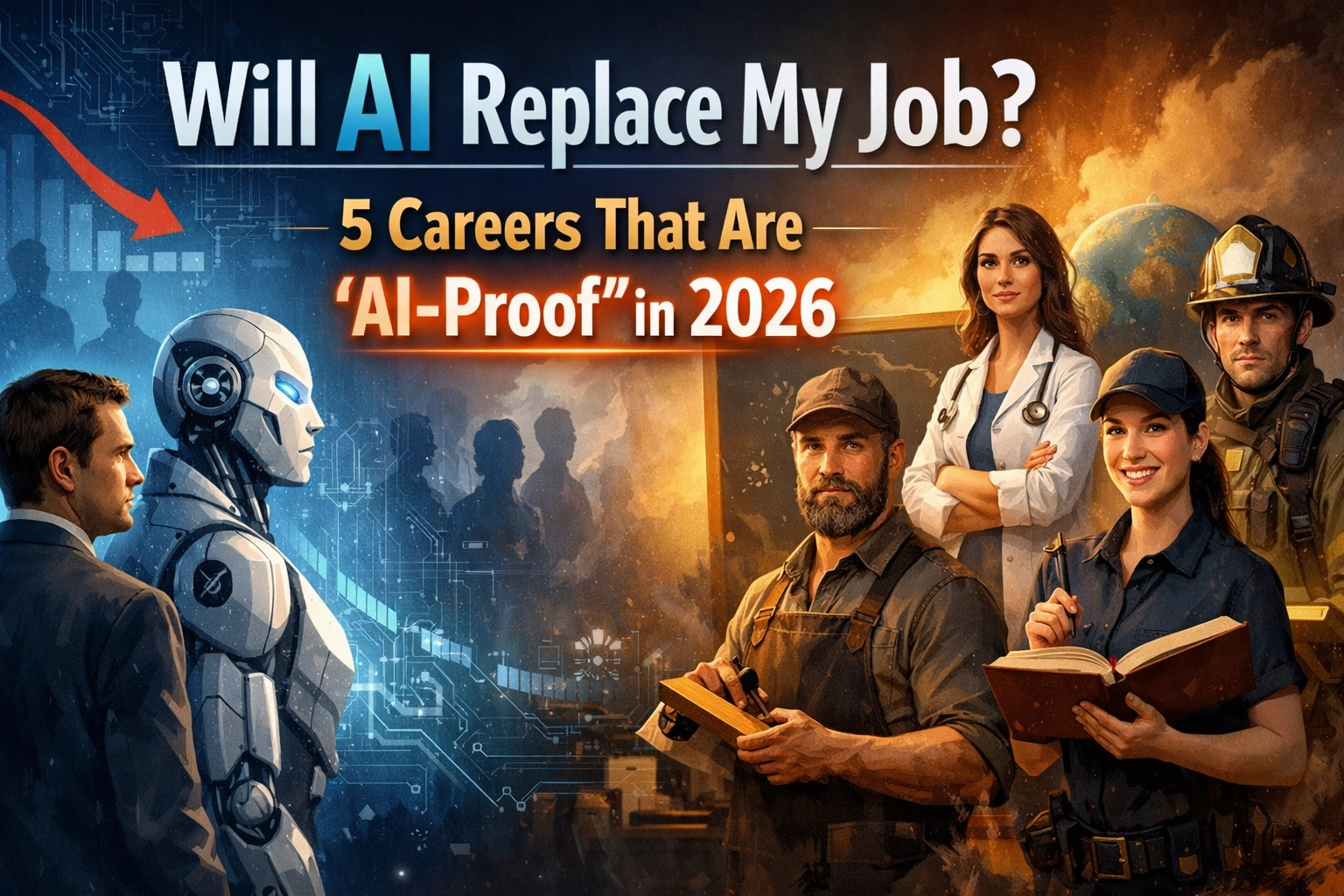
Here are the five careers that remain "AI-proof" in 2026 and the technical reasons why they defy the algorithms.
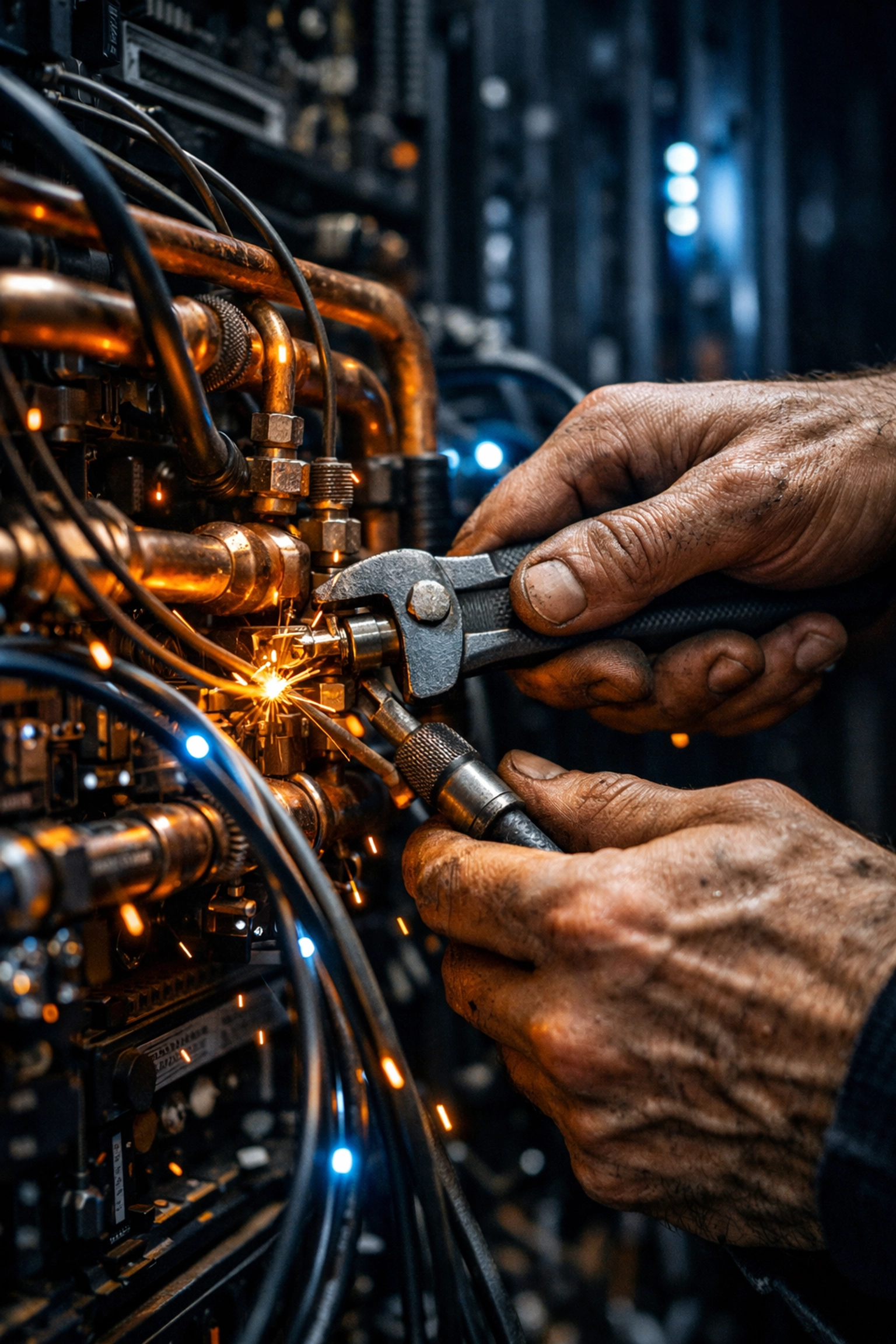
1. High-Stakes Specialized Trades (Infrastructure & Repair)
While we have impressive humanoid robots from Tesla and Boston Dynamics, the "Moravec’s Paradox" remains undefeated in 2026. This paradox notes that high-level reasoning (like playing chess or coding) requires very little computation, but low-level sensorimotor skills (like walking through a cluttered room or fixing a pipe) require enormous computational resources.
Specialized tradespeople: electricians, HVAC technicians for modular data centers, and commercial plumbers: operate in "unstructured environments." Unlike a factory floor where every variable is controlled, a technician entering a 40-year-old building must navigate unique architectural quirks, legacy hardware, and unpredictable physical decay.
Why it’s AI-proof:
- Tactile Feedback: AI currently lacks the fine motor haptics to feel the tension of a stripped screw or the heat of a failing circuit in real-time.
- Spatial Reasoning: Navigating a crawlspace requires dynamic 3D mapping that exceeds current edge-computing capabilities in mobile robotics.
- Liability: In 2026, insurance providers still require a licensed human signature for high-voltage or structural repairs to maintain liability coverage.
2. Mental Health & Complex Behavioral Therapy
In early 2025, we saw a surge in "AI Therapy" apps. While they are excellent for basic Cognitive Behavioral Therapy (CBT) exercises and mood tracking, they have hit a hard ceiling when it comes to complex trauma, addiction, and acute crisis intervention.
2026 has proven that human psychology is not a closed-loop data set. Effective therapy relies on "therapeutic alliance": the subconscious trust built between two humans. AI can simulate empathy through sentiment analysis, but it cannot experience shared human condition, which remains a cornerstone of deep psychological healing.
The Technical Gap:
AI models are trained on past data (stochastic parrots). They can predict the most likely helpful response, but they struggle with the "Black Swan" moments of human crisis where a patient’s behavior deviates from historical patterns. Furthermore, the ethical implications of an AI "hallucinating" advice during a suicidal ideation crisis have led to strict 2026 regulations (like the updated AI Safety Accord) that mandate human intervention for mental health services.
3. AI Ethics, Compliance & Governance Officers
Ironically, the rise of AI has created one of the most stable career paths in history: the people who manage, audit, and restrain the AI. As companies move toward "Agentic Workflows," where AI agents talk to other AI agents to complete tasks, the risk of "systemic drift" or "algorithmic collusion" becomes a massive legal liability.
In 2026, the role of an AI Ethics Officer is no longer a PR move; it is a core technical requirement. These professionals must understand the "Black Box" of neural networks, perform bias audits on training sets, and ensure that the company’s LLM deployments comply with the EU AI Act 2.0 and local privacy laws.
Key Responsibilities in 2026:
- Explainability Audits: Translating complex weights and biases into plain language for regulators.
- Red Teaming: Proactively trying to "jailbreak" company agents to find security vulnerabilities.
- GEO Oversight: Ensuring that the company’s content is optimized for Generative Engine Optimization (GEO) without violating "helpful content" guidelines.

4. Strategic Negotiation & High-Stakes Diplomacy
Whether it’s a corporate merger, a sensitive legal settlement, or international trade agreements, high-stakes negotiation remains a human domain. Why? Because negotiation is rarely about logic; it’s about leverage, ego, and the reading of non-verbal cues.
An AI can calculate the "Nash Equilibrium" (the optimal mathematical outcome for both parties) in seconds. However, humans are notoriously irrational. A CEO might walk away from a deal because of a perceived slight, or a diplomat might offer a concession based on a personal bond built over a dinner. AI cannot replicate the "gut feeling" or the social engineering required to pivot a strategy in a room full of hostile negotiators.
The Human Edge:
- Contextual Nuance: Understanding the cultural or personal subtext that isn't present in the formal briefing.
- Improvisation: AI is bound by its training data; a human negotiator can invent a third-way solution that has never been documented before.
5. R&D in Emergent Sciences (The Pioneers)
AI is a master of synthesis. It can read 10,000 papers on oncology and suggest a new combination of existing drugs. But AI struggles with "Zero-to-One" innovation: discovering something for which there is no existing data.
Researchers in fields like synthetic biology, quantum computing architecture, and climate engineering are safe because they are the ones creating the data that the AI will eventually learn from. In 2026, we are seeing a massive trend of "AI-Augmented Research," where scientists use AI to handle the grunt work of simulations, but the hypothesis generation and the "Eureka" moments remain human.
Technical Insight:
Current LLMs (Large Language Models) are essentially high-dimensional probability engines. They predict the next token based on what has already been written. They cannot, by definition, predict a breakthrough that contradicts the current scientific consensus.

How to "AI-Proof" Your Current Role
If your job didn't make the list, don't panic. The goal in 2026 isn't to beat the AI, but to integrate with it. The concept of the "Living Resume" has replaced static PDFs; employers now look for your "AI-to-Human Synergy" score.
Here are three ways to stay relevant:
- Master Agentic Workflows: Don't just learn to write prompts. Learn to build "agents" that handle your repetitive tasks. A marketing manager who can orchestrate five AI agents to run a campaign is 10x more valuable than one who writes copy manually.
- Double Down on "Soft" Skills: In a world of infinite, cheap, machine-generated content, human traits like charisma, leadership, and genuine storytelling have become premium commodities.
- Understand GEO (Generative Engine Optimization): As traditional SEO fades, understanding how AI engines (like Gemini or SearchGPT) cite sources is critical for any digital professional.
The Verdict: 2026 and Beyond
The divide in the 2026 job market is clear: if your job can be described as "receiving data, processing it, and outputting it," you are in the danger zone. If your job involves "physical navigation of the real world, complex human empathy, or the creation of new knowledge," you are not just safe: you are in higher demand than ever.
The "AI-proof" worker of 2026 is someone who uses the machine to handle the quantifiable so they can focus on the qualitative.
About the Author: Malibongwe Gcwabaza
Malibongwe Gcwabaza is the CEO of blog and youtube, a leading consultancy focused on the intersection of emerging technology and career development. With over a decade of experience in digital transformation, Malibongwe helps professionals navigate the complexities of the AI-driven economy. He is a frequent speaker on the ethics of automation and a staunch advocate for skills-based hiring in the 2026 landscape. When he isn't deconstructing the latest LLM updates, he's exploring the future of remote work cities across Africa.
About the Author