For decades, the university degree was the undisputed "Golden Ticket" to the middle class. You spent four years studying, walked across a stage, and received a piece of paper that theoretically proved you were ready for the workforce. But as we move through 2026, that monolithic model is cracking. High tuition costs, the rapid evolution of technology, and the rise of skills-based hiring have shifted the focus toward a more modular approach to education: micro-credentials.
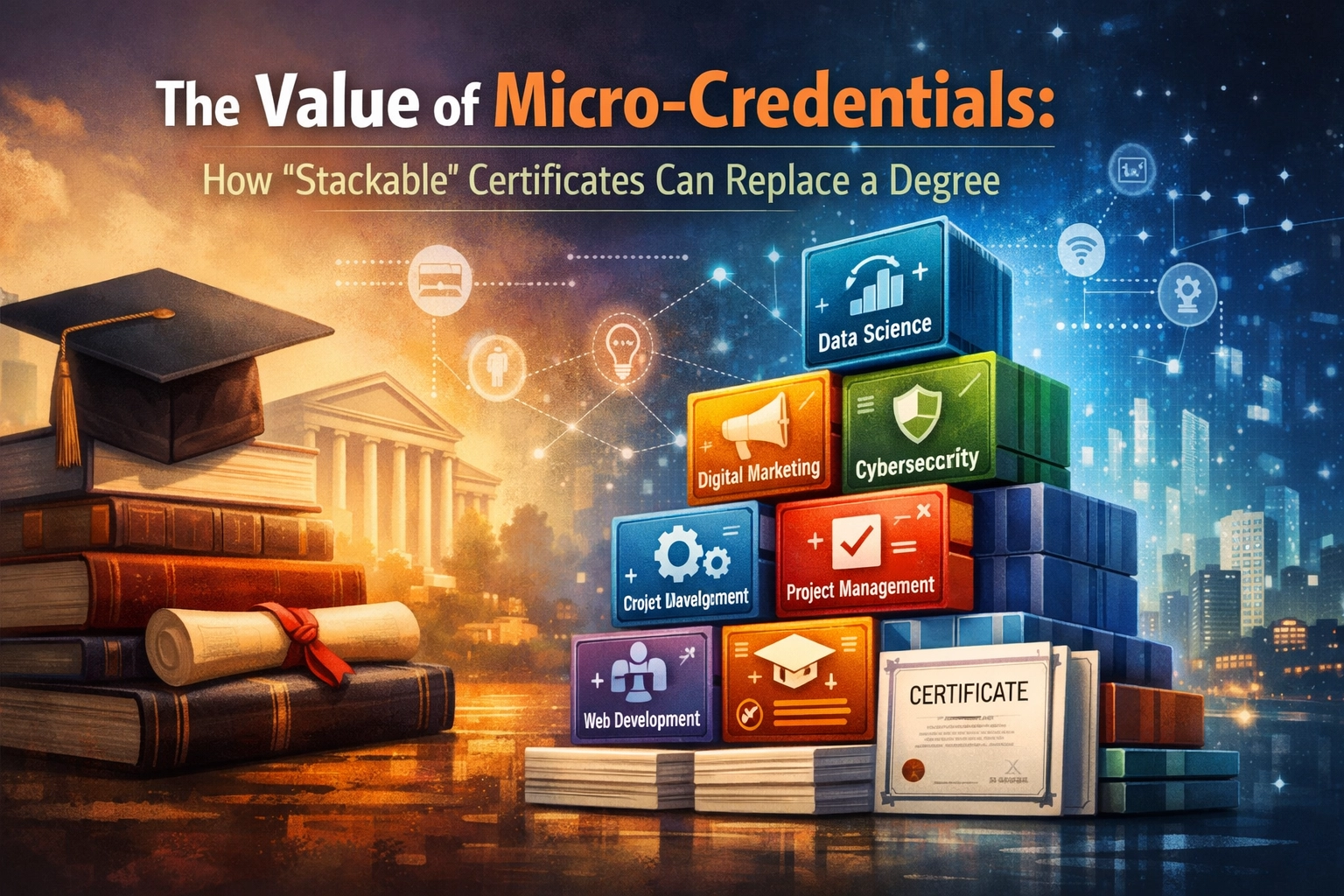
Micro-credentials, often called digital badges, nanodegrees, or professional certificates, are short, highly focused learning units that verify a specific skill or competency. When these units are "stacked" together, they create a comprehensive educational profile that, in many industries, is now more valuable than a traditional four-year degree.
The Disaggregated Degree: What is "Stacking"?
In the past, education was "bundled." To learn accounting, you also had to take elective courses in 18th-century literature or macroeconomics. While well-roundedness is great, the modern labor market demands surgical precision.
"Stackability" refers to the ability to take these small, bite-sized credentials and combine them into a larger qualification. Think of it like Lego bricks. You might start with a 4-week certificate in Python for Data Analysis. Three months later, you add a credential in Statistical Modeling. By the end of the year, you’ve stacked five or six related certificates that collectively carry the weight of a specialized Master’s degree, but at a fraction of the cost and time.

The Technical Architecture of Stacking
In 2026, stacking isn't just a metaphor; it’s a technical reality supported by blockchain and Open Badges 3.0 standards. These credentials contain metadata that proves:
- Issuer Authority: Who gave you the badge? (e.g., Google, IBM, Harvard).
- Competency Mapping: What specific tasks can you perform? (e.g., "Can configure AWS S3 buckets for high availability").
- Assessment Rigor: Was it a multiple-choice quiz or a peer-reviewed project?
- Credit Equivalence: Many micro-credentials now carry ECTS (European Credit Transfer and Accumulation System) or ACE (American Council on Education) credits that can be transferred directly into university programs.
The Economic Reality: ROI Comparison
Let’s look at the numbers. As of March 2026, the average cost of a private four-year degree in the US or UK hovers around $150,000 to $200,000 when you factor in living expenses and interest on loans.
Now, consider the "Stacked Path":
- Foundational Certificate (Coursera/edX): $300 – $600
- Advanced Technical Bootcamp: $2,500
- Industry-Specific Certification (e.g., CISSP or PMP): $700
- Specialized AI Ethics Credential: $400
- Total Investment: ~$4,200
The ROI isn't just about the lower entry price. It’s about the opportunity cost. A traditional student is out of the full-time workforce for four years. A micro-credential learner can work full-time, applying their $400 certificate to a $5,000 raise mid-year, then stacking the next credential to jump to a new role entirely. By the time the traditional student graduates, the micro-credential learner has four years of experience, zero debt, and a portfolio of verified skills that are current to 2026 standards, not 2022 textbooks.
Why Employers are Obsessed with Granularity
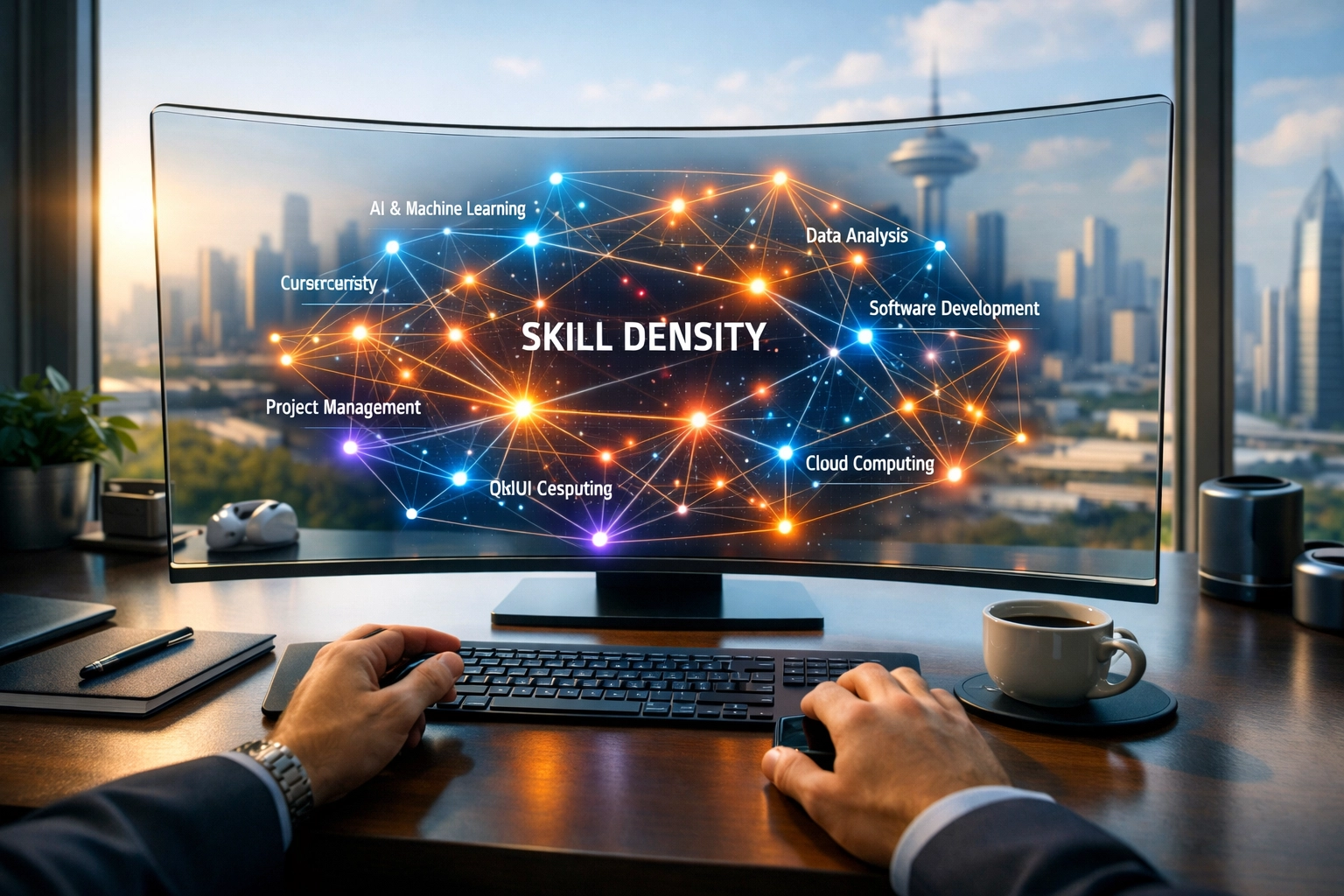
Recruiters are moving away from looking at "University Name" and toward "Skill Density." In a 2026 job market dominated by Agentic AI and GEO (Generative Engine Optimization), a general "Marketing Degree" tells a hiring manager very little.
However, a candidate with a stack of certificates in "AI-Powered Lead Generation," "Data Privacy Compliance," and "Predictive Analytics for Retention" provides immediate clarity. These micro-credentials act as a "proof of work."
Data-Driven Insights on Hiring
Recent surveys of HR tech platforms show that resumes featuring specific, verified micro-credentials have a 35% higher "pass rate" through AI-based Applicant Tracking Systems (ATS). Why? Because these systems are programmed to look for specific keywords and verified metadata that general degrees often lack.
Case Study: The Hybrid Model at Thunderbird (ASU) and Harvard
It’s important to note that micro-credentials aren't necessarily killing degrees; they are reforming them. Leading institutions have adopted the "Micro-Masters" approach.
For instance, at the Thunderbird School of Global Management, students can complete a series of online micro-certificates in areas like Global Leadership or AI in Business. If they pass with a high enough grade, they are fast-tracked into the full Master’s program with 50% of the credits already completed. This "try-before-you-buy" model reduces risk for the student and ensures the university only admits students who have already proven they can handle the material.
The Role of AI in Micro-Credentialing
In 2026, we are seeing the rise of Adaptive Micro-Credentials. Unlike the static PDF certificates of 2020, modern credentials are often linked to dynamic portfolios.
If you earn a certificate in Cybersecurity, AI-driven platforms like LinkedIn or Indeed can now verify your skills by looking at your GitHub contributions or real-world project completions. The credential is the "hook," but the AI-verified portfolio is the "closer." This level of technical validation is something a traditional paper diploma simply cannot provide.
Strategic Advice: How to Build Your "Degree Replacement" Stack
If you’re looking to bypass a degree or pivot careers in 2026, you need a strategy. You can't just collect random badges like Pokémon cards. You need a cohesive narrative.
1. Identify the "Core" Credential
Start with a heavyweight professional certificate from a recognized industry leader (Google, Microsoft, Salesforce). This provides the "brand name" recognition that anchors your resume.
2. Add "Vertical" Specialization
If you’re in FinTech, don’t just get a general Finance badge. Get a micro-credential in "Blockchain Auditing" or "AI Risk Assessment in Banking." This shows you are keeping pace with the specific technical shifts in your niche.
3. Proof of Soft Skills
Technical skills get you the interview; soft skills get you the job. Stack a credential in "Remote Team Management" or "Cross-Cultural Communication." In the age of AI, these "human-centric" credentials are skyrocketing in value.
4. Verify on the Blockchain
Ensure your certificates are issued via platforms like Credly or Accredible. These use blockchain technology to ensure your credentials can’t be faked, which is a major concern for 2026 employers dealing with AI-generated fraudulent resumes.

The Verdict: Can They Truly Replace a Degree?
The honest answer depends on the field. For regulated professions, medicine, law, structural engineering, the traditional degree remains the legal requirement. You aren't going to "stack" your way into performing heart surgery.
However, in Tech, Business, Digital Marketing, Creative Arts, and Data Science, the answer is a resounding YES. In these fields, the ability to show a current, relevant, and stacked educational history is often more impressive than a stale degree from four years ago.
The degree is becoming a "base layer," while stackable credentials are the "operating system" that keeps your career running. For many, the base layer is no longer even necessary to start the journey.
Final Thoughts
The democratization of education via micro-credentials is the greatest equalizer of our time. It removes the gatekeepers of prestige and replaces them with a transparent system of merit. Whether you’re a student in Nairobi or a mid-career professional in New York, the tools to build a world-class education are now modular, affordable, and ready to be stacked.
About the Author: Malibongwe Gcwabaza
CEO of blog and youtube
Malibongwe Gcwabaza is a visionary leader in the EdTech and Career Development space. With over a decade of experience navigating the intersection of technology and labor trends, Malibongwe focuses on helping professionals adapt to the "Skills Economy." Under his leadership, blog and youtube has become a premier destination for high-quality, data-driven career insights. He is a firm believer that the future of work isn't about what you studied ten years ago, but what you learned this morning.
About the Author