By 2026, the AI job market has undergone a massive shift. The era of "I know how to call an OpenAI API" is over. Recruiters at top-tier firms like DeepMind, Anthropic, and NVIDIA are no longer impressed by certificates or basic Jupyter Notebooks. They are looking for AI Engineers and Machine Learning specialists who understand the "production" side of the equation.
Research shows that over 50% of AI portfolios fail to secure an interview because they lack production deployment pipelines. In a sea of candidates who have all finished the same Coursera specialization, your portfolio needs to scream "I can ship reliable code." To stand out, you need to solve business problems, not academic exercises.
The Death of the Toy Dataset
If your GitHub repository features the Titanic survival dataset, the Iris flower classification, or the MNIST digit recognizer, you are inadvertently signaling to recruiters that you are still in the "learning" phase. These are toy datasets. They are cleaned, structured, and solved. In the real world, data is messy, biased, and often missing.
To impress a tech recruiter in 2026, you must pivot to Business-Focused AI. A project that predicts customer churn for a subscription service using real-world noisy data is worth ten times more than an academic classifier. A project solving document processing bottlenecks using Agentic workflows will get you noticed.
The goal is to demonstrate a 5-10% performance improvement over established baselines or current manual processes. Recruiters aren't just looking for accuracy; they are looking for ROI.
The 2026 Tech Stack: What Your Portfolio Needs
The definition of a "modern" AI stack has evolved. To prove you are industry-ready, your projects should move beyond basic Python scripts. You need to demonstrate proficiency in:
- Agentic Frameworks: Show you can build systems that don't just "talk" but "do." Use frameworks like LangGraph, CrewAI, or Pydantic AI to build multi-agent systems that solve complex, multi-step tasks.
- Vector Databases & RAG: Basic LLM calls are cheap. High-quality Retrieval-Augmented Generation (RAG) is where the value lies. Your portfolio should include implementations using Pinecone, Weaviate, or Milvus, complete with advanced retrieval techniques like "HyDE" (Hypothetical Document Embeddings) or "Parent Document Retrieval."
- LLM Observability and Evaluation: This is the biggest gap in junior portfolios. How do you know your model is performing well? Include tools like LangSmith, Arize Phoenix, or WhyLabs in your projects. If you aren't measuring latency, token cost, and hallucination rates, you aren't building production AI.

Three High-Impact Project Blueprints
If you’re starting from scratch or looking to upgrade your portfolio, here are three project archetypes that carry immense weight in 2026.
1. The Enterprise Knowledge Agent (Advanced RAG)
Instead of a simple PDF uploader, build a system that indexes an entire company’s documentation (e.g., Notion, Slack, and GitHub) and uses a multi-agent approach to answer complex queries.
- The Technical Flex: Implement a "Reranker" step to improve search precision and use "G-Eval" (using a stronger LLM to grade a weaker one) to automate your testing suite.
- Business Value: Reduces internal support tickets by 30%.
2. Real-Time Predictive Operations Dashboard
Find a public API (like weather, stock market, or transit data) and build a real-time predictive engine.
- The Technical Flex: Use Kafka or Spark for stream processing and deploy the model using a FastAPI wrapper inside a Docker container.
- Business Value: Demonstrates the ability to handle live, shifting data distributions (Data Drift).
3. The Vision-Based Quality Control System
Use a framework like YOLOv11 or a fine-tuned Vision Transformer (ViT) to identify defects in a specific niche: like cracks in solar panels or mislabeled pharmaceutical packaging.
- The Technical Flex: Fine-tune the model on a custom, small-scale dataset and show how you handled class imbalance (e.g., more "good" samples than "bad" ones).
- Business Value: High-impact automation for manufacturing or logistics sectors.
Engineering Rigor: Moving Beyond the Notebook
A recruiter’s biggest fear is hiring an "AI Researcher" who can’t write production-grade code. You must prove you are an engineer first. Every project in your portfolio must follow these three rules:
Version Control and CI/CD
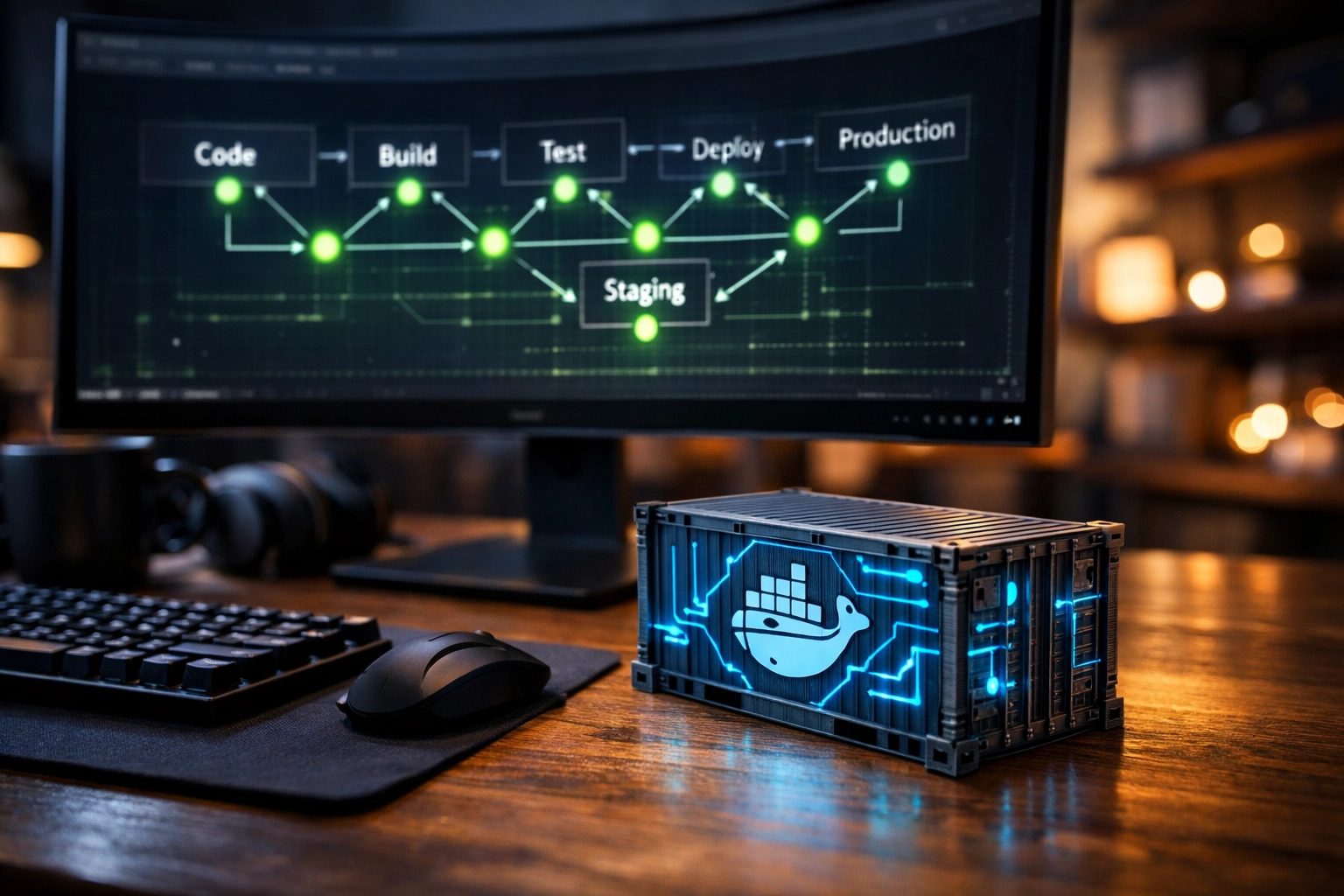
Sixty percent of AI projects without proper version control fail to make it to production. Your GitHub should show a clean history of branches and pull requests. Use GitHub Actions to automate your testing. If a recruiter sees that pushing code triggers a suite of unit tests and a model evaluation script, you have already moved into the top 5% of candidates.
Containerization (Docker)
"It works on my machine" is a career-killer. Every project should include a Dockerfile. This proves that your environment is reproducible and that your code can be easily integrated into a company’s existing Kubernetes cluster or cloud infrastructure.
Documentation (The "One-Page Brief")
Recruiters spend an average of 6 seconds looking at a resume. They won't spend much longer on your GitHub. Every repository needs a professional README.md that includes:
- The "Why": What business problem does this solve?
- The Architecture: A mermaid.js diagram or an image showing the data flow.
- The Results: Concrete metrics (e.g., "Achieved 94% F1-score with a 120ms latency").
- Setup Instructions: A one-liner to get the project running.
Strategic Visibility: Where to Host Your Work
Code on GitHub is the foundation, but visibility requires more. In 2026, the best portfolios are multi-channel.
- Hugging Face Spaces: This is the "LinkedIn for AI." Host live, interactive demos of your models using Gradio or Streamlit. If a recruiter can play with your model in their browser, the engagement factor skyrockets.
- Technical Blogging: Write a deep-dive article on Medium or your personal blog explaining a specific technical challenge you overcame during a project. For example: "How I reduced RAG hallucinations by 40% using Semantic Chunking." This demonstrates communication skills: a trait highly valued in senior roles.
- The Video Demo: Create a 2-minute "walkthrough" video of your best project. Post it on LinkedIn and tag relevant recruiters. It shows confidence and allows you to explain your design decisions visually.
Data-Driven Insights: What the Numbers Say
Internal data from tech recruitment platforms indicates that candidates who include Model Monitoring in their portfolios receive 40% more callbacks than those who don't. Furthermore, projects that utilize Small Language Models (SLMs) like Phi-3 or Llama-3-8B for specialized tasks are currently trending higher than generic GPT-4 wrappers. This is because companies are looking for ways to reduce compute costs while maintaining performance.
If you can show that you chose a smaller, cheaper model and optimized it through fine-tuning or quantization (using bitsandbytes or AutoGPTQ), you are speaking the language of a CFO and a CTO simultaneously.
Final Thoughts: Quality Over Quantity
You do not need 20 repositories. You need three "Banger" projects.
One project that shows you can handle Data Engineering, one that shows you can handle Model Training/Optimization, and one that shows you can handle Agentic Deployment.
Treat your portfolio like a product. It needs to be fast, reliable, and solve a problem. When a recruiter looks at your work, they shouldn't just see code; they should see a solution that is ready to be shipped.
About the Author: Malibongwe Gcwabaza
Malibongwe Gcwabaza is the CEO of blog and youtube, a leading digital media company focusing on the intersection of emerging technology and career development. With over a decade of experience in the tech ecosystem, Malibongwe specializes in identifying the skill gaps that define the future of work. His mission is to simplify complex AI concepts and provide actionable roadmaps for the next generation of digital professionals. Under his leadership, blog and youtube has become a go-to resource for over 500,000 monthly readers seeking to navigate the 2026 job market.
About the Author