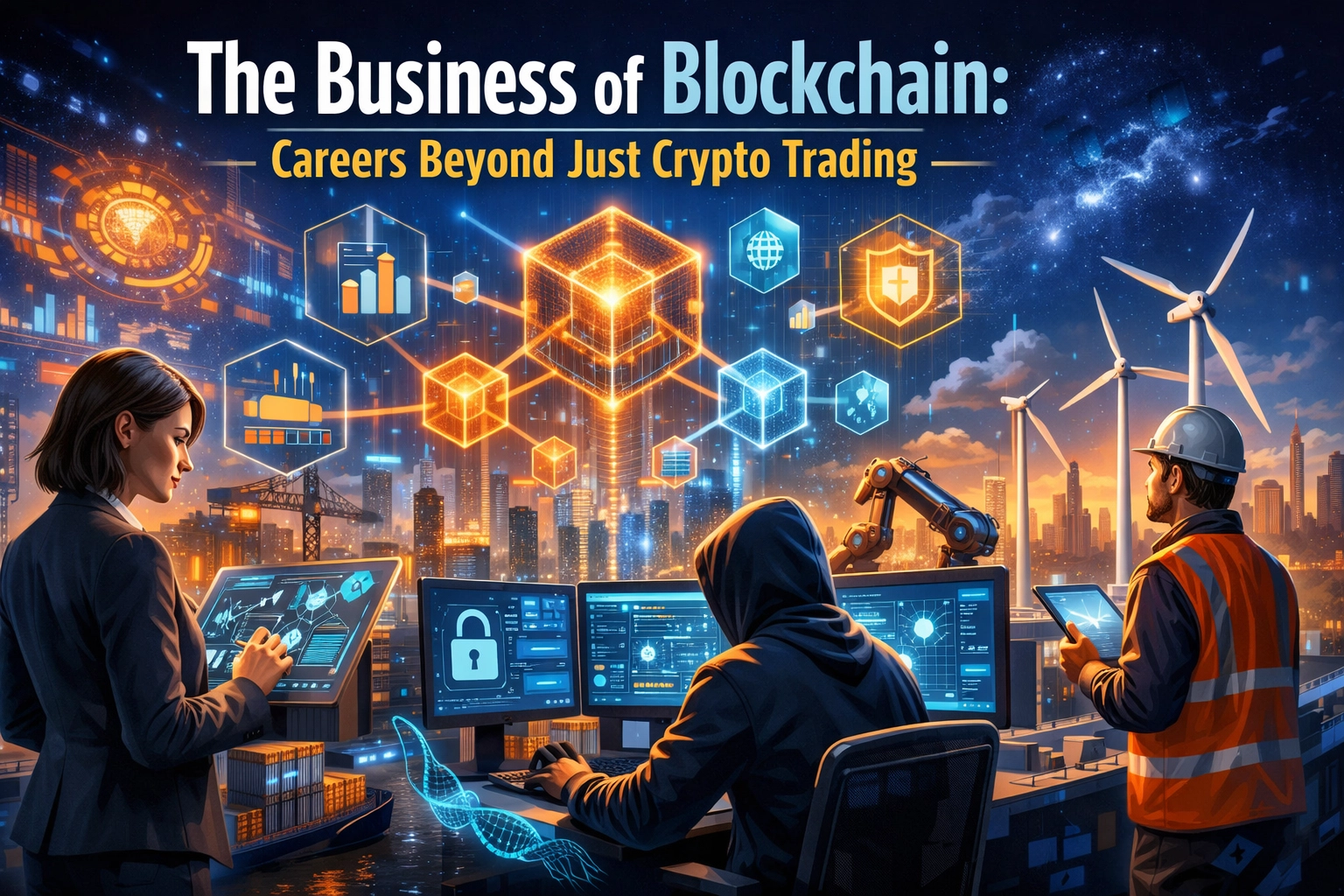
If you still think the blockchain industry is just about checking candle charts and hoping your "alt-bag" goes to the moon, you’re looking through a telescope the wrong way. By 2026, the speculative dust has settled. We’ve moved past the era of "memecoin millionaires" and entered the age of institutional architecture.
Blockchain has become the invisible plumbing of the global financial and logistical world. Whether it’s tokenizing real-world assets (RWAs) like real estate, managing cross-border settlements in sub-seconds, or providing a transparent ledger for AI agent transactions, the technology is integrated.
Because the "hype" has transitioned into "utility," the career landscape has shifted. We aren't just looking for "crypto enthusiasts" anymore. We are looking for protocol architects, compliance heavyweights, and on-chain data scientists. Here is the 2026 guide to building a career in the business of blockchain: without ever having to execute a trade.
The Technical Core: Protocol Engineering and DevEx
The demand for developers is higher than ever, but the requirements have become significantly more specialized. In 2026, simply knowing how to copy-paste a Solidity smart contract isn't enough.
1. Protocol Architects & L2 Specialists
With the explosion of Layer 2 (L2) and Layer 3 (L3) solutions designed for scalability, the industry needs engineers who understand the "metal." This means working on zero-knowledge (ZK) rollups, optimistic rollups, and data availability layers. If you can write code that optimizes gas fees while maintaining high-security guarantees, you are in the top 1% of earners.
2. DevEx (Developer Experience) Engineers
Platforms like Ethereum, Solana, and Aptos are now competing for talent. A DevEx Engineer acts as the bridge between the core protocol and the app developers. They build the SDKs, the documentation, and the tooling that make it easier for others to build. If you have a knack for simplifying complex technical hurdles, this is a high-growth niche.

3. Smart Contract Security Auditors
In a world where millions are lost in minutes due to logic flaws, security is paramount. Professional auditors who specialize in Formal Verification: using mathematical proofs to ensure code behaves exactly as intended: are the surgeons of the blockchain world. Salaries for senior auditors in 2026 often exceed $250,000, reflecting the massive responsibility they carry.
The Regulatory Guardians: Compliance and Governance
2026 is the year of the "Regulated Web3." Between the maturation of MiCA (Markets in Crypto-Assets) in Europe and new SEC frameworks in the US, compliance is no longer an afterthought: it’s the entire game.
Crypto Compliance Officers
Financial institutions are now required to adhere to the "Travel Rule" (FATF) and rigorous Anti-Money Laundering (AML) standards for every on-chain transaction. A Crypto Compliance Officer manages the intersection of traditional law and decentralized tech. They handle:
- Transaction Monitoring: Using tools like Chainalysis or Elliptic to flag "tainted" assets.
- Jurisdictional Strategy: Deciding where to license a protocol based on shifting global regulations.
- Sanctions Screening: Ensuring that decentralized protocols don't inadvertently interact with sanctioned entities.
Policy Lead & Government Relations
As governments integrate Central Bank Digital Currencies (CBDCs), they need advisors who understand decentralized architecture. Policy leads work with regulators to draft laws that protect consumers without stifling innovation. This role requires a rare blend of a Law degree and a deep technical understanding of how private keys and validators work.
The Data Revolution: On-Chain Analytics
In the legacy world, financial data is siloed behind bank walls. In the blockchain world, it’s all public: if you know how to read it.
On-Chain Data Scientists
Every transaction, swap, and mint is recorded on a ledger. On-chain data scientists use SQL and Python to pull insights from this "big data" stream. Companies use this data for:
- Risk Scoring: Determining the creditworthiness of a wallet for DeFi lending.
- Market Intelligence: Tracking "whale" movements to predict liquidity shifts.
- Forensics: Assisting law enforcement in tracking stolen funds across cross-chain bridges.

The Strategic Layer: Product and Operations
Building a blockchain product is fundamentally different from building a traditional SaaS app. You have to account for decentralization, tokenomics, and community governance.
AI-Blockchain Product Managers
A massive trend in 2026 is the intersection of AI and Blockchain. We are seeing the rise of Agentic AI, where autonomous software agents use blockchain to pay for their own computing power or storage. Product Managers in this space design the "economic rails" that allow these AI agents to interact with human-led markets.
Solutions Engineers (Enterprise Blockchain)
Companies like Maersk, Walmart, and Goldman Sachs are using private and hybrid blockchains for supply chain and settlement. Solutions Engineers are the consultants who walk into these boardrooms and design a custom blockchain architecture that solves a specific business problem (e.g., reducing the "settlement lag" in international shipping from 30 days to 30 seconds).
Compensation: What Does the 2026 Market Look Like?
The days of getting paid in "worthless tokens" are largely over. Most reputable blockchain firms now offer competitive fiat salaries with token-based bonuses.
| Role | Junior Salary (Est.) | Senior Salary (Est.) |
|---|---|---|
| Blockchain Developer (Rust/Solidity) | $110,000 | $220,000+ |
| On-Chain Data Analyst | $95,000 | $180,000 |
| Compliance Officer | $105,000 | $200,000 |
| Product Manager | $120,000 | $250,000 |
| Security Auditor | $150,000 | $350,000 |
Data reflect 2026 market trends in tech hubs like London, Dubai, Singapore, and New York.

How to Break In (Without a CS Degree)
If you aren't a coder, you can still dominate this field by focusing on the "soft" technical skills.
- Master On-Chain Forensics: Learn how to use block explorers (Etherscan, Solscan) and analytics platforms (Dune Analytics). If you can prove you can track a hack across three bridges, you’re hirable.
- Understand Tokenomics: Every blockchain project is an economy. If you understand supply/demand sinks, inflation schedules, and liquidity incentives, you can work in "Growth" or "Operations."
- Get Certified in Compliance: Look for certifications like the CCFC (Certified Crypto Forensics Specialist) or specialized courses in Digital Asset Law.
The 2026 Perspective: It’s About Infrastructure
The "Business of Blockchain" has matured. We’ve moved past the "Wild West" and into the "Industrial Era." The careers available today are for people who want to build stable, scalable, and secure systems that will underpin the internet of value for the next twenty years.
Trading crypto is a gamble. Building the infrastructure of crypto is a career.

About the Author: Malibongwe Gcwabaza
Malibongwe Gcwabaza is the CEO of blog and youtube, a leading digital media firm focusing on the intersection of emerging technology and career development. With over a decade of experience in tech strategy, Malibongwe has navigated multiple market cycles, helping professionals pivot into high-impact roles in the AI and Blockchain sectors. He is a frequent speaker at global tech summits and an advocate for accessible, high-quality technical education in the African tech ecosystem.
About the Author