For over two decades, search engine optimization (SEO) followed a predictable rhythm: find the keywords, build the backlinks, and hope Google’s "10 blue links" favored your domain. But as of March 2026, that era is officially in the rearview mirror. The arrival of massive AI integration into search: spearheaded by Google’s SGE (Search Generative Experience), OpenAI’s SearchGPT, and Perplexity: has fundamentally broken the traditional click-through model.
We are now living in the age of Generative Engine Optimization (GEO).
The goal is no longer just "ranking #1." In a world where AI Overviews dominate the top of the screen, the goal is "Inclusion." If your content isn't being used by the Large Language Models (LLMs) to synthesize an answer, your brand effectively doesn't exist for a large segment of the market.
The Brutal Reality: Data Behind the GEO Shift
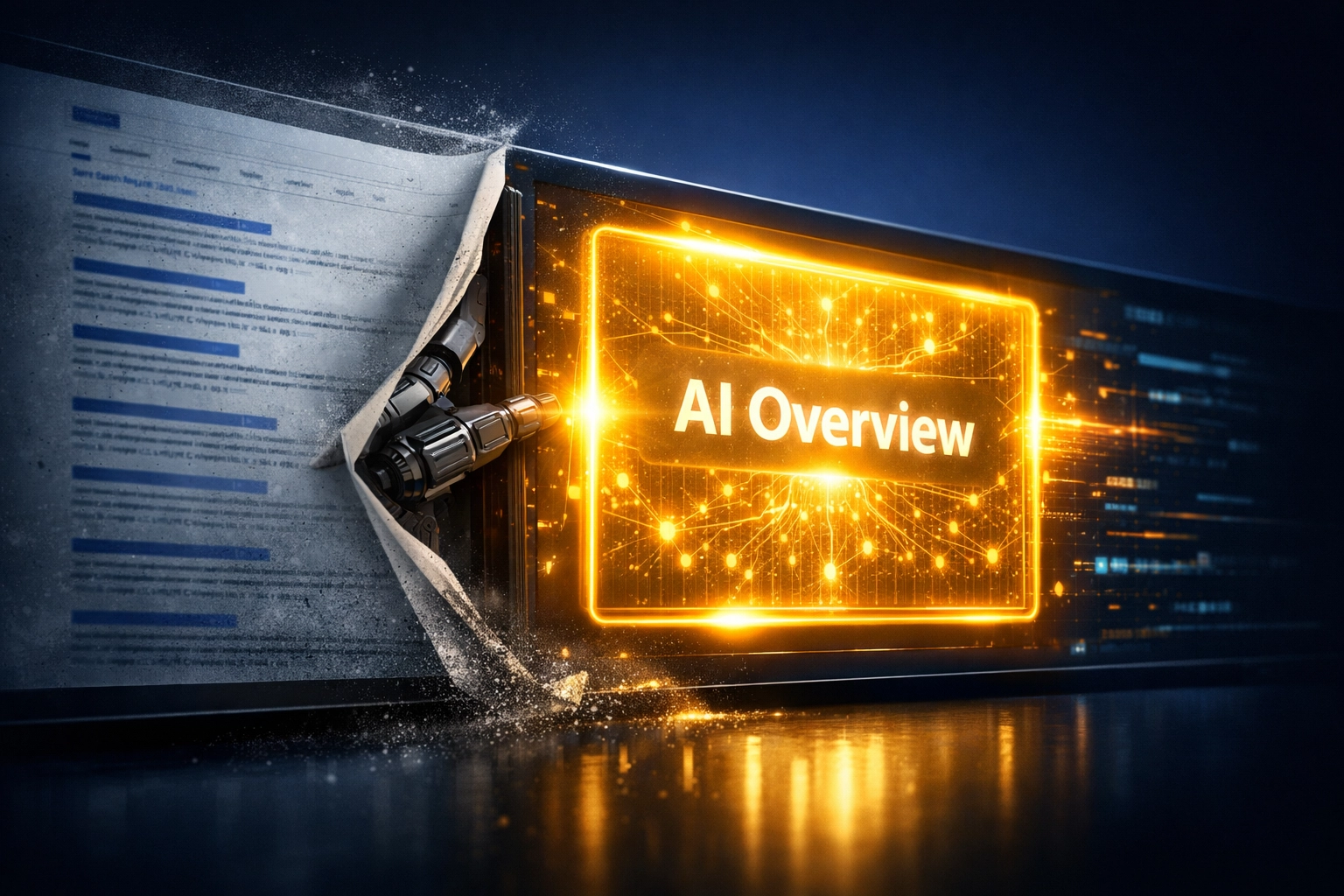
The transition to GEO isn't a theoretical trend; it’s a survival response to the latest data. According to industry analysis from February 2026, AI Overviews now appear in roughly 47% to 88% of all search queries, depending on the intent.
The impact on traditional traffic is staggering:
- Organic click-through rates (CTR) have plummeted by an average of 58%.
- Informational queries: the bread and butter of many blogs: are the hardest hit, as users receive their answers directly on the Search Engine Results Page (SERP) without ever needing to click a link.
- Zero-click searches are now the majority for most top-of-funnel queries.
However, while clicks are down, the value of an "AI Citation" is at an all-time high. Being cited as a source in a Google AI Overview or a Gemini response provides a level of brand authority that traditional SEO could never achieve. This is why we are pivoting from optimizing for algorithms to optimizing for Generative Engines.
What Exactly is GEO?
GEO is the technical discipline of structuring information so that it is easily ingestible, verifiable, and citable by an AI. Unlike traditional SEO, which focuses on keyword density and domain authority, GEO prioritizes information density, technical formatting, and factual transparency.
If traditional SEO was about talking to a search engine, GEO is about being the source material for an AI’s brain.
The Three Pillars of GEO:
- Citable Atomic Facts: Breaking content down into discrete, data-backed units that an AI can easily extract.
- Structured Semantic Formatting: Using advanced Schema 2.0 and hierarchical headers to tell the LLM exactly what the relationship between concepts is.
- Authority Verification: Providing verifiable evidence (statistics, citations, and expert consensus) that allows the AI to "trust" your content enough to repeat it.
The Technical Framework of GEO Optimization
To succeed in 2026, your content must be architected differently. Large Language Models don't read like humans; they predict tokens. To make your content more "predictable" and "valuable" for an LLM, you need to apply these technical strategies.
1. Optimizing for "In-Text" Citations
LLMs are trained to avoid hallucination. They prefer sources that provide specific numbers and citations. To optimize for this:
- Lead with Statistics: Don't say "Many people are switching to remote work." Say, "According to a 2025 Bureau of Labor study, 42% of the US workforce now operates in a hybrid or remote capacity."
- The "Claim-Evidence-Reasoning" (CER) Model: Structure your paragraphs so the AI can easily extract a fact. State a claim, provide the evidence (the data), and explain the reasoning. This makes your content the perfect "snippet" for an AI overview.
2. Information Density vs. Word Count
The old SEO advice of "writing 2,000 words for the sake of length" is dead. LLMs value information density. If you can say in 500 words what your competitor says in 2,000, the LLM will favor your content because it is a more efficient source of truth.
- Avoid Fluff: Every sentence must provide a new data point or a unique perspective.
- Use Lists and Tables: LLMs love structured data. Use Markdown tables to compare products or bulleted lists to outline steps. These are highly likely to be pulled directly into a generative response.

3. Implementing Advanced Schema for 2026
Standard "Article" or "Product" schema isn't enough anymore. You need to leverage Speakable Schema and FactCheck Schema.
- AboutContent and Mentions: Use JSON-LD to explicitly define the "entities" mentioned in your post. This helps the AI connect your content to the broader Knowledge Graph.
- FAQ Schema: This remains the single most powerful way to feed direct answers into the AI’s prompt window.
The "Authoritative Voice" and E-E-A-T
Google’s E-E-A-T (Experience, Expertise, Authoritativeness, and Trustworthiness) has evolved. In 2026, "Trust" is measured by how often your brand is mentioned across high-authority datasets.
GEO involves a "Search Everywhere" approach. If your brand is mentioned in Reddit threads, cited in Wikipedia, and discussed on specialized forums, the LLM recognizes your brand as a "Trusted Entity." This is why digital PR and community engagement are now core components of technical GEO. You aren't just building links; you are building an identity that the AI recognizes as a factual anchor.
Strategy: The "Direct Answer" Lead Paragraph
One of the most effective GEO tactics we’ve deployed this year is the Direct Answer Lead.
For every major heading in your article, the first paragraph immediately following it should be a 2-3 sentence "definition" or "summary" that directly answers the intent of that heading.
- Why? LLMs often perform "needle in a haystack" retrieval. They look for the most relevant sentence to fulfill a user's prompt. By providing a concise, data-rich summary at the top of every section, you increase the mathematical probability of being the selected source.

GEO for Startups: A Level Playing Field
The most exciting part about the shift from SEO to GEO is that it levels the playing field. In the old world, a startup could never outrank a giant like Amazon or Forbes for a high-volume keyword because they lacked the "Domain Authority."
In the GEO world, the AI is looking for the best, most relevant answer, regardless of where it comes from. If a startup provides a more current, technically accurate, and better-structured data point than a legacy giant, the AI will cite the startup.
We are seeing "GEO-first" websites bypass years of traditional SEO growth by focusing purely on becoming the most citable source in their niche.
Measuring Success in the GEO Era
If clicks are down, how do we know if we're winning? We have to change our Key Performance Indicators (KPIs).
- Generative Share of Voice (GSoV): What percentage of AI Overviews for your target keywords cite your brand?
- Brand Mention Frequency: How often is your brand named in the "Sources" or "Learn More" tabs of AI responses?
- Attributed Conversions: Tracking users who enter the site not from a generic search, but from a specific citation link within an AI response.

Final Thoughts: The Road Ahead
The transition from SEO to GEO isn't just a change in tactics; it’s a change in philosophy. We are moving away from "gaming an algorithm" and toward "contributing to a global knowledge base."
To win in 2026, you must stop thinking about how to get people to click on your site and start thinking about how to make your data indispensable to the AI. The websites that survive will be those that prioritize technical precision, data-backed claims, and structured transparency.
The "10 blue links" might be fading, but the opportunity for those who master the generative landscape has never been larger.
About the Author: Malibongwe Gcwabaza
Malibongwe Gcwabaza is the CEO of blog and youtube, a forward-thinking digital agency specializing in the intersection of AI and content strategy. With over a decade of experience in the tech sector, Malibongwe has navigated the shift from mobile-first to AI-first marketing. He is a frequent speaker at digital marketing summits and is dedicated to helping businesses leverage "GEO" to maintain visibility in an increasingly zero-click world. When he's not dissecting the latest search algorithm updates, he’s exploring the future of decentralized education and career development.

About the Author