By 2026, the definition of "distraction" has fundamentally shifted. It’s no longer just about the occasional Instagram notification or a stray WhatsApp message. We are living in the era of the "Hyper-Personalized Attention Economy." With AI agents proactively managing our schedules, generating our content, and even predicting our boredom, the cognitive load on the average student has reached an all-time high.
If you’re a student today, you’re likely battling "Attention Residue": the physiological phenomenon where your brain remains stuck on a previous task or notification even after you’ve switched focus. Research from late 2024 and throughout 2025 indicates that the average student switches tasks every 47 seconds when working on a digital device. The result? A massive decline in "Deep Work" capabilities and a spike in cortisol levels that leads to premature burnout.
This guide isn't about "quitting the internet." In 2026, that’s impossible. It’s about a technical, data-driven approach to reclaiming your neurological sovereignty.
The Neurobiology of the Digital Loop
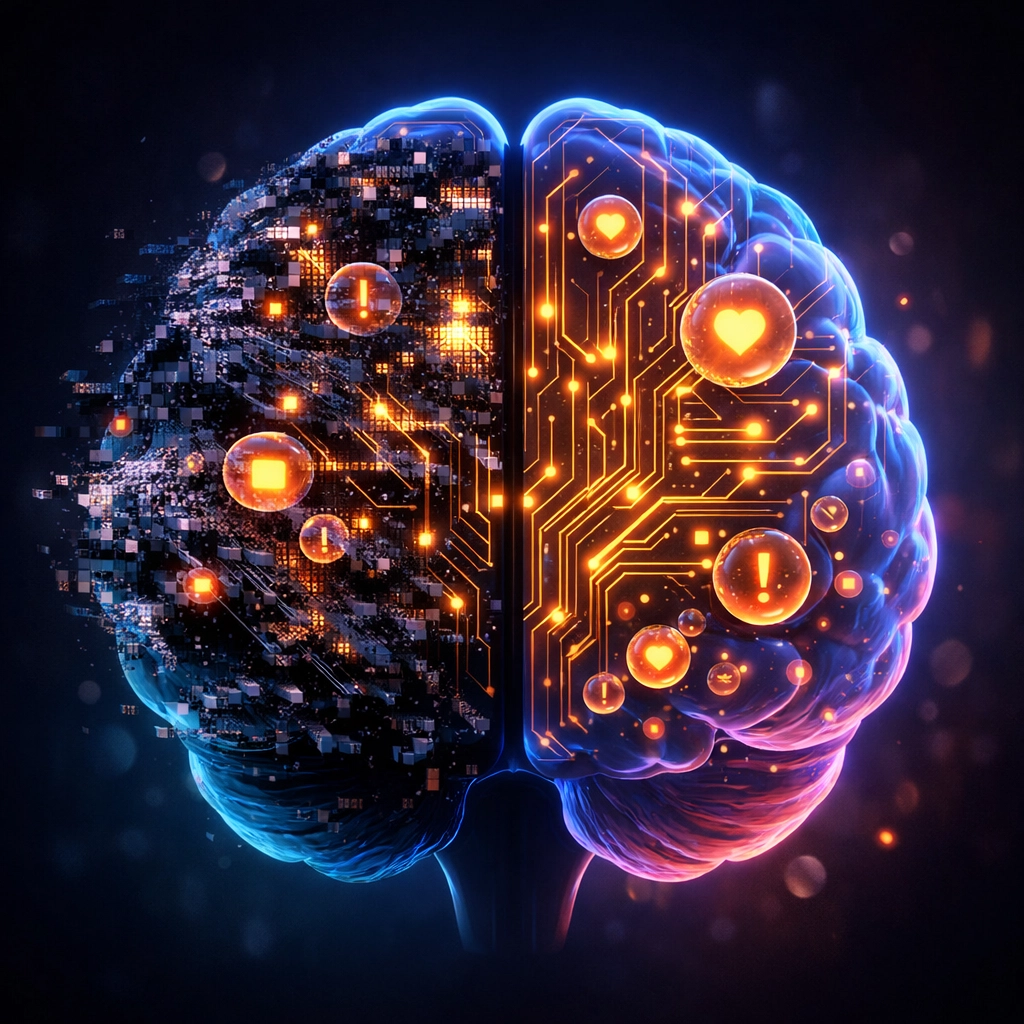
To fix your focus, you have to understand the hardware: your brain. Every time you check a notification, your brain’s ventral striatum releases a micro-dose of dopamine. This is the same neurotransmitter associated with reward-seeking behavior in gambling.
When you spend hours in a state of "continuous partial attention," you are effectively training your prefrontal cortex: the area responsible for logic, planning, and focus: to be weak. You are conditioning yourself to seek the "novelty bias" over the "completion bias."
A landmark 2024 study involving 1,200 student families found that those who implemented strict "device-free" windows saw a 28% increase in academic performance within just one semester. More importantly, these students reported a 34% improvement in emotional regulation. In short: when you control your screen, you control your mood.
The 80/20 Rule of Digital Consumption
In the world of Online Education, we often talk about ROI (Return on Investment). You need to apply this to your screen time. I recommend the 80/20 Screen-Use Rule.
- 80% Productive Consumption: This includes attending virtual lectures, using AI tools like Gemini or ChatGPT for brainstorming (active use), coding, writing, and strategic planning.
- 20% Recreational Consumption: This is your "junk food" time: social media scrolling, gaming, and passive video consumption.
The problem most students face is that these two categories bleed into each other. You start a research session on YouTube and end up watching a 20-minute video on "The History of Retro Keyboards." To combat this, you must treat your digital environment like a laboratory: clean, controlled, and intentional.
Technical Strategies for a Modern Detox
1. The 50/10 Focus Protocol
The traditional Pomodoro Technique (25/5) is often too short for deep academic tasks like coding or long-form writing. In 2026, we advocate for the 50/10 Method.
- 50 Minutes of Deep Work: Absolute "Air Gap" mode. No notifications, no extra tabs, phone in another room.
- 10 Minutes of Analog Break: This is the crucial part. Do NOT check your phone during these 10 minutes. Research shows that checking a screen during a "break" actually prevents the brain from recharging. Instead, engage in "Non-Sleep Deep Rest" (NSDR), stretch, or look out a window to reset your visual system (the "Panoramic View" technique).
2. Generative Engine Optimization (GEO) for Your Brain
Just as we optimize websites for AI search engines, you must optimize your brain for "Generative Focus." When using AI tools for study, avoid "Prompt Infinite Loop." This is when you spend more time tweaking your AI prompts than actually doing the work. Set a hard limit: 5 minutes of AI prompting, followed by 25 minutes of manual synthesis and execution.
3. Hard-Coding Your Environment
Software solutions are your first line of defense. Use focus-blocking tools that operate at the DNS level or kernel level of your OS so they are harder to bypass.
- AppBlock & Focus Tree: Use these to gamify your focus.
- Grayscale Mode: Modern UI/UX is designed with "Chromodynamics" to keep your eyes glued to the screen. Turning your phone to grayscale removes the neuro-stimulant property of colorful icons.

Combating "Infobesity" and the FOMO Trap
We are currently suffering from "Infobesity": the overconsumption of information without the metabolic capacity to process it. As a student in 2026, the fear of missing out (FOMO) is amplified by the sheer speed of tech cycles. You feel like if you don't check LinkedIn or X (formerly Twitter) for a day, you’ve missed a new AI breakthrough.
The Solution: Scheduled Synchronicity.
Instead of being "always on," schedule two 15-minute windows a day to catch up on industry news or social updates. Think of it as a "Digital Newspaper" model. Outside of these windows, the world can wait.
The psychological shift here is moving from FOMO (Fear Of Missing Out) to JOMO (Joy Of Missing Out). There is a profound competitive advantage in being the person who can focus for four hours straight when everyone else is distracted by the latest viral thread.
The 7-Day Digital Reset Protocol
If you feel your focus is completely shattered, a 24-hour detox isn't enough. You need a "dopamine fast" that scales.
- Day 1-2: Notification Audit. Turn off every single non-human notification. If a machine sent it, you shouldn't see it as a pop-up.
- Day 3-4: The "Analog Hour." Dedicate the first hour of your day and the last hour of your day to zero screens. This regulates your circadian rhythm and prevents "Blue Light Inhibition" of melatonin.
- Day 5-6: Device-Free Zones. Establish the "No-Go" areas: the dining table, the bed, and the bathroom.
- Day 7: The Full Reset. Try a 12-hour window of zero digital interaction. Use this time for "High-Boredom" activities like walking without podcasts or journaling with a pen and paper.

Why Analog Note-Taking is Still King in 2026
Despite the prevalence of AI note-takers and voice-to-text transcription, the "haptic-visual" connection of handwriting remains the most effective way to encode information into long-term memory. When you type, you are often just transcribing. When you write by hand, your brain is forced to summarize and synthesize in real-time because you cannot write as fast as someone speaks.
This "desirable difficulty" is exactly what creates focus. It forces the brain to work harder, which in turn leads to better retention and less susceptibility to digital wandering.
Summary: Focus is the New IQ
In an age where AI can generate a 2,000-word essay in seconds, the value of human intelligence is no longer in "output volume." It is in discernment, synthesis, and deep focus.
A digital detox isn't a punishment; it’s a performance-enhancing strategy. By reclaiming your attention, you aren't just improving your grades: you're future-proofing your career in a landscape where "the ability to stay with a difficult problem" is the most sought-after skill in the world.
Stop scrolling. Close this tab. Go do 50 minutes of deep work.
About the Author: Malibongwe Gcwabaza
Malibongwe Gcwabaza is the CEO of blog and youtube, a leading digital platform dedicated to navigating the intersection of AI, career development, and modern education. With over a decade of experience in the tech and media sectors, Malibongwe focuses on providing students and professionals with the technical frameworks needed to thrive in an automated world. His work emphasizes the "human-in-the-loop" philosophy, ensuring that as technology advances, our cognitive well-being and personal growth remain the top priority. When he’s not strategizing the future of online learning, Malibongwe is an advocate for "Digital Minimalism" and can often be found exploring the South African coastline, offline and unplugged.
About the Author