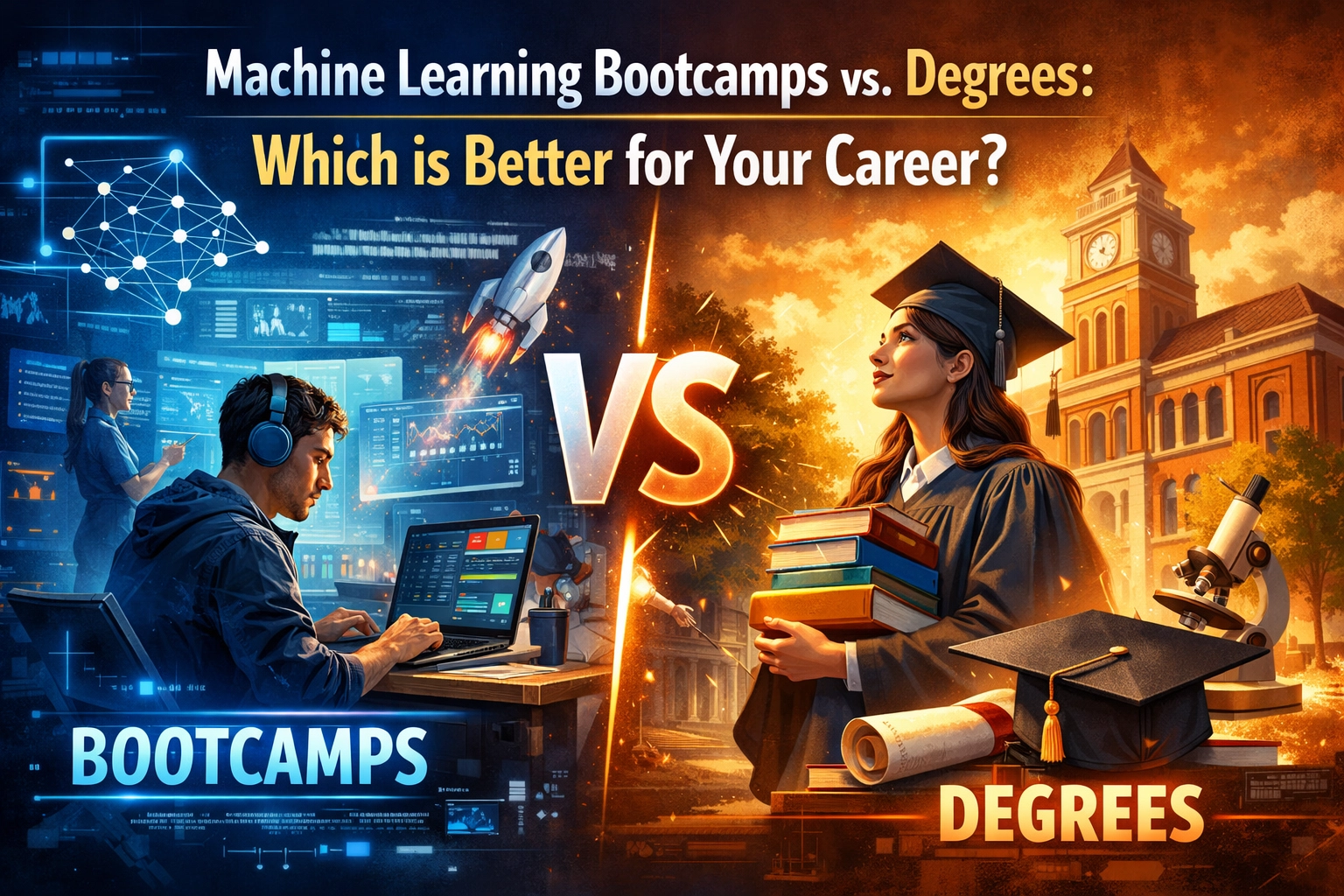
By March 2026, the landscape of Artificial Intelligence has shifted from "building models" to "orchestrating intelligence." With the maturation of Agentic AI and the commoditization of basic neural network architectures, the bar for entry into Machine Learning (ML) engineering has never been higher. If you are standing at the crossroads of your career, you’re likely asking the $50,000 question: Do I spend four years and a small fortune on a Computer Science degree, or do I grind through a 12-week intensive bootcamp?
The answer isn't a simple "yes" or "no." It depends on whether you want to be the person who uses AI tools or the person who architects them.
The 2026 Reality: The "Great Compression" of Entry-Level Tech
In the previous decade, knowing how to import scikit-learn and run a linear regression was enough to land a junior data science role. Today, LLMs (Large Language Models) and automated machine learning (AutoML) platforms handle those tasks in seconds.
Employers in 2026 are looking for "T-shaped" professionals. They need deep technical expertise in underlying mathematics and broad execution skills in cloud deployment. This shift has fundamentally changed how we value degrees versus bootcamps.
The Case for the Degree: Theoretical Depth and Research Rigor
If your goal is to work at the cutting edge: think OpenAI, DeepMind, or specialized biotech firms: the degree remains the undisputed champion.
1. The Mathematical Foundation
Machine Learning is, at its core, applied high-level mathematics. A University degree (specifically a B.S., M.S., or Ph.D. in Computer Science, Math, or Physics) provides a structured environment to master:
- Linear Algebra & Multivariable Calculus: Essential for understanding how backpropagation works in deep neural networks.
- Probability & Statistics: Necessary for Bayesian inference and understanding model uncertainty.
- Optimization Theory: The backbone of Stochastic Gradient Descent (SGD) and loss function minimization.
Bootcamps often treat these as "black boxes." In a degree program, you aren't just learning how to use a library; you are learning how to build the library from scratch.
2. The "Long-Term" Signal
A degree acts as a high-intent signal to recruiters. It proves you can commit to a rigorous, multi-year objective. In 2026, as the job market faces saturation from "prompt engineers" and surface-level practitioners, the academic degree serves as a filter for high-level R&D roles.

The Case for the Bootcamp: Speed to Market and Applied Engineering
On the flip side, the traditional education system is notoriously slow. A curriculum designed in 2022 is often obsolete by 2026. This is where bootcamps shine.
1. The Focus on the "Modern ML Stack"
While a CS student is learning about MIPS assembly language, a bootcamp student is mastering:
- MLOps (Machine Learning Operations): Using tools like Kubeflow, BentoML, and Weights & Biases to deploy and monitor models.
- Vector Databases: Mastering Pinecone or Milvus for Retrieval-Augmented Generation (RAG).
- Agentic Frameworks: Building autonomous systems using LangGraph or CrewAI.
2. Economic Efficiency (ROI)
The average ML-focused bootcamp in 2026 costs between $12,000 and $20,000 and lasts 4 to 6 months. Compared to a $150,000 private degree, the Return on Investment (ROI) can be realized much faster: provided you can bridge the theoretical gap.
Technical Breakdown: What’s Actually Inside?
| Feature | Academic Degree (CS/ML) | Professional ML Bootcamp |
|---|---|---|
| Duration | 2–4 Years | 3–6 Months |
| Cost | High ($40k – $200k) | Moderate ($10k – $20k) |
| Focus | Theory, Research, Algorithms | Deployment, Tooling, Projects |
| Math Depth | High (Calculus, Stats, Linear Algebra) | Low to Medium (Applied logic) |
| Networking | Alumni, Research Labs, Internships | Hiring Partners, Industry Mentors |

The "Invisible" Gap: Why Bootcampers Often Struggle in ML
According to 2025 industry data, 72% of employers believe bootcamp grads are ready for web development, but only 34% feel the same about machine learning engineering.
Why? Because ML failures are silent. If you write a bug in a web app, the page doesn't load. If you write a "bug" in an ML model: like data leakage or improper feature scaling: the model still runs, but its predictions are garbage. Understanding why a model is failing requires the theoretical depth typically taught in degree programs.
To succeed as a bootcamp grad in 2026, you must pursue "over-learning" in:
- Computational Complexity: Understanding O(n) notation for large-scale data processing.
- Statistical Significance: Knowing when a model's performance boost is real or just noise.
- Hardware Acceleration: Understanding the difference between CUDA kernels on a GPU versus TPU optimization.
The Hybrid Model: The 2026 Winning Strategy
The most successful candidates we see in 2026 don't choose one; they combine both. This is the "Stackable Credential" approach.
Scenario A: The Degree Holder
You have a CS degree but don't know how to deploy a model to AWS. You take a 6-week "MLOps Intensive" to gain the practical engineering skills that academia missed.
Scenario B: The Self-Taught/Bootcamper
You finished a bootcamp and can build a RAG pipeline, but you fail the technical math interview. You enroll in specialized online certifications (like those from Stanford or MIT via edX) specifically for "Mathematics for Machine Learning."

Employer Sentiment and the ATS Factor
In 2026, Applicant Tracking Systems (ATS) are driven by… you guessed it, AI. These systems are now sophisticated enough to look past keywords. They analyze your GitHub repositories for code quality and your portfolio for architectural complexity.
A degree still gets you through the door at "Big Tech" (Google, Meta, Apple). However, for mid-market firms and AI startups, a Portfolio of Verifiable Impact often outweighs a diploma. If you can show a live, deployed Agentic AI system that solves a specific business problem, the "where did you go to school" question becomes secondary.
Conclusion: Which is for You?
Choose a Degree if:
- You want to work in Research & Development (R&D).
- You are interested in the "why" more than the "how."
- You have the time and financial runway to invest in long-term foundational knowledge.
- You want to work on the hardware-software interface or novel model architectures.
Choose a Bootcamp if:
- You are pivoting from an adjacent technical field (like Software Engineering or Data Analysis).
- You are a "builder" who wants to deploy products immediately.
- You need a career change within 6–12 months.
- You are disciplined enough to study the "boring" math on your own time.
In the age of AI, the most important skill isn't the credential: it's the ability to learn faster than the models evolve. Whether you choose the ivory tower of academia or the trenches of a bootcamp, your value will be defined by your ability to solve complex, non-generic problems that an LLM can't figure out on its own.
About the Author: Malibongwe Gcwabaza
Malibongwe Gcwabaza is the CEO of blog and youtube, a leading digital media company focused on the intersection of education and emerging technology. With over a decade of experience in the tech sector, Malibongwe has navigated the shift from traditional software engineering to the AI-first economy. He is a passionate advocate for skills-based hiring and has mentored hundreds of professionals in transitioning to high-impact tech careers. When he isn't analyzing the latest Google algorithm updates, he's exploring the future of decentralized learning.
About the Author