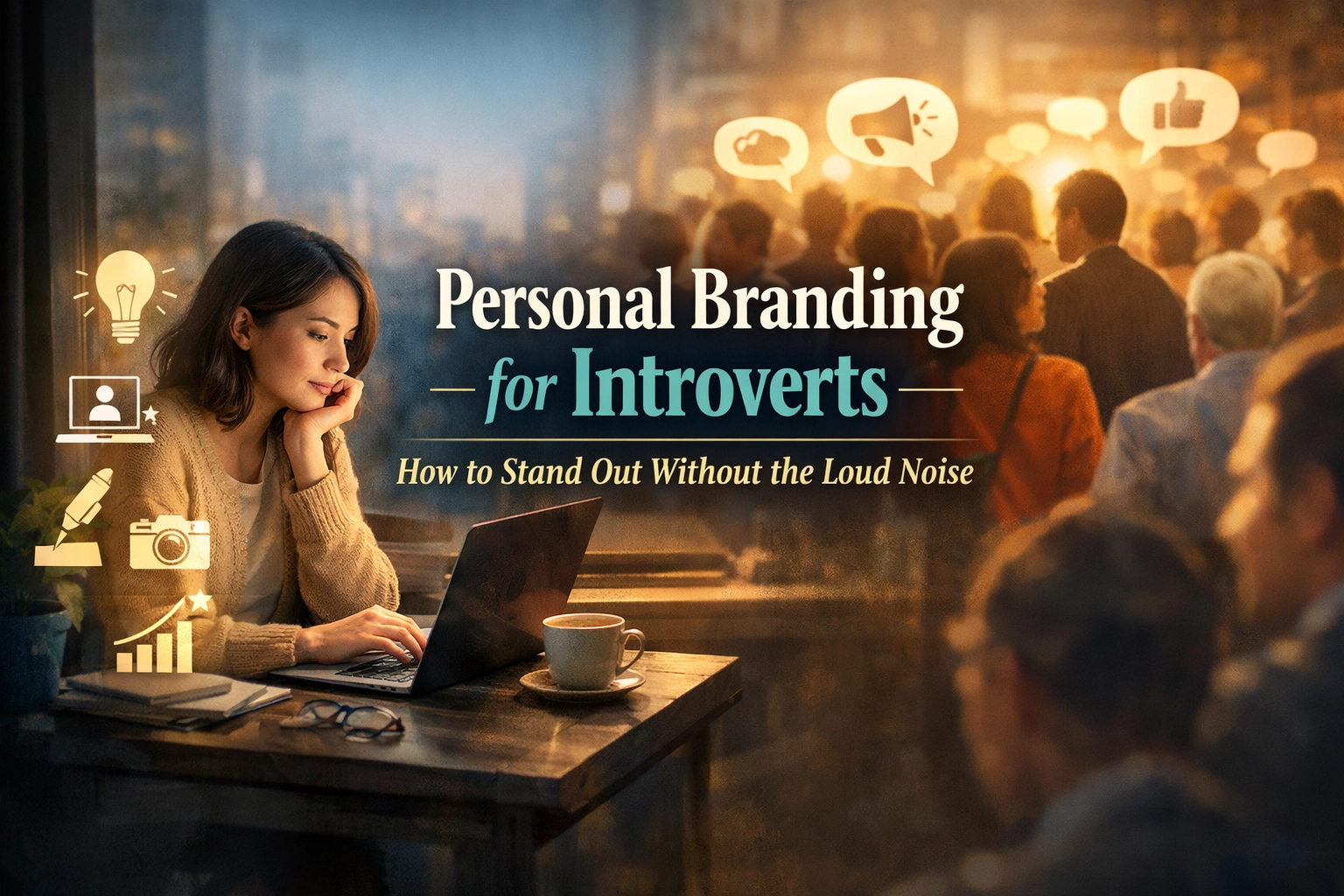
For decades, the standard blueprint for personal branding was written by extroverts, for extroverts. It favored the loudest voice in the room, the most frequent poster on social media, and the person who could work a networking event until their throat was sore. But as we move through 2026, the digital landscape has shifted.
The rise of Generative AI and the saturation of "shallow" content have created a premium on depth, nuance, and quiet authority. For introverts, this isn’t just good news: it’s a competitive advantage. Personal branding in 2026 isn't about being seen; it's about being sought out.
The Death of the "Loudness" Metric
In 2026, the metric for a successful personal brand has moved from "reach" to "resonance." According to 2025 industry data, 68% of hiring managers and high-ticket clients now prioritize "Demonstrated Deep Expertise" over "Social Influence." We are seeing the decline of the "Generalist Influencer" and the rise of the "Niche Authority."
Introverts naturally gravitate toward deep work, exhaustive research, and focused execution. While the extroverted brand might be wide and thin, the introverted brand is narrow and deep. In a world where AI can generate 1,000 generic tweets in seconds, your ability to provide a 2,000-word technical teardown or a specialized architectural solution is what makes you unreplaceable.

The "Proof of Work" Architecture
If you hate self-promotion, stop doing it. Instead, pivot to "Proof of Work" (PoW). Borrowed from blockchain and open-source communities, PoW is the practice of letting your output do the talking. For an introvert, your personal brand shouldn't be a collection of selfies; it should be a digital museum of your competence.
1. The Digital Garden vs. The Stream
Most people treat branding like a "stream": constantly pouring content into a feed that disappears in hours. For introverts, this is exhausting. Instead, build a "Digital Garden." This is a central repository (a personal blog or GitHub repository) where you publish evergreen, highly technical content.
- Why it works: You write it once, and it earns for you forever.
- The 2026 Angle: Generative Engine Optimization (GEO) favors structured, high-value data. When someone asks Gemini or ChatGPT "Who is the expert on [Your Niche]?", the AI crawls your "garden," not your ephemeral social media posts.
2. Case Study Documentation
Instead of saying "I am a great project manager," publish a detailed retrospective on a complex project you completed. Detail the tech stack, the bottlenecks, the ROI, and the failures. Technical transparency builds more trust than a polished LinkedIn headline ever could.
Async Networking: Building Bridges While Sleeping
The word "networking" often triggers a fight-or-flight response in introverts. The traditional model: happy hours and cold calls: is high-energy and low-yield. In 2026, the most effective networking is asynchronous.
Leveraging "Niche Nodes"
Rather than trying to reach everyone, identify 5-10 "Niche Nodes": influencers, CEOs, or lead engineers in your specific field.
- Strategy: Engage with their high-level content through thoughtful, technical comments. A single well-placed comment on a Substack deep-dive or a GitHub pull request can be more valuable than 500 "Nice post!" comments on LinkedIn.
- Data Insight: 2026 recruitment trends show that 42% of high-level tech placements originate from "indirect digital interactions" like forum contributions and technical community engagement.

Content Systems for Energy Management
Introverts often fail at branding because they try to mimic the "daily grind" of content creators. This leads to rapid burnout. To stand out without the loud noise, you need a system that respects your "Social Battery."
The "Hub and Spoke" Model
- The Hub: Once a month, produce one "Massive Value" piece. This could be a whitepaper, a detailed coding tutorial, or a market analysis report.
- The Spokes: Use AI tools to break that one piece into 10 smaller "micro-insights." Schedule these to go out over the next 30 days.
- The Result: You spend 4 hours in deep, solitary work (Introvert heaven) and maintain a consistent digital presence for a month without ever having to "be online" daily.
Video Without the Vulnerability
In 2026, video is still king, but you don't have to be a "vlogger."
- Screen-Share Over Selfies: Technical walkthroughs, "Build With Me" sessions, and annotated presentations allow you to showcase your brain without focusing the camera on your face.
- Voice-Over Authority: High-quality audio and a well-structured script can convey more authority than a high-energy face-to-camera video.
GEO: The New SEO for Introverts
We have moved beyond simple keyword stuffing. In 2026, Generative Engine Optimization (GEO) is the key to personal branding. AI engines like Perplexity and Gemini look for unique perspectives and authoritative data.
Introverts excel here because they tend to be more comfortable with the research-heavy side of content creation. To optimize your brand for AI search:
- Include Proprietary Data: Share your own findings or unique spreadsheets.
- Use Technical Schemas: Ensure your website uses JSON-LD schema to tell AI exactly who you are and what you know.
- Cite Sources: Linking to high-authority papers and data makes you part of the "Expertise Cluster" that AI engines trust.

The "Quiet" Brand Stack: Essential Tools for 2026
To maintain a top-tier brand without losing your mind, you need a tech stack that works in the background:
| Tool Category | Purpose | Why for Introverts? |
|---|---|---|
| Ghost / Quartz | Digital Garden / Blog | Focuses on writing and clean aesthetics over "likes" and "shares." |
| Readwise / Obsidian | Knowledge Management | Helps you connect dots between complex ideas for deep-dive posts. |
| Buffer / Taplio | Async Scheduling | Allows you to post during "high-traffic" times while you are actually offline. |
| Descript | Low-Stress Video | Edit video by editing text; perfect for those who feel awkward on camera. |
| LinkedIn Service Page | Passive Discovery | Let clients find you through search filters rather than outbound pitching. |
Managing the "Imposter Syndrome" Trap
Introverts are statistically more likely to suffer from imposter syndrome because they are acutely aware of how much they don't know. In personal branding, this leads to "The Silent Expert" syndrome: being highly qualified but completely invisible.
The Fix: Focus on contribution, not status.
Don't try to be "The Best." Try to be "The Most Helpful." When you frame your personal brand as a way to solve problems for others, the ego-driven anxiety of "self-promotion" disappears. You aren't bragging; you're providing a solution.

Conclusion: The Power of the Pause
In a noisy world, the person who pauses before speaking: and speaks with substance: is the one who gets listened to. Personal branding for introverts in 2026 is about creating a "Gravity Well." By consistently producing high-quality, technical, and thoughtful work, you create a pull that brings opportunities to you.
You don’t need a megaphone to be heard. You just need to build something worth finding.
About the Author: Malibongwe Gcwabaza
CEO of blog and youtube
Malibongwe Gcwabaza is a strategist and tech leader specializing in the intersection of AI, digital education, and career development. With over a decade of experience in navigating the evolving digital economy, Malibongwe focuses on helping professionals leverage emerging technologies to build sustainable, high-impact careers. As the CEO of "blog and youtube," he is committed to providing clear, actionable insights that cut through the noise of the modern tech landscape. Under his leadership, the company has become a primary resource for over 1 million monthly readers seeking to master the skills of tomorrow. When not analyzing market trends, Malibongwe advocates for "quiet leadership" and the power of deep-work environments.
About the Author