By March 2026, the traditional "black hole" of job applications has evolved into a sophisticated, AI-driven gatekeeper. If you’re still applying for jobs using a resume optimized for 2022 standards, you’re likely being filtered out before a human even sees your name. Modern Applicant Tracking Systems (ATS) like Workday, Greenhouse, and SAP SuccessFactors have integrated Large Language Models (LLMs) and Agentic AI to do more than just scan for keywords: they now evaluate context, skill adjacency, and "cultural fit" markers.
To land an interview today, you need to understand the technical architecture of these systems. We aren't just fighting a keyword filter anymore; we are optimizing for a reasoning engine.
The Technical Shift: From Keyword Matching to Semantic Embeddings
In the early 2020s, ATS optimization was simple: if the job description mentioned "Python," you put "Python" on your resume five times. Today, modern AI recruiters use Semantic Search and Vector Embeddings.
Instead of looking for a literal string of text, the AI converts your resume into a mathematical vector. It does the same for the job description. If your "vector" is mathematically close to the job's "vector," you get flagged as a high-potential candidate. This means the AI understands that if you list "PyTorch" and "TensorFlow," you are an expert in Deep Learning, even if the job description only mentions "Machine Learning."
Why "Keyword Stuffing" No Longer Works
Advanced ATS now have "hallucination checks" and relevance scoring. If you paste the job description in white text at the bottom of your resume (an old "hack"), modern parsers will detect the hidden text, flag it as a deceptive practice, and automatically reject your application. The goal is now Contextual Density.

1. Structuring for Machine Readability (The Parser Layer)
Before an AI can "reason" about your experience, it has to parse the data. If your resume is a visual masterpiece with dual columns, progress bars for skills, and intricate icons, the parser will likely fail.
The Problem with Dual Columns
Most LLM-based parsers read a document from left to right, top to bottom. In a dual-column layout, the AI often merges the text from both columns into a single line of gibberish.
- Human view:
- Column 1: Experience at Google.
- Column 2: Skills: Python, SQL.
- AI Parser view: "Experience at Skills: Google. Python, SQL."
This breaks the semantic relationship between your titles and your skills. Use a single-column layout.
File Formats: PDF vs. DOCX
While most modern systems claim to handle PDFs, the most reliable format for AI parsing remains .docx. Why? Because PDF "layers" can sometimes become scrambled during the OCR (Optical Character Recognition) process, especially if you used a design tool like Canva or Adobe Illustrator. If you must use PDF, ensure it is "text-searchable" and not saved as a flat image.
2. Implementing the "XYZ" Formula for AI Scoring
Google’s famous XYZ formula: "Accomplished [X] as measured by [Y], by doing [Z]": is now more important than ever because AI is trained to look for impact metrics.
When an AI scans your bullet points, it looks for high-weight verbs and quantifiable data.
- Weak (Low Score): "Managed a team of developers to build a new app."
- Strong (High Score): "Led a cross-functional team of 12 engineers (Z) to deploy a React-based fintech application, resulting in a 22% increase in user retention (Y) over six months (X)."
The second example provides "data anchors" that the AI uses to rank you against other candidates. In 2026, AI recruiters are specifically programmed to prioritize candidates who demonstrate "revenue-centric" or "efficiency-centric" outcomes.
3. Skill Adjacency and "GEO" for Resumes
Generative Engine Optimization (GEO) is the practice of optimizing content for AI models like Gemini or GPT-5. Applying this to your resume involves including Adjacent Skills.
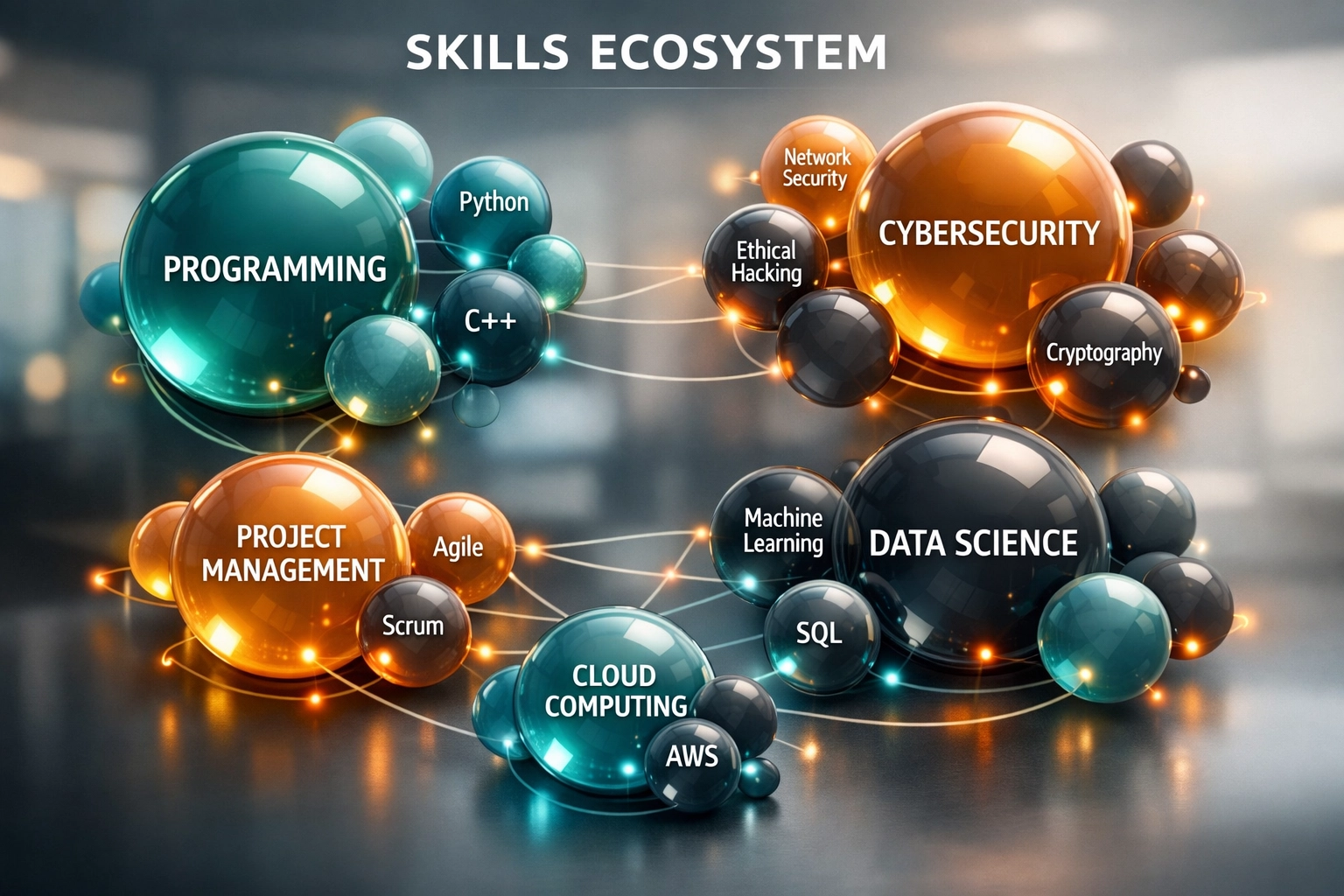
If you are applying for a Data Science role, the AI expects to see a cluster of related technologies. If you only list "Data Science" but omit "Pandas," "NumPy," "Data Cleaning," and "R," the AI’s confidence score in your profile drops.
Use the "Skills Matrix" Strategy
At the bottom or top of your resume, include a categorized skills matrix. This helps the AI's "Entity Recognition" layer quickly categorize you.
| Category | Keywords (The "Entities") |
|---|---|
| Languages | Python (Advanced), SQL, TypeScript, Go |
| Frameworks | React, Node.js, FastAPI, LangChain |
| Cloud/DevOps | AWS (EC2, S3), Docker, Kubernetes, CI/CD |
| Tools | Jira, GitHub, Postman, Weights & Biases |
4. Standardizing Job Titles and Terminology
AI loves standards. If your current company uses quirky titles like "Marketing Ninja" or "Code Wizard," you must translate these for the ATS.
The AI's training data links "Software Engineer" to a specific set of salary expectations and skill requirements. It may not have enough data on "Code Wizard" to categorize you accurately. On your resume, use: Software Engineer (Code Wizard). This keeps the AI happy while maintaining the truth of your internal title.
5. The Role of Agentic AI in 2026 Recruitment
By 2026, many companies use "Agentic" recruiters: AI agents that can actually browse your LinkedIn, check your GitHub contributions, and even watch your video introductions.
Cross-Platform Consistency
The ATS is no longer an isolated silo. It will often "cross-reference" your resume against your LinkedIn profile. If your dates of employment or job titles don't match exactly, the AI flags this as a "High-Risk Discrepancy." Ensure your digital footprint is synchronized.
Optimizing for LLM Summarization
When a human recruiter looks at the ATS dashboard, they often see an AI-generated summary of your resume. To influence this summary:
- Lead with a "Core Competency" summary: 3-4 lines of high-impact text at the top.
- Use Industry-Standard Acronyms: AI models are trained on professional corpora; they recognize "ROAS," "KPI," "SLA," and "B2B" instantly.
6. Testing Your Resume: The "LLM Prompt" Hack
Before you submit your resume, you can simulate how an AI will view it. Copy the text of your resume and the job description into a tool like ChatGPT or Gemini and use the following prompt:
"Act as a technical recruiter using a modern ATS. Analyze my resume against this job description. Provide a 'Match Percentage,' identify missing technical keywords, and flag any formatting issues that might hinder parsing. Then, summarize my profile in 3 sentences as an AI would for a human hiring manager."
This gives you a "dry run" of the automated screening process.

7. Common Pitfalls to Avoid in 2026
- Graphics and Charts: AI cannot reliably interpret a pie chart showing your "Proficiency in Java." It needs text.
- Headers and Footers: Many older parsers skip headers and footers entirely. Place your contact information in the main body of the document.
- Uncommon Fonts: Stick to "Web Safe" fonts like Arial, Calibri, or Roboto. Exotic fonts can lead to character encoding errors (e.g., the AI sees "Prgrmmr" instead of "Programmer").
- Hyperlinks: Ensure your links (LinkedIn, Portfolio) are clean. Some ATS strip out the "hidden" URL behind hyperlinked text. It’s safer to write out
linkedin.com/in/yourname.
The Future: Personal AI Job Search Agents
We are entering an era of "AI vs. AI." While companies use AI to filter you, you should be using AI to optimize. However, the "Human-in-the-loop" still makes the final hiring decision. Your goal with ATS optimization is not to "trick" the system, but to ensure that your genuine qualifications are translated into a language the machine understands.
By focusing on semantic relevance, clean formatting, and data-driven impact, you ensure that your resume doesn't just pass the filter: it rises to the top of the pile.
About the Author: Malibongwe Gcwabaza
Malibongwe Gcwabaza is the CEO of blog and youtube, a leading digital platform dedicated to bridging the gap between emerging technologies and career success. With over a decade of experience in the tech industry and a deep focus on AI integration, Malibongwe has helped thousands of professionals navigate the complexities of the modern job market. He is a frequent speaker on the future of work, AI ethics, and digital transformation, committed to making high-level career strategies accessible to everyone.
About the Author