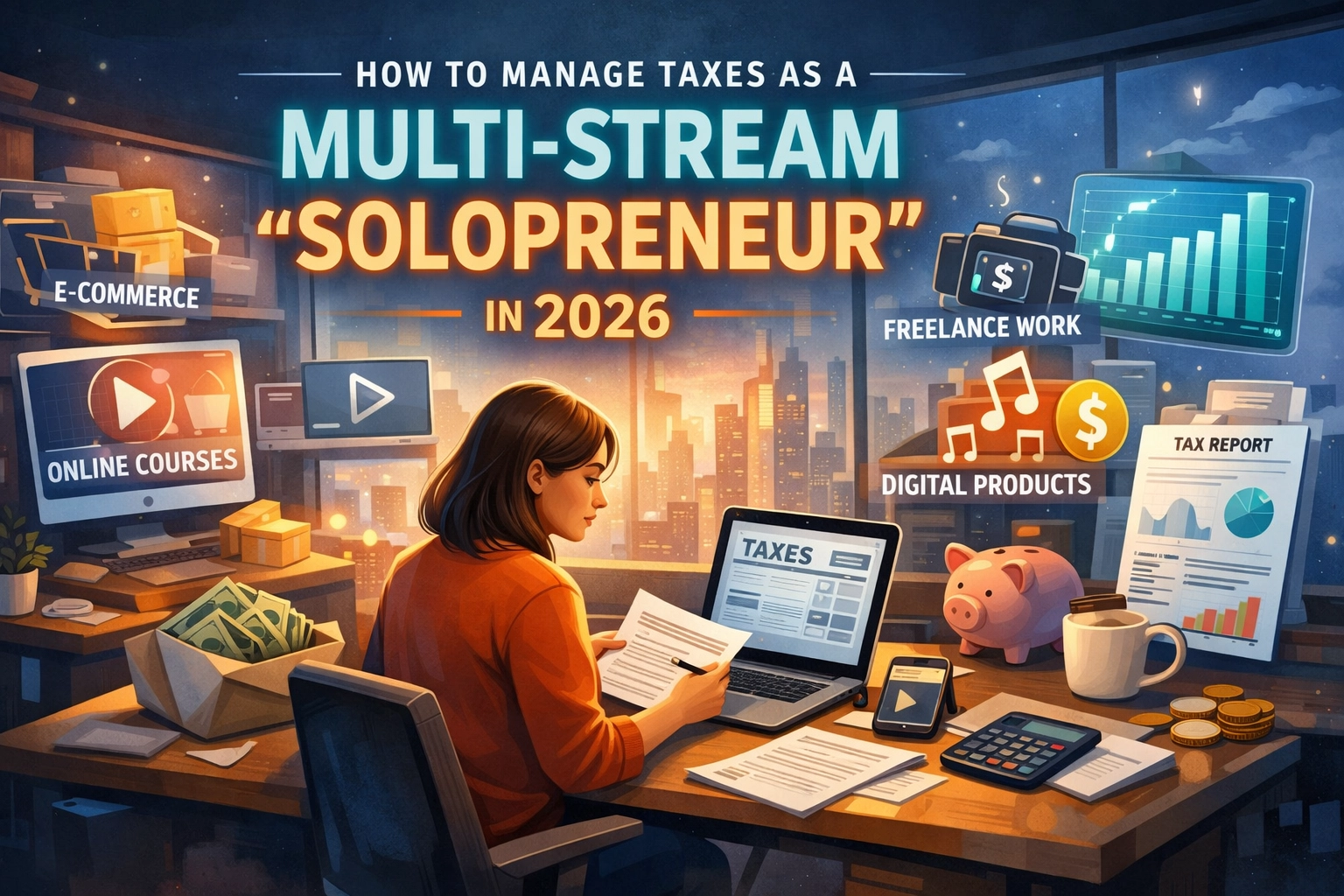
By 2026, the concept of a single "job" has largely evaporated for the modern professional. If you’re reading this, you likely have three or four different income streams: maybe a SaaS product generating MRR, a high-traffic blog monetized via AdSense, a YouTube channel, and perhaps some high-ticket consulting on the side.
While this "portfolio career" offers incredible financial freedom and resilience, it creates a logistical nightmare come tax season. In 2026, the IRS has become significantly more efficient at tracking digital payments through AI-driven auditing tools. If you aren't managing your multi-stream income with surgical precision, you aren't just leaving money on the table: you're inviting a "red flag" audit.
Here is the technical blueprint for managing your taxes as a multi-stream solopreneur in 2026.
The "One Form" Myth: Consolidating on Schedule C
A common misconception among new solopreneurs is that every different "project" requires a different tax return. Thankfully, that’s not the case. As a solo operator (specifically a single-member LLC or a sole proprietorship), the IRS views all your business activities as a single "entity" of you.
You will report all your combined business income and expenses on a single Schedule C, which is then attached to your Form 1040.
However, "consolidated reporting" does not mean "lazy accounting." In 2026, it is best practice to track each income stream independently in your bookkeeping software. If your YouTube channel is bleeding money while your consulting business is booming, you need to know that. When you file, you’ll roll them all into one net profit or loss figure. If you earned $50,000 from AdSense, $30,000 from affiliate marketing, and $40,000 from freelancing, your gross receipts for the year are $120,000.

The 2026 Self-Employment Tax Reality
For 2026, the Self-Employment (SE) tax remains at 15.3%. This is broken down into 12.4% for Social Security and 2.9% for Medicare. While 15.3% sounds manageable, remember that this is in addition to your standard income tax.
The big change for 2026 is the Social Security wage base limit, which has climbed to $184,500.
What this means for you:
- You pay the 12.4% Social Security portion only on the first $184,500 of your combined net income.
- Anything you earn above $184,500 is exempt from the 12.4% Social Security tax, though you still pay the 2.9% Medicare tax on every dollar, regardless of how much you earn.
- You can still deduct 50% of your total self-employment tax as an "above-the-line" deduction on your Form 1040, which helps lower your overall taxable income.
Quarterly Estimated Payments: The 1040-ES Workflow
If you expect to owe more than $1,000 in taxes for the year: which is almost certain if you're a successful multi-streamer: you must pay quarterly estimated taxes.
In the 2026 economy, income is volatile. One month your video goes viral and you clear $20k; the next month, an algorithm shift drops you to $4k. To avoid the dreaded underpayment penalty, use the Safe Harbor Rule: Pay at least 100% of the tax shown on your prior year’s return (or 110% if your adjusted gross income was over $150,000).
The 2026 Strategy: Don't wait for the quarterly deadlines (April, June, September, and January). Instead, set aside 25% to 30% of every single payment you receive into a high-yield "Tax Savings" bucket immediately. In 2026, many neo-banks offer automated "tax tagging" that does this for you.

Maximizing the 2026 QBI Deduction
The Qualified Business Income (QBI) deduction (Section 199A) is still one of the most powerful tools in your arsenal. It allows you to deduct up to 20% of your qualified business income from your taxes.
For 2026, keep an eye on the updated phaseout limits:
- Single filers: Phaseout begins at $70,000.
- Married filing jointly: Phaseout begins at $150,000.
If your total income is below these thresholds, you generally get the full 20% deduction. If you are a "Specified Service Trade or Business" (SSTB): which includes many consultants and professionals: your deduction starts to vanish once you cross these income levels. If you’re a content creator or e-commerce seller, you generally have more leeway.
Retirement as a Tax Shield: The 2026 SEP IRA and Solo 401(k)
As a solopreneur, your retirement account is your biggest tax-saving lever. By contributing to a SEP IRA or a Solo 401(k), you aren't just saving for the future; you're actively deleting taxable income from your 2026 return.
- SEP IRA: In 2026, you can contribute up to 25% of your net earnings, with a cap that has moved up to approximately $72,000.
- Solo 401(k): This is often the better choice for high-earning solopreneurs because it allows for both "employee" and "employer" contributions.
If you’re having a "unicorn year" with your multiple streams, maxing out these contributions can drop you into a lower tax bracket entirely.

Strategic Expense Tracking for the Multi-Streamer
Because you have multiple streams, your "office" and "equipment" are likely shared across projects. You don't need two laptops if you use one for both your blog and your consulting. However, you must be diligent about proportionate deductions.
Key 2026 Deductions to Track:
- The Home Office: In 2026, with remote work being the standard, the IRS is stricter on the "exclusive use" rule. Your home office must be your principal place of business.
- AI and Software Subscriptions: These are 100% deductible. In 2026, the average solopreneur spends $500+/month on LLM APIs, automation tools (like Make or Zapier), and specialized AI agents.
- Hardware: Using the Section 179 deduction, you can often write off the full cost of new computers or servers in the year you buy them, rather than depreciating them over five years.
- 1099-NEC Compliance: If you hire other freelancers or virtual assistants and pay them more than $600 in 2026, you must issue them a Form 1099-NEC by January 31, 2027. Failure to do this can lead to stiff penalties and the loss of the labor deduction.
When to Switch to an S-Corp Election?
As your multi-stream empire grows, you’ll eventually hit a point where a standard LLC is costing you too much in self-employment tax. This usually happens when your net profit exceeds $70,000 to $80,000.
By electing S-Corp status, you can split your income into:
- A Reasonable Salary: You pay 15.3% SE tax on this.
- Distributions: You pay income tax, but not the 15.3% SE tax on this portion.
In 2026, the IRS is using improved data analytics to flag "unreasonably low" salaries in S-Corps. Ensure your "reasonable salary" aligns with industry standards for your role.

Final Checklist for 2026 Tax Success
- Separate Business and Personal: If you are still using your personal credit card for business expenses in 2026, you are asking for an audit. Open a dedicated business account for all streams.
- Automate Your Bookkeeping: Use an AI-based accounting tool that can categorize transactions across different "tags" (e.g., Tag: YouTube, Tag: SaaS).
- Review Your QBI Eligibility: Check your total income against the $70k/$150k thresholds quarterly.
- Consult a Pro: Tax laws in 2026 are moving faster than ever. A CPA who specializes in the digital economy is worth 10x their fee.
Managing taxes across multiple income streams isn't just about compliance; it's about cash flow. By staying ahead of the 2026 regulations and maximizing your deductions, you ensure that your "portfolio career" remains a wealth-builder rather than a source of stress.
About the Author: Malibongwe Gcwabaza
Malibongwe Gcwabaza is the CEO of blog and youtube, a media firm dedicated to helping solopreneurs navigate the intersection of AI, automation, and digital finance. With over a decade of experience in the creator economy, Malibongwe focuses on technical strategies for scaling one-person businesses without the overhead of traditional corporate structures. He is a frequent speaker on the "fractional" workforce and the future of sovereign digital careers.
About the Author