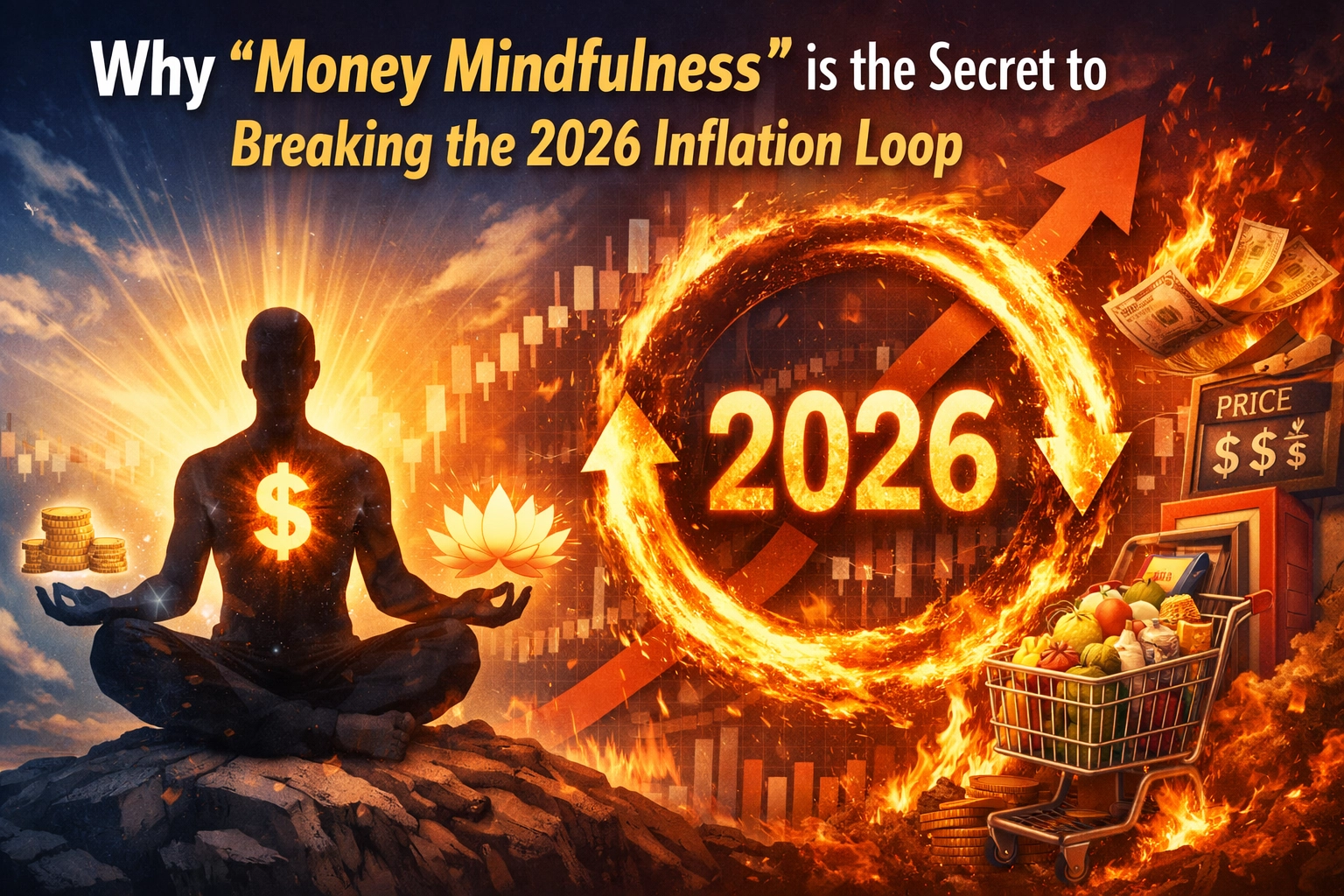
As we navigate the fiscal landscape of 2026, it’s clear that the economic "vibe shift" we’ve been feeling isn’t a temporary glitch. We are currently trapped in what economists call the 2026 Inflation Loop: a cycle driven by high energy costs, the premium on AI-managed services, and a "convenience tax" that has become invisible yet pervasive.
Traditional budgeting apps and spreadsheets aren't cutting it anymore. In an era where "Buy Now, Pay Later" (BNPL) has evolved into autonomous micro-streaming payments, the only way to protect your net worth is through a technical and psychological shift known as Money Mindfulness. This isn't just about "spending less." It’s about re-engineering your cognitive relationship with capital to break the feedback loops that keep most professionals in a state of perpetual financial anxiety.
The Architecture of the 2026 Inflation Loop
To break the loop, you have to understand its mechanics. In 2026, inflation is no longer just "the price of eggs going up." It’s driven by three specific technical factors:
- Algorithmic Pricing Elasticity: E-commerce platforms now use real-time AI to adjust prices based on your personal browsing data, urgency, and even your device's battery level. If the algorithm senses you're in a "high-need" state, you pay the premium.
- Subscription Bloat: From your coffee machine’s software updates to your AI career coach, the "as-a-service" model has colonized every corner of our lives. These small, recurring leaks are the primary drivers of 2026’s lifestyle creep.
- The Convenience Tax: We pay for time. Whether it’s 10-minute grocery delivery or AI-curated wardrobes, the technical infrastructure required to provide these services has created a permanent floor for inflation that traditional monetary policy can't touch.

What Exactly is "Money Mindfulness" in 2026?
In the previous decade, mindfulness was about meditation. In 2026, it’s a high-level financial strategy. It is the practice of maintaining a non-judgmental, real-time awareness of every capital outflow and the psychological trigger behind it.
Think of it as a "Personal Firewall" for your bank account. Instead of looking at your bank statement at the end of the month and wondering where $2,000 went, Money Mindfulness involves a "Pause-and-Audit" protocol before the transaction is even authorized.
The Technical "Pause-and-Audit" Protocol
When an AI-driven marketing engine pushes a "limited time" notification to your neural-linked device or smartphone, the mindful practitioner follows this three-step technical audit:
- The Origin Check: Is this purchase solving a biological need, a professional requirement, or an algorithmic suggestion?
- The Utility Duration: Will the value of this purchase last longer than the time it took to earn the money to pay for it?
- The Energy Cost: In 2026, every dollar represents a specific amount of your cognitive energy. Is this transaction a fair trade for your life force?
Why "Hard Skills" Budgeting is Failing
Most people try to fight 2026 inflation with "Hard Skills": better spreadsheets, more aggressive investing, or chasing high-yield "Sovereign Clouds." While these are important, they are reactive.
Data from the 2025 Global Financial Wellness Report showed that individuals who used automated budgeting tools still saw a 12% increase in impulsive spending compared to 2024. Why? Because the algorithms selling to us are smarter than the apps helping us save.
Money Mindfulness is the "Soft Skill" that outmaneuvers the AI. It focuses on Interceptive Awareness: the ability to feel the physical sensation of a "want" before it translates into a "click." By mastering this, you effectively unplug yourself from the consumerist loop that feeds the inflation cycle.

Tactical Steps to Implement Money Mindfulness
If you want to move from financial defense to financial sovereignty, you need to implement these high-leverage practices:
1. Audit Your "Digital Shadow"
Every subscription, every "follow" on social media, and every saved credit card on a retail site is a hole in your financial bucket.
- Action: Conduct a 2026 "Subscription Purge." If you haven't used a service in the last 14 days, kill the auto-renew.
- Technical Tip: Use a virtual card provider that allows you to set "one-time" limits for any new service you try.
2. Practice "Slow Finance"
The 2026 economy is built on speed. Breaking the loop requires intentional friction.
- Action: Implement a 48-hour "Cooling Period" for any non-essential purchase over $100. By the time the 48 hours are up, the dopamine hit from the advertisement has usually faded, allowing your rational mind to take over.
3. Replace "Retail Therapy" with "Value Investing"
In 2026, the cost of living is high because we seek "micro-doses" of happiness through small purchases.
- Action: Whenever you feel the urge to spend impulsively, divert that exact amount into a high-yield fractional asset or a "Green Energy" bond. This shifts your psychological reward from consuming to owning.

The Data-Driven Case for Mindfulness
A 2025 study by the Institute for Financial Cognitive Science found that practitioners of mindful spending saved an average of $850 per month on "invisible costs": things like unutilized SaaS tiers, surge pricing on deliveries, and emotional spending during high-stress work weeks.
In the context of 2026 inflation, where the cost of living has risen by a projected 4.2% globally, an $850 monthly saving isn't just "extra money." It is the difference between building a "Portfolio Career" and being trapped in a 9-to-5 just to pay for your subscriptions.
The Role of AI in Mindful Finance
Ironically, one of the best ways to practice Money Mindfulness is to use AI: but you have to use it as a shield, not a sword.
There are now "Mindfulness-First" fintech tools that don't just track your spending; they track your mood when you spend. By identifying that you tend to buy expensive tech gadgets on Thursday nights when you’re burnt out, the AI can proactively lock your "shopping" apps during those windows. This is the synthesis of technical automation and human consciousness.

Breaking the Loop: A Vision for 2027
As we look toward 2027, the gap between the "Mindful Wealthy" and the "Algorithmic Poor" will widen. Those who rely on the "system" to manage their money will find themselves constantly chasing the next inflation-adjusted raise, only to see it swallowed by the next "must-have" digital service.
By adopting Money Mindfulness today, you are doing more than just saving money. You are reclaiming your attention. You are signaling to the market that your capital cannot be manipulated by a notification or a trending hashtag. That is the ultimate secret to breaking the inflation loop: realizing that the loop only exists if you keep running in it.
Conclusion
The 2026 Inflation Loop is a technical challenge, but the solution is deeply human. Money Mindfulness allows you to navigate a high-cost world with a sense of abundance rather than scarcity. When you stop reacting to every price hike and every "limited offer," you regain the power to direct your resources toward what actually matters: your freedom, your health, and your future.
About the Author: Malibongwe Gcwabaza
CEO of blog and youtube
Malibongwe Gcwabaza is a forward-thinking entrepreneur and the CEO of blog and youtube. With over a decade of experience in digital media and financial technology, Malibongwe specializes in analyzing how emerging tech trends: from AI to decentralized finance: impact the everyday lives of professionals. He is a vocal advocate for "Financial Sovereignty" and spends his time exploring the intersection of human psychology and the digital economy. When he’s not steering the ship at blog and youtube, you can find him researching the next big shift in "Lifestyle Investing."
About the Author