By March 2026, the traditional "spray and pray" method of cold outreach hasn’t just slowed down: it has effectively been erased from the professional landscape. With Google, Microsoft, and major ISP providers implementing hyper-aggressive AI-driven spam filters, the cost of sending low-quality, automated sequences has become too high. One bad campaign can now blacklist a corporate domain in hours.
However, sales quotas haven't decreased. The pressure to generate pipeline is higher than ever. This friction has birthed a new standard in Revenue Operations (RevOps): Human-in-the-Loop (HITL) AI.
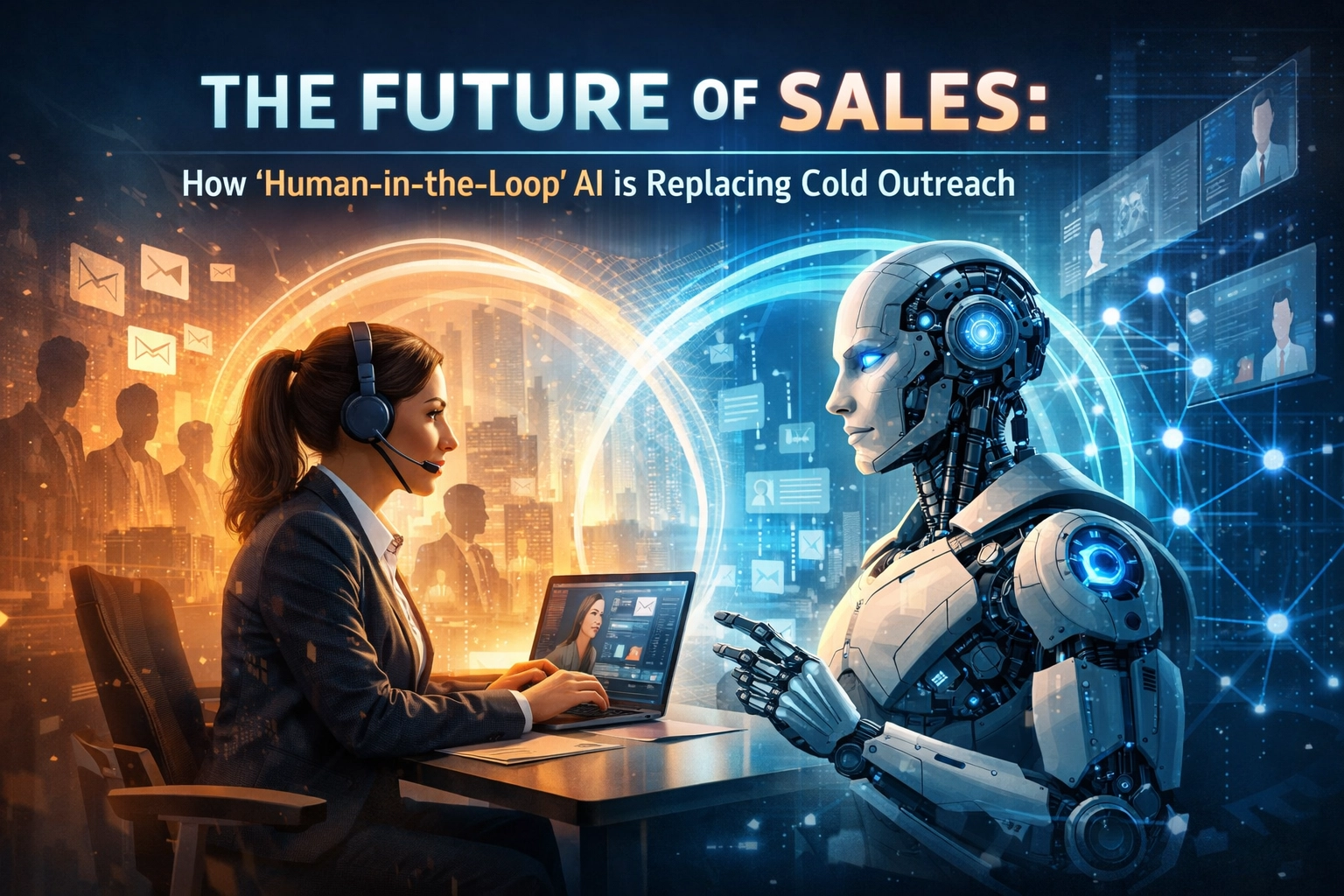
We are moving away from "automation for the sake of volume" and toward "augmentation for the sake of precision." In this new paradigm, AI handles the heavy lifting of data synthesis and initial drafting, while the human salesperson acts as the strategic editor and relationship architect. Here is how the "Human-in-the-Loop" model is fundamentally restructuring the sales floor in 2026.
The Death of the "Bot-Blast" and the Rise of Intent-Based Sales
In 2024, you could get away with using a basic LLM to personalize the first line of an email based on a prospect's LinkedIn profile. In 2026, that is considered table stakes and is often ignored by sophisticated buyers.
Modern cold outreach now relies on Agentic Workflows. Instead of a single script, sales teams use a multi-agent AI system. One agent monitors "intent signals": such as a prospect’s company hiring for a specific role, a change in their tech stack detected via job postings, or a mention of a specific pain point in a podcast transcript. A second agent then synthesizes this data into a comprehensive "brief" for the salesperson.
The human isn't writing the email from scratch; they are reviewing a draft that is already 80% accurate and contains data points a human would take hours to find. But that remaining 20%: the nuance, the cultural context, and the strategic alignment: is where the deal is won.

What is "Human-in-the-Loop" (HITL) AI?
Technically speaking, HITL is a model that requires human interaction to bridge the gap between AI output and real-world execution. In a sales context, this means the AI does not have "send" authority.
1. Data Synthesis over Data Entry
In the past, Sales Development Representatives (SDRs) spent 60% of their time in CRMs like Salesforce or HubSpot, manually updating records. Today, AI agents autonomously update records based on real-time web activity. The human's job is to validate the "Sentiment Analysis." For example, the AI might flag a prospect as "Warm," but the human, noticing a specific reorganization in the prospect’s department, might override that to "Hold" to avoid appearing tone-deaf.
2. The "Strategic Editor" Role
AI content generation tools using advanced Natural Language Processing (NLP) can draft 50 variations of a pitch in seconds. However, these tools still struggle with "brand voice" and "hallucination." A human-in-the-loop ensures that the AI hasn't promised a feature that doesn't exist or used a tone that is too aggressive for a high-value Enterprise lead.
3. Hyper-Personalization at Scale
We are seeing a shift toward "Video-in-the-Loop." AI can generate a digital twin of a salesperson to deliver a personalized video message. The HITL element involves the salesperson recording a specific 10-second "hook" that is seamlessly stitched into an AI-generated technical deep-dive. This creates a high-trust touchpoint that pure automation cannot replicate.
Why Empathy is the High-CPC Skill of 2026
From an AdSense and market value perspective, "Sales Enablement" and "AI CRM Integration" are currently some of the highest-CPC keywords. This is because companies are desperate to integrate these technologies without losing the "human touch" that drives high-ticket B2B conversions.
The data is clear: 93% of high-performing sales organizations now use AI to draft marketing and product content, but the top 1% of those organizations mandate a human review for every external communication.
Why? Because AI lacks "Strategic Intuition." An AI can tell you who to email and what to say based on historical data, but it cannot predict the "Political Will" of an organization. It doesn't know that the CEO and the VP of Sales just had a public disagreement at a conference, making a specific pitch dangerous. The human in the loop provides the safety net that prevents brand-damaging errors.

The Technical Workflow of a 2026 Sales Stack
If you are looking to optimize your sales process or build a startup in this space, the 2026 "Gold Standard" workflow looks like this:
- Autonomous Prospecting: AI agents scan 10-K filings, social media, and technical forums to identify companies experiencing specific "friction points."
- Contextual Briefing: The AI generates a "Prospect Dossier" for the human, summarizing the prospect’s recent wins, challenges, and even their preferred communication style (e.g., "Direct and data-heavy" vs. "Narrative and visionary").
- Drafting & Iteration: The AI drafts an omnichannel sequence (LinkedIn, Email, and Phone script).
- The Human "Green Light": The salesperson reviews the dossier and the drafts. They spend 2 minutes per prospect adding a "Human Variable": a reference to a shared connection or a specific, non-public insight.
- Closed-Loop Feedback: As the human edits the AI’s work, the system learns. If the salesperson consistently deletes a specific paragraph, the AI stops generating it.
Overcoming the "Uncanny Valley" in Outreach
One of the biggest risks in 2026 is the "Uncanny Valley" of sales. This happens when a prospect receives an email that looks personalized but feels "off." It’s too perfect, too robotic, or references data points in a way that feels invasive rather than helpful.
HITL AI solves this by injecting "Digital Sincerity." By having a human review the output, you ensure the message feels like it’s coming from a peer, not a script. In high-stakes B2B sales, where contract values exceed $100k, the buyer's primary filter is "Does this person actually understand my business, or are they just using a better bot than the last guy?"

The Economic Impact: Fewer SDRs, More "Account Orchestrators"
The job market is shifting. We are seeing a decline in the "entry-level SDR" role: the person who makes 100 cold calls a day. That role is being replaced by the Account Orchestrator.
This is a higher-paying, more technical role. These professionals must understand:
- Prompt Engineering: How to tell the AI to extract specific insights from a messy data set.
- Data Literacy: Identifying when an AI’s lead scoring is biased or based on outdated firmographics.
- High-Level Negotiation: Since AI handles the "opening," humans are spending more time in the "middle" and "end" of the funnel where the real complexity lies.
Conclusion: The New Alpha in Sales
The future of sales isn't AI vs. Human. It’s Human + AI vs. The Old Way.
Companies that lean too hard into pure automation will see their deliverability tank and their brand reputation suffer. Companies that ignore AI entirely will be out-competed on speed and volume. The winners in the 2026 market are the "Human-in-the-Loop" practitioners: those who use technology to handle the noise so they can focus on the one thing AI still can't do: build a genuine, high-stakes human relationship.
About the Author: Malibongwe Gcwabaza
CEO at blog and youtube
Malibongwe Gcwabaza is a forward-thinking leader in the intersection of AI and business strategy. With over a decade of experience in digital transformation and RevOps, Malibongwe focuses on how emerging technologies can enhance, rather than replace, human potential. Under his leadership, blog and youtube has become a leading voice for professionals navigating the complexities of the 2026 labor market, providing actionable insights into AI integration, high-value skill acquisition, and the future of work. When he isn't analyzing the latest in "Agentic Workflows," Malibongwe is an advocate for "Skill-Based Hiring" and democratizing access to high-tech education.
About the Author