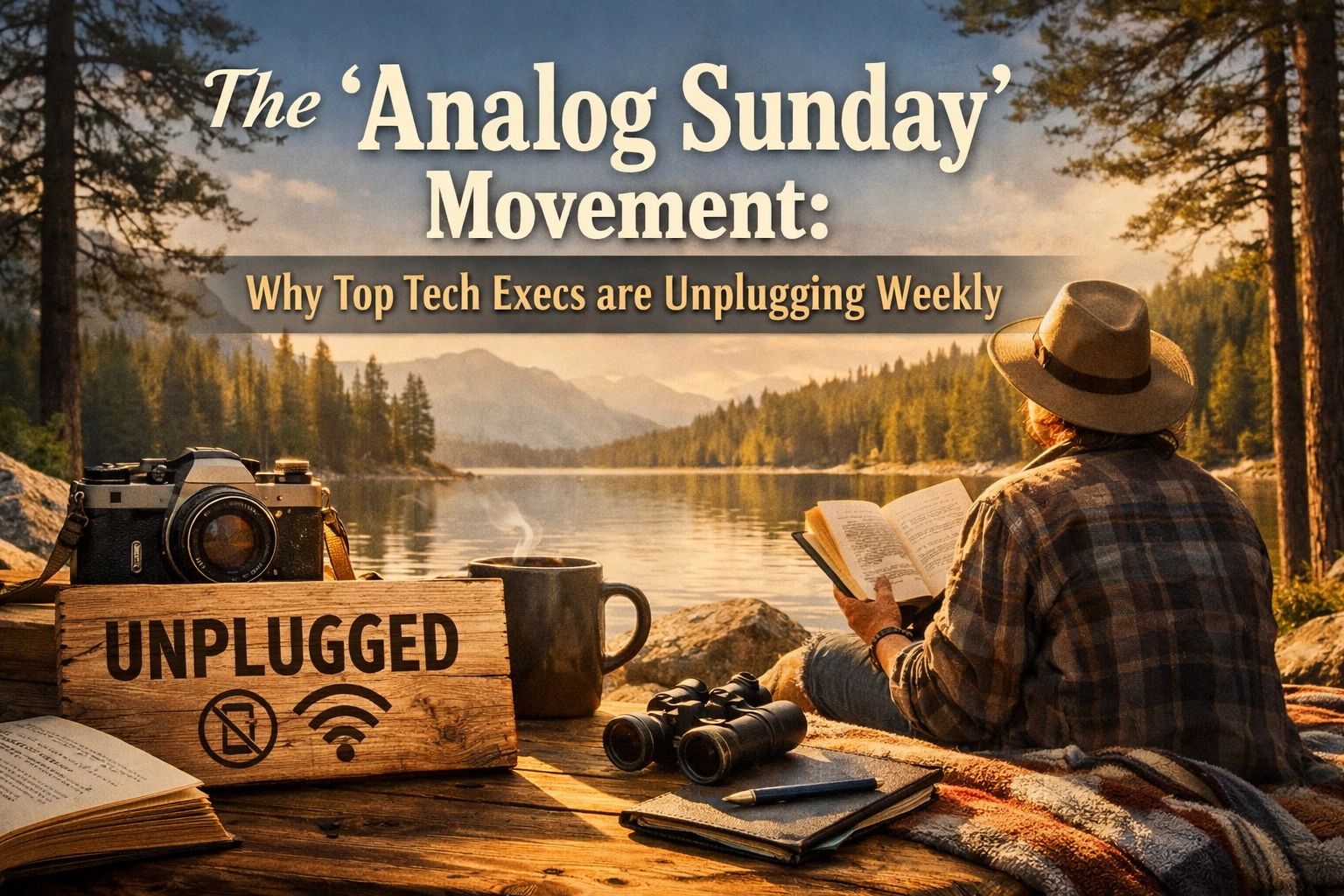
By March 2026, the digital landscape has shifted from a tool we use to an environment we inhabit. With the mainstreaming of "Agentic AI": autonomous software that manages our schedules, replies to our emails, and even negotiates our contracts: the line between "online" and "offline" has effectively vanished for the average professional. However, a counter-culture has emerged from the very epicenter of the tech world: Silicon Valley.
The "Analog Sunday" movement isn't just a trendy digital detox; it is a calculated cognitive strategy adopted by high-performing CEOs and tech architects to reclaim their neurobiology. In an era where synthetic media and constant algorithmic feedback loops dominate the workday, the most successful individuals are finding that their greatest competitive advantage is the ability to be completely unreachable for 24 hours.
The Rise of "Analog Privilege"
The concept of "Analog Privilege" has become a defining sociological term in 2026. Research suggests that while the working class is increasingly managed by invasive AI productivity trackers and algorithmic supervisors, the executive tier is using its social and economic capital to "opt out."
For a high-level creative director or a CEO like those leading the charge at OpenAI or Anthropic, the ability to turn off all connected devices is a luxury that signals status. But beyond the status symbol, there is a technical necessity. Constant connectivity leads to "cognitive fragmentation." When your brain is subjected to the rapid-fire context switching required by modern AI-integrated workflows, the prefrontal cortex: the area responsible for complex decision-making and emotional regulation: begins to show signs of fatigue similar to chronic sleep deprivation.
The Neurobiology of the "Deep Reset"
To understand why a simple 24-hour break is so effective, we have to look at the "Default Mode Network" (DMN) of the brain. The DMN is active when we are not focused on the outside world: when we are daydreaming, reflecting, or thinking about the future. This is where original ideas are born.
In a standard 2026 workweek, our DMN is constantly suppressed by "Task-Positive" triggers: notifications from our Neural-Link apps, smart-glass HUDs, and the persistent hum of the "Living Resume" updates. By enforcing an Analog Sunday, tech leaders are allowing their DMN to re-engage.
The Dopamine Baseline Shift
By Sunday morning, the average tech worker’s dopamine receptors are essentially fried. The constant hits of validation from LinkedIn's AI-curated feeds and the "ping" of closed tickets create a high baseline. Without a reset, you require more stimulation just to feel "normal," leading to burnout. An Analog Sunday forces a "dopamine fast." By removing the high-frequency rewards of the digital world, you reset your brain's sensitivity, making you sharper and more focused when you log back in on Monday morning.
The CEO Strategy: Why Silence is a Competitive Advantage
If you look at the habits of the top 1% of earners in the tech sector, you’ll notice a shift toward "Asynchronous Governance." They aren't in the Slack channels; they aren't in the Discord servers. They provide high-level "prompts" to their teams and then disappear.
The Analog Sunday is the ultimate extension of this. Here is why it works for the bottom line:
- Strategic Vision vs. Tactical Reaction: Most people spend their lives reacting to the "Red Dot" notifications. Execs use Sundays to process the week’s data without new data coming in. This leads to "Macro-Thinking": the ability to see where the market is going in six months, rather than just solving today's bug.
- Emotional Intelligence (EQ) Recovery: AI can handle the logic, but humans still handle the people. Constant tech use is proven to degrade our ability to read non-verbal cues. Tech leaders use Sundays to engage in face-to-face interactions, which sharpens the "Empathy Skill" that we’ve identified as the most valuable job skill in 2026.
- Creative Incubation: Some of the most significant breakthroughs in generative AI architecture over the last year didn't happen in front of a terminal. They happened on hiking trails in Marin County or during quiet woodworking sessions in Austin.

The Mechanics of a True Analog Sunday
An Analog Sunday in 2026 is harder to achieve than it was a decade ago. It requires more than just putting your phone in a drawer. You are likely surrounded by "Smart" devices: from your fridge to your biometric-tracking mattress.
Here is the blueprint used by the "Unplugged" elite:
1. The "Device Dead-Zone"
Most practitioners utilize a timed Faraday box. At 8:00 PM on Saturday, all wearables (watches, rings, glasses) and mobile devices are locked away. They do not come out until 8:00 AM Monday.
2. Paper-Based Navigation
If you’re leaving the house, you use a physical map or simply internalize the route beforehand. Removing GPS dependency forces the hippocampus: the brain's spatial navigation center: to work. This has been linked to a reduced risk of cognitive decline.
3. Tactical Hobbies
The goal isn't just to do nothing; it’s to do something "Tactile." This is why we see a massive resurgence in gardening, vinyl records, and film photography among the tech elite. These activities require "Slow Feedback." If you make a mistake in a woodshop, you can't hit Cmd+Z. That friction is exactly what the brain needs to stay grounded.
4. Reading Physical Media
In 2026, the distinction between AI-generated text and human-written long-form content is becoming blurred. Tech execs are returning to physical books and printed journals. The lack of hyperlinks and "Recommended for You" sidebars allows for "Deep Reading": the ability to hold a single complex argument in your head for hours at a time.

The Economic Impact: Tech-Wellness as a High-CPC Niche
For those looking at the business side of this trend, the "Analog Sunday" movement is fueling a massive new economy. We are seeing a surge in high-ticket products and services designed to facilitate this unplugged lifestyle:
- Dumb-Tech: Premium "minimalist" phones that only handle calls and texts (fetching prices of $800+).
- Analog Retrears: Luxury off-grid cabins that offer "Signal-Jammed" environments for $2,000 a weekend.
- Bio-hacking Wellness: Coaches who specialize in "Neuro-Architectural Design," helping professionals rebuild their homes to minimize EMF and blue-light exposure.
From an AdSense perspective, the keywords surrounding "Digital Detox," "Mental Health for Executives," and "High-End Wellness Retreats" are seeing record-breaking CPC (Cost-Per-Click) rates. Advertisers are desperate to reach this affluent, health-conscious demographic that is willing to pay a premium to escape the very systems they built.
Conclusion: The Future is Hybrid
The Analog Sunday movement isn't about being a Luddite or hating technology. It’s about "Digital Sovereignty." It’s the recognition that in order to be a master of the AI-driven economy, you cannot be a slave to its delivery mechanisms.
As we move further into 2026, the people who will lead the world are those who know how to use AI to its fullest on Monday through Saturday, but who have the discipline to be completely, beautifully human on Sunday.

About the Author: Malibongwe Gcwabaza
Malibongwe Gcwabaza is the CEO of blog and youtube and a leading voice in the "Tech-Humanism" movement. With over 15 years of experience in digital architecture and executive coaching, Malibongwe focuses on the intersection of high-growth technology and human cognitive performance. He advocates for a "Hybrid Life," where AI serves as a tool for liberation rather than a tether for burnout. When he’s not strategizing the next big move for the company, you can find him offline, tending to his organic garden or reading mid-20th-century philosophy.
About the Author