By March 2026, the global workforce has undergone a seismic shift. We’ve moved past the initial "AI will take our jobs" panic and settled into a reality where agentic workflows, autonomous LLMs, and synthetic employees handle roughly 60% of routine administrative and analytical tasks. In this landscape, a strange paradox has emerged: as technical skills become increasingly commoditized by high-functioning AI, the most profitable skill a professional can possess isn't Python or prompt engineering: it’s empathy.
The "Human Premium" is the defining economic trend of 2026. When software can write better code than a junior developer and AI diagnostic tools outperform general practitioners in pattern recognition, the value of a human worker shifts from output to connection. Empathy is no longer a "soft skill" relegated to HR seminars; it is a hard economic asset that drives customer lifetime value, employee retention, and ethical risk management.
The Economic Shift: From Information to Intuition
In the early 2020s, data was the new oil. By 2026, data is a utility, as accessible and cheap as electricity. AI models can process petabytes of information to predict market trends or optimize supply chains in milliseconds. However, these models still struggle with what sociologists call "thick description": the ability to understand the underlying cultural, emotional, and irrational motivations behind human behavior.
This is where the Empathy ROI comes into play. Businesses are realizing that while AI can maximize efficiency, it cannot build loyalty. A 2025 study on consumer behavior showed that 82% of customers preferred interacting with brands that demonstrated genuine human understanding during high-stakes conflict resolution, even if the resolution took longer than an automated response.
For professionals, this means the highest-paying roles are moving toward "high-touch" sectors. Wealth management, specialized healthcare, and complex B2B sales are seeing a massive surge in compensation for individuals who can navigate the nuanced emotional waters that AI simply cannot feel.

Why AI Can’t "Fake It Until It Makes It"
Large Language Models in 2026 are incredibly convincing. They can mirror tone, use sentiment analysis to pivot their responses, and even simulate "vulnerability" to build rapport. But there is a fundamental "Uncanny Valley" of emotional intelligence.
AI operates on statistical probability. It predicts the most likely empathetic response based on a training set. Human empathy, however, is rooted in shared biological experience and mirror neurons. When a leader sits across from an employee struggling with burnout, the empathy expressed isn't just a sequence of "correct" words; it’s a physical and psychological resonance.
In 2026, we’ve seen the rise of "Authenticity Audits." Companies are finding that when they use AI to deliver sensitive news: like layoffs or performance reviews: the long-term damage to the organizational culture is catastrophic. Empathy is the glue that keeps teams functional when the "black box" of AI makes a decision that humans find cold or illogical.
The Role of the "Empathy Interpreter"
As organizations integrate multi-agent AI systems, a new high-paying role has emerged: the Empathy Interpreter. These are professionals who act as the bridge between cold algorithmic outputs and human stakeholders.
Consider a 2026 hospital setting. An AI diagnostic agent might identify a terminal condition with 99.9% accuracy. The "technical" job is done. However, the valuable job: the one that requires advanced training and commands a high salary: is the clinician who can synthesize that data and deliver it with the nuance, timing, and emotional support that a screen cannot provide.
This applies to the corporate world as well. Strategic consultants are now less focused on "crunching the numbers" (which AI does for them) and more focused on "organizational alignment." They spend their time understanding the hidden fears of a C-suite team or the cultural friction of a merger. These are problems that don't have a "data-driven" solution; they have a "human-driven" solution.

Leadership in the Age of Agentic Workforces
The definition of leadership has been rewritten. In 2026, a manager’s job isn't to oversee tasks: AI project managers like "AutoPM" handle the Trello boards and the deadlines. A leader's job is to manage the energy and emotional health of their human talent.
Data from the 2026 Global Talent Report suggests that the #1 reason top-tier talent leaves a company isn't salary (which has largely stabilized due to remote global competition) but a lack of "Empathetic Connection." In a world where you can work for any company from a VR headset in your living room, the only thing keeping you at a specific firm is how valued and understood you feel.
Leaders who master "Radical Empathy": the ability to proactively sense and address the needs of their team: are seeing 40% higher retention rates than those who rely on metrics alone. This is driving a massive investment in EQ (Emotional Quotient) training across the Fortune 500.
Empathy as Ethical Oversight
One of the most technical applications of empathy in 2026 is in the realm of AI Ethics. As we rely more on automated decision-making for everything from mortgage approvals to parole hearings, the risk of "Algorithmic Cruelty" has spiked.
Empathetic oversight is the process of human-in-the-loop review where professionals look at AI decisions through a lens of human impact rather than just statistical fairness. This requires a deep, visceral understanding of systemic bias and the lived experiences of marginalized groups.
Career paths like "AI Bias Arbitrator" or "Ethical Impact Assessor" are now among the fastest-growing niches in tech. These roles require a background that combines data literacy with deep psychological and sociological expertise.

How to Scale Your "Empathy Skill" for 2026
If you want to future-proof your career, you need to treat empathy as a muscle that requires deliberate practice. Here are three concrete ways to build your empathy advantage:
- Active Listening 2.0: In a world of digital noise, the ability to give someone 100% of your undistracted attention is a superpower. Practice "reflective listening": summarizing not just the words someone said, but the emotion behind them.
- Cross-Disciplinary Exposure: Empathy grows through perspective. Spend time studying fields outside of your own: history, literature, and psychology. Understanding the "human story" helps you predict human reactions in a way that training data cannot.
- Conflict De-escalation: AI is notoriously bad at handling angry or irrational humans. Master the art of de-escalation. Learn how to validate someone’s feelings without necessarily agreeing with their logic. This skill is gold in management and high-end client relations.
The Future is "Cyborg Empathy"
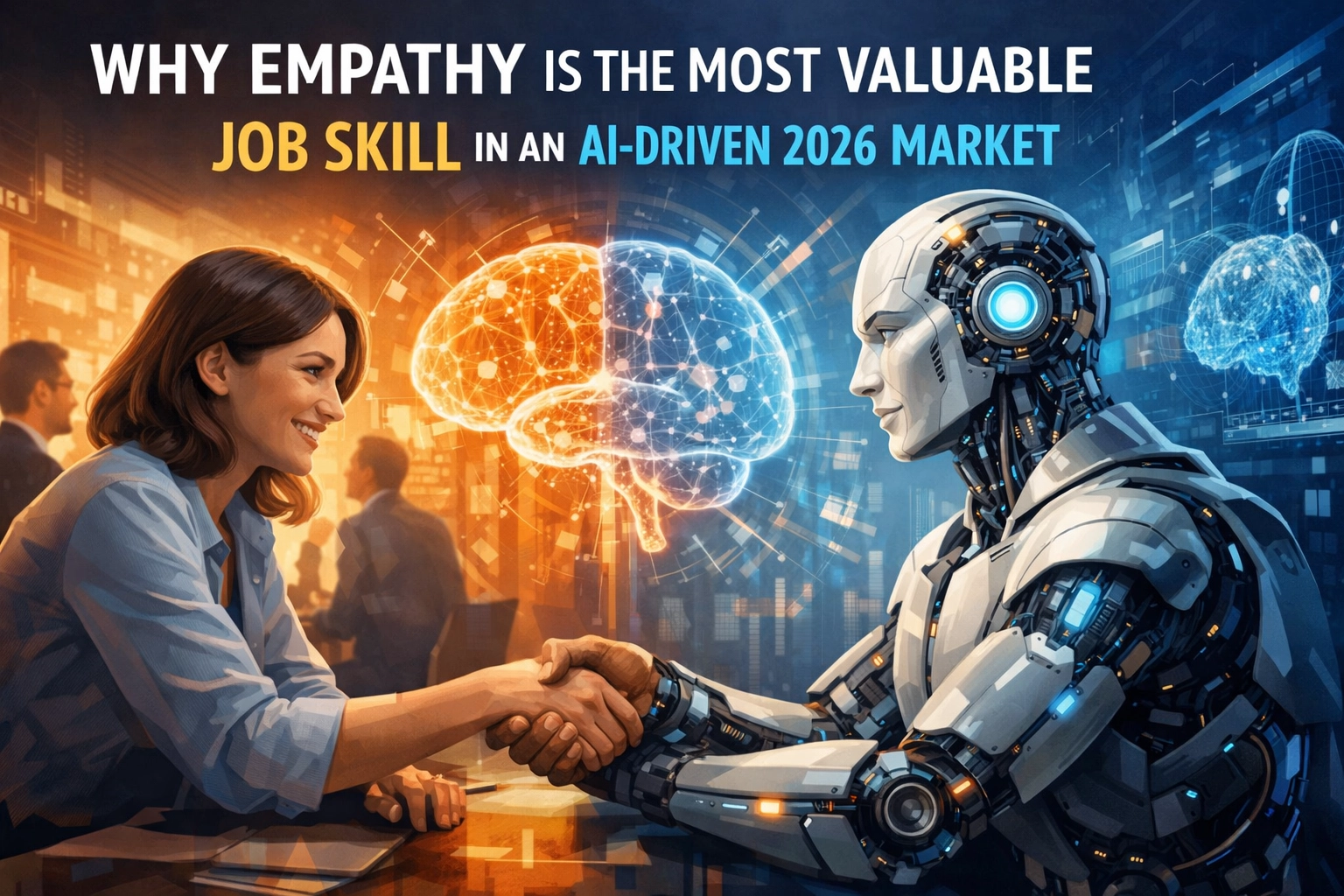
We aren't moving toward a world where it’s Humans vs. AI. We are moving toward a world of "Cyborg Empathy," where human professionals use AI to handle the "thinking" so they can focus entirely on the "feeling."
Imagine a customer service rep who has an AI whispering real-time data about a customer’s history and preferences into their ear, allowing the rep to focus 100% on the tone of the customer’s voice and the best way to reassure them. This synergy is where the most successful businesses of 2026 are winning.
Efficiency is the baseline. Empathy is the differentiator. As we continue to automate the cognitive, the emotional becomes our most valuable currency.
About the Author: Malibongwe Gcwabaza
CEO of blog and youtube
Malibongwe Gcwabaza is a forward-thinking leader at the intersection of technology and human potential. With over a decade of experience in digital media and strategic consulting, he focuses on how emerging technologies like AI can be harnessed to enhance: rather than replace: the human experience. Under his leadership, blog and youtube has become a premier destination for professionals looking to navigate the complexities of the 2026 economy with clarity and purpose. When he's not analyzing market trends, Malibongwe is an advocate for "Tech-Wellness" and the preservation of human-centric workplace cultures.
About the Author