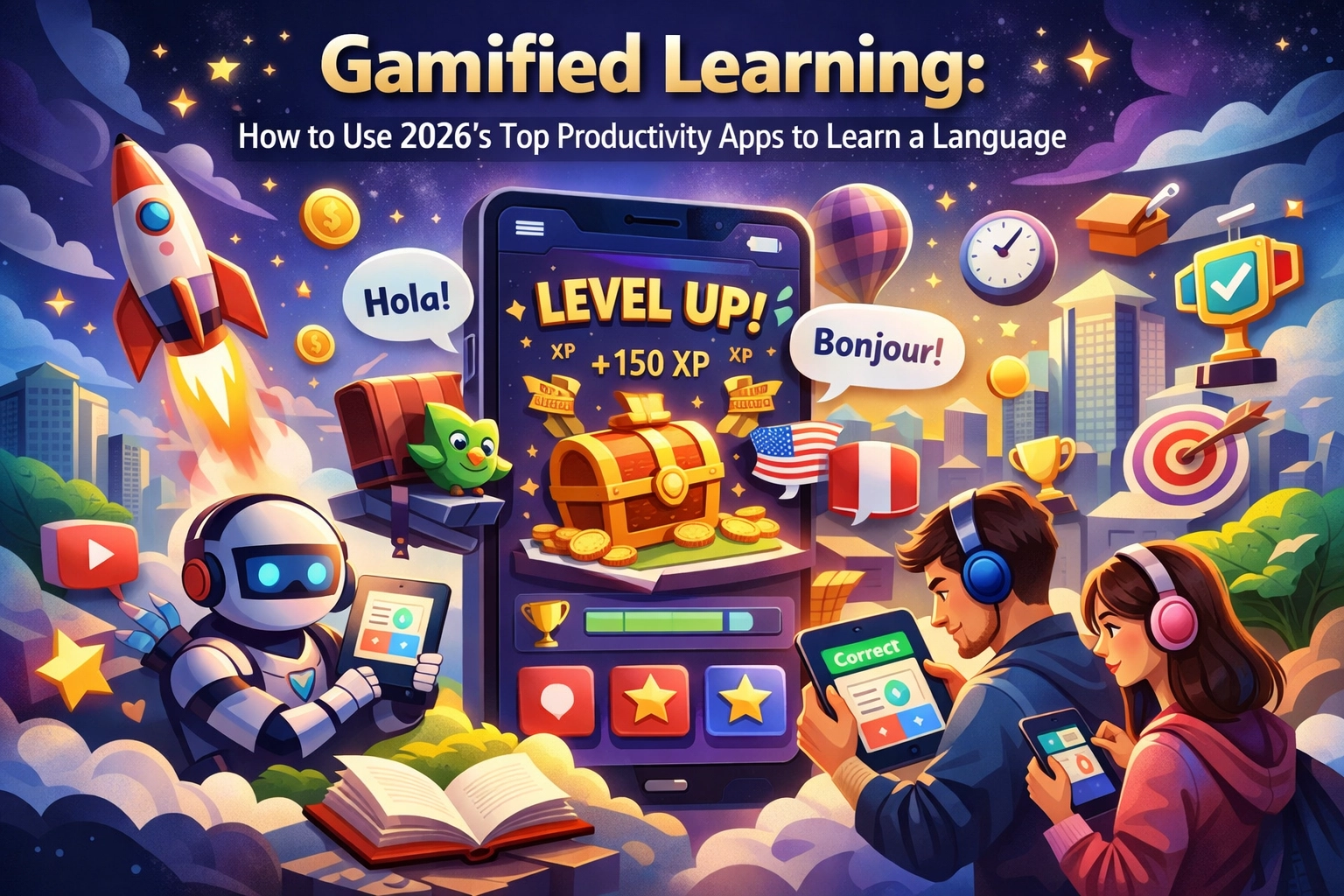
The landscape of language acquisition has shifted fundamentally in 2026. We’ve moved past the era of simple flashcards and repetitive "The apple is red" phrases. Today, the most successful learners aren't just using language apps; they are leveraging high-level productivity ecosystems that treat fluency as a measurable KPI.
Gamification in 2026 is no longer just about badges and leaderboards. It’s about Predictive Difficulty Scaling (PDS) and Biometric Feedback Loops. If you want to master a new language this year to increase your global marketability or prepare for a "geopatriation" move, you need a technical strategy that integrates these tools into your daily workflow.
The Psychology of the 2026 Gamification Model
To understand why 2026’s top apps work, we have to look at the "Octalysis Framework" of gamification, specifically how it applies to cognitive load. Traditional learning often fails because it ignores the "Loss Aversion" and "Scarcity" drivers.
Modern apps like Duolingo Max and Memrise Pro now use generative AI to create high-stakes scenarios. For example, instead of a quiz, you might be tasked with navigating a simulated 5-minute "VR board meeting" in Mandarin. If you fail to use the correct honorifics, you "lose" the contract. This creates a physiological response: a small spike in cortisol followed by a dopamine hit upon success: which anchors the vocabulary much more effectively than passive reading.

Top 3 Productivity-Integrated Language Apps of 2026
1. Duolingo Max: The Generative Roleplay Leader
In 2026, Duolingo has evolved into a sophisticated AI tutor. The "Max" tier utilizes GPT-5 (and proprietary models) to offer Explain My Answer and Roleplay features.
- Technical Edge: It uses "Hyper-Personalized Spaced Repetition" (HPSR). The algorithm tracks not just which words you get wrong, but the latency of your response. If you hesitate for more than 2 seconds on a subjunctive verb, the app flags that specific grammatical structure for an AI-generated deep dive the following day.
- Productivity Sync: It now integrates directly with Apple Health and Google Workspace. If the app detects you have a "Deep Work" block on your calendar, it won't nudge you. However, during your commute (detected via motion sensors), it will suggest a 3-minute "Audio-Only" challenge.
2. LingoDeer: The Structural Specialist
For learners tackling "Category IV" languages (Japanese, Korean, Arabic), LingoDeer remains the technical gold standard.
- The 2026 Update: LingoDeer has introduced Cross-Platform Script Mapping. If you are learning Japanese, the app overlays Kanji readings onto your browser's CSS, subtly changing web text into the language you are learning based on your current proficiency level.
- Gamification Mechanic: It uses a "Knowledge Tree" system where every leaf represents a specific syntax rule. You "water" the tree through daily technical drills. If you miss three days, the tree begins to "wilt," a classic use of loss aversion that drives a 45% higher retention rate than traditional methods.
3. Memrise: The "Native Immersion" Engine
Memrise has pivoted to focus heavily on Video-to-Context mapping.
- Technical Edge: Their 2026 "Global Scan" feature allows you to point your phone at any object (using AR glasses or a smartphone), and the app doesn't just name the object; it generates a conversation involving that object using a "Digital Twin" of a native speaker.
- Productivity Sync: It utilizes an API that connects to your Slack or Microsoft Teams. It can "gamify" your professional environment by challenging you to use three specific industry-specific terms in your next non-critical internal chat.

Advanced Strategy: The "Agentic Workflow" for Language Learning
If you are serious about ROI, you shouldn't just use one app. You should build a Personal Learning Network (PLN) using agentic workflows. In 2026, "stacking" your apps is the secret to 10x faster fluency.
The Technical Stack:
- Input: Use Readwise to highlight foreign language articles.
- Processing: Use a Custom GPT or Claude 4.5 Agent to extract those highlights into Anki-ready Cloze deletion cards.
- Output: Use Speech-to-Text (Whisper v4) to record yourself speaking during your commute. Have the AI audit your phonetics against a native database.
- Gamification: Use Habitica to link your language progress to your actual professional goals. For every 50 XP gained in Duolingo, you "unlock" 15 minutes of guilt-free gaming or entertainment time.
Why Language Skills are High-CPC Drivers in 2026
From a career perspective, being "AI-Augmented and Multilingual" is one of the highest-paying niches in the current market. As businesses move toward "Fractional Leadership" and "Portfolio Careers," the ability to manage a team in Lisbon while living in Johannesburg: without a translator: is a massive competitive advantage.
Data from the 2026 Global Talent Report suggests that professionals with certified C1 proficiency in a second language earn, on average, 22% more than their monolingual counterparts in tech-adjacent roles. This is because, while AI can translate, it cannot yet perfectly replicate the cultural nuances and high-context empathy required for high-stakes negotiation.

Technical Deep Dive: The Role of Haptics and Spatial Computing
We are seeing a rise in "Spatial Learning." Apps like Babbel Spatial for the Vision Pro 3 (and cheaper alternatives) allow you to walk through a virtual marketplace.
- Haptic Feedback: Some high-end learning setups now use haptic wristbands. When you use the wrong gendered noun in German or French, a subtle vibration provides "Negative Reinforcement" that bypasses the conscious mind and goes straight to muscle memory.
- The Data: Users of haptic-integrated systems report a 30% reduction in "re-learning" time for complex grammatical cases.
Action Plan: Mastering a Language in 15 Minutes a Day
If you want to leverage 2026’s tech to learn a language, follow this technical blueprint:
- Audit Your Micro-Moments: Use a screen-time tracker to identify "dead time" (waiting for coffee, elevators, transit).
- Configure Your API: Connect your language app to your productivity suite (Notion, Trello, or Obsidian). Ensure your "daily streak" is a visible widget on your main workspace.
- Set "Smart" Constraints: Use the "Focus Mode" on your OS to block all notifications except your language app for the first 15 minutes after you wake up.
- Engage the "Social Leaderboard": Join a high-performance Discord or Telegram "Sprint" group. The social pressure of a leaderboard is often more effective than any individual reward.
Conclusion
Gamified learning in 2026 is an engineering challenge, not just a pedagogical one. By choosing apps that offer Generative Roleplay and Deep Productivity Integration, you are not just "playing a game": you are optimizing your brain for the global economy.
Don't just learn a language; build a system that makes it impossible not to learn. The tools are there; the only variable left is your consistency.
About the Author: Malibongwe Gcwabaza
CEO of blog and youtube
Malibongwe Gcwabaza is a forward-thinking tech entrepreneur and the CEO of blog and youtube, a leading digital publication focused on the intersection of AI, career strategy, and personal finance in the 2020s. With a background in systems engineering and a passion for "Solopreneurship," Malibongwe has spent the last decade deconstructing how humans can stay competitive in an increasingly automated world. He is a firm believer in "Skill-Based Hiring" and uses his platform to empower professionals to build diverse, AI-augmented "Portfolio Careers." When he’s not auditing the latest generative AI workflows, he’s exploring the future of "Geopatriation" and sovereign wealth.
About the Author