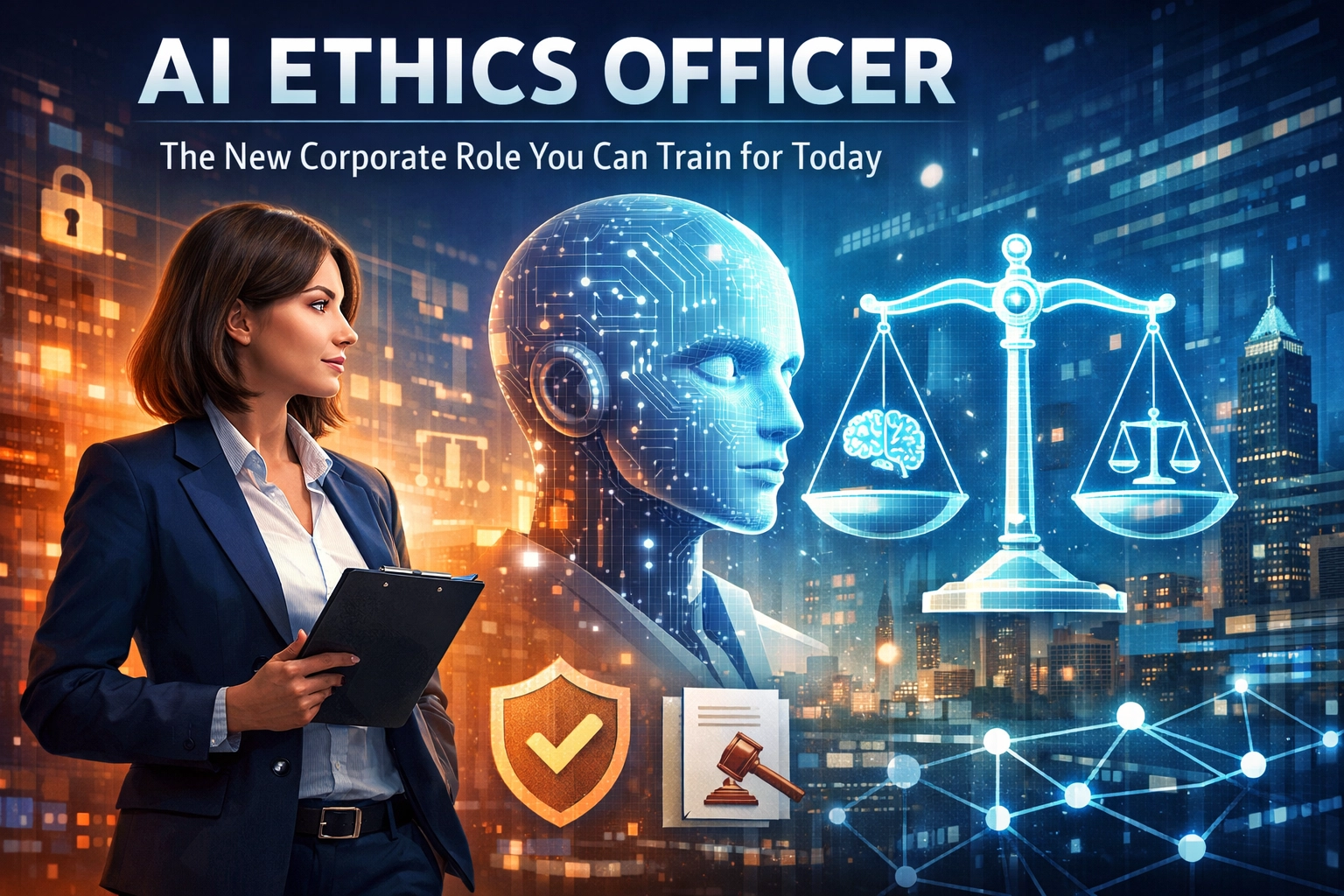
By mid-2026, the novelty of "chatting" with AI has officially worn off. We’ve moved into the era of Agentic Workflows, where AI isn't just a chatbot; it's a co-worker with its own API keys and decision-making power. But as companies hand over the keys to autonomous systems, a terrifying question has emerged in boardrooms from Johannesburg to Silicon Valley: Who is responsible when the machine makes a billion-dollar mistake?
Enter the AI Ethics Officer (AEO).
Two years ago, this sounded like a niche role for philosophy majors. Today, it is one of the highest-paying, most critical positions in the corporate world. If you’re looking to future-proof your career, this isn't just a job title: it’s a gold mine. Here is why the AI Ethics Officer is the breakout career of 2026 and how you can position yourself for it right now.
The 2026 Regulatory Cliff: Why Companies are Panicking
The demand for AI Ethics Officers didn't happen by accident. It was forced by a "perfect storm" of regulation and litigation. By early 2026, the EU AI Act has moved from a roadmap to a hammer, imposing fines of up to 7% of global turnover for non-compliant systems.
In the United States and South Africa, new "Algorithmic Transparency" laws now require companies to explain exactly why an AI denied a loan, rejected a resume, or flagged a medical claim. Without an AEO, companies are flying blind, risking massive lawsuits and brand-killing PR disasters.
The "move fast and break things" era of AI is dead. The "move fast and stay compliant" era has begun.

What Does an AI Ethics Officer Actually Do?
Don't mistake this for a "soft" HR role. The modern AI Ethics Officer sits at the intersection of Data Science, Law, and Product Strategy. Their daily tasks involve more than just writing "Value Statements." They are deeply embedded in the technical pipeline.
1. Algorithmic Bias Auditing
AEOs work with data engineers to ensure that training sets aren't perpetuating old-world biases. For example, if a recruitment AI is 20% more likely to recommend male candidates because of historical data, the AEO is the one who flags the "Class Imbalance" and mandates a synthetic data re-balancing.
2. Red-Teaming for "Jailbreaks"
In 2026, "Prompt Injection" is a sophisticated cyber-threat. An AEO oversees "Red Teams" that try to trick the company’s internal AI agents into leaking sensitive customer data or bypassing security protocols.
3. The "Right to Explanation" Governance
When an AI model makes a high-stakes decision (like a medical diagnosis or a credit score), the AEO ensures the system uses Explainable AI (XAI) frameworks. They ensure that the logic used by the neural network can be translated into human-readable reports for regulators and customers.
4. Agentic Oversight
As we move toward "Multi-Agent Systems," AEOs set the "Guardrail Policies." They define what an AI agent can and cannot do autonomously: such as the maximum financial limit an AI can approve without a "Human-in-the-Loop" signature.
The Technical Stack You Need to Master
If you want to command the high salaries associated with this role (which are currently ranging from $180k to $350k in global markets), you can't just talk about ethics; you have to understand the architecture.
- Model Monitoring Tools: You need to be familiar with platforms like Arize, Fiddler, or WhyLabs. These tools track "Model Drift": the phenomenon where an AI's performance degrades or becomes biased over time as real-world data changes.
- Privacy-Preserving Tech: Knowledge of Differential Privacy and Federated Learning is a massive plus. These allow companies to train models on user data without actually "seeing" the sensitive details.
- Frameworks: You must be fluent in the NIST AI Risk Management Framework and the IEEE 7000-2021 standards for ethical system design.

The Training Pathway: From Generalist to Specialist
You don't need a PhD in Philosophy to get started. In fact, most AEOs in 2026 are transitioning from three specific backgrounds:
The Data Science Pivot
If you are already a Data Scientist, you are halfway there. Your path involves layering on Governance and Risk Management (GRC) certifications. Focus on learning how to audit RAG (Retrieval-Augmented Generation) pipelines for "Hallucination Rates."
The Legal/Compliance Pivot
Corporate lawyers are flocking to this role. By taking technical "AI for Leaders" bootcamps, legal professionals can bridge the gap between "The Law" and "The Code." You don't need to write the Python scripts, but you must be able to read a model card and understand what "Stochastic Parrots" are.
The Product Management Pivot
Technical PMs who understand the lifecycle of a software product are perfectly positioned. By specializing in "Responsible AI" (RAI) product cycles, you can lead the ethics committee within a tech firm.
Why Empathy is a Technical Requirement
In a world where 90% of technical tasks are automated, the ability to predict human impact is the ultimate "Hard Skill."
An AI Ethics Officer must have the "Empathy-First" mindset to ask: "This model is 99% accurate, but who is that 1% it fails? And what happens to their lives when it does?"
In 2026, companies aren't just hiring for IQ or technical prowess; they are hiring for Ethical Intelligence (EQ + AI). The market has realized that an unethical AI is an expensive liability.

Salary Outlook and Market Demand
The CPC (Cost-Per-Click) for keywords like "AI Compliance Careers" and "Responsible AI Certifications" has skyrocketed. This reflects the massive corporate budgets being poured into these roles.
According to 2026 industry reports:
- Entry-Level AI Ethics Analyst: $110,000 – $145,000
- Senior AI Ethics Officer: $190,000 – $260,000
- VP of Trust & Safety / Chief AI Ethics Officer: $350,000+ (plus equity)
The demand isn't just in Big Tech. Healthcare providers, insurance companies, and even government agencies in South Africa are actively recruiting for these roles to navigate the complex intersection of local POPIA (Protection of Personal Information Act) requirements and global AI standards.
How to Start Training Today
You don't need to wait for a university to launch a four-year degree. The 2026 workforce is built on Micro-learning and Stackable Credits.
- Get the Basics: Take the IBM AI Ethics or Google Responsible AI foundational courses on Coursera or edX.
- Learn the Tools: Experiment with open-source bias detection tools like IBM AI Fairness 360 or Microsoft’s Fairlearn.
- Network in Discord: Join communities like the Responsible AI Institute. This is where the real-world case studies: the stuff that isn't in textbooks yet: are being discussed.
- Build a Portfolio: Don't just list skills. Create a "Model Audit" of a public LLM. Show how you would identify its biases and what guardrails you would implement to fix them.
Final Thoughts: The Conscience of the Machine
We are no longer in the "early days" of AI. The tech is here, it’s powerful, and it’s being integrated into every facet of human life. The AI Ethics Officer is the bridge between the cold logic of the machine and the messy, nuanced reality of human society.
If you want a career that offers both a massive paycheck and the chance to protect the future of humanity, there is no better time to start. The machines are learning. It’s time for you to learn how to guide them.
About the Author: Malibongwe Gcwabaza
Malibongwe Gcwabaza is the CEO of blog and youtube, a forward-thinking digital consultancy specializing in the intersection of AI, career strategy, and the 2026 creator economy. With over a decade of experience in tech leadership and digital transformation, Malibongwe focuses on helping professionals navigate the "Great Automation" with practical, high-value skills. He believes that while AI will change every job, the most successful people will be those who master the human-centric roles that machines can't replicate.
About the Author