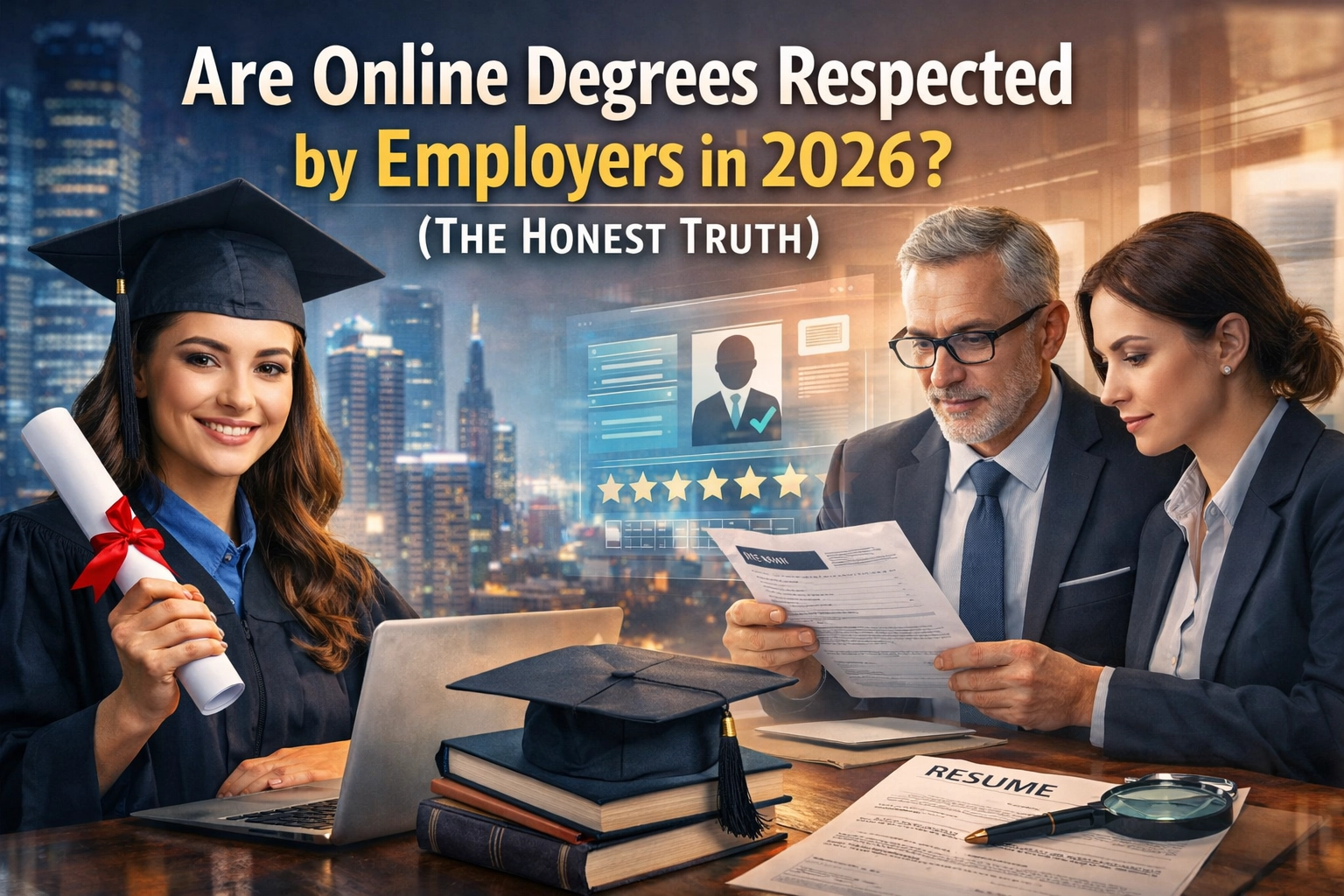
By 2026, the question "Is an online degree respected?" has shifted from a skeptical inquiry to an outdated one. The line between "online" and "traditional" education hasn't just blurred; it has effectively dissolved. In a world where the largest tech companies operate on hybrid models and global teams collaborate via spatial computing and AI agents, the idea that learning must happen within four physical walls is a relic of the early 2000s.
However, "respected" is not a blanket term. While the delivery method: the screen you looked at: doesn't matter to a hiring manager, the rigor, the accreditation, and the institution's brand matter more than ever. If you are sitting on the fence about enrolling in a digital program, you need to understand the technical and cultural landscape of the 2026 job market.
The 2026 Consensus: Data Doesn’t Lie
The stigma that once plagued distance learning is statistically dead. Recent data from 2024 and 2025: which has only solidified in 2026: shows that approximately 83% of employers now view online degrees as being of equal quality to on-campus degrees. More importantly, a Georgetown University Center on Education and the Workforce report noted that for 87% of job postings requiring a bachelor’s degree, recruiters did not differentiate between online and in-person credentials, provided the institution held proper accreditation.

The driver behind this shift wasn’t just a change in heart; it was a change in experience. The cohort of hiring managers in 2026 consists largely of Millennials and Gen Xers who lived through the "Great Remote Pivot" of the early 2020s. They have seen firsthand that productivity isn't tied to a desk, and they apply that same logic to education. If a candidate can master complex multivariable calculus or full-stack development through an asynchronous portal while managing a job, that speaks to a level of self-discipline that an 18-year-old in a dorm might not yet possess.
Why the "Online" Label is Disappearing
In 2026, most major universities: from the Ivy League to state schools: no longer distinguish between delivery formats on diplomas or transcripts. If you earn a Master’s in Computer Science from the University of Texas or an MBA from UNC Chapel Hill, your degree doesn't say "Online." It says "University of Texas."
This is a critical technical distinction. Employers evaluate the institution, not the internet connection. The respect is directed toward the curriculum and the faculty.
The Rise of the LXP (Learning Experience Platform)
Technically, online education in 2026 is far superior to the "Zoom University" era of 2020. Modern programs use advanced Learning Experience Platforms (LXPs) that integrate:
- AI-Driven Personalization: Tailoring the difficulty of modules based on student performance.
- Biometric Proctoring: Ensuring academic integrity through advanced identity verification.
- Virtual Labs: Using VR and AR to simulate engineering or chemical experiments that were previously only possible in physical labs.
Because these technical hurdles have been cleared, employers have higher confidence in the "proof of knowledge" that a degree represents.
The Hierarchy of Respect: What Actually Matters
While the format is a non-issue, the type of online degree you choose dictates your employability. Not all digital credentials are created equal.
1. Accreditation: The Non-Negotiable
In 2026, the technical divide is between "Accredited" and "Non-Accredited." Regional accreditation remains the gold standard. In the U.S., the Department of Education’s shift toward a unified accreditation oversight has made it easier for employers to verify the legitimacy of an institution instantly. If an online school lacks institutional accreditation, its degree is essentially a decorative PDF.
2. Institutional Brand vs. Online-Only Schools
There is still a "prestige gap." A degree from a traditional university with a robust online presence (like Arizona State, Southern New Hampshire University, or Purdue Global) generally carries more weight than a degree from an "online-only" for-profit entity that lacks a research footprint. Employers respect institutions that have skin in the game: those that produce research and have a long history of academic output.
3. Field-Specific Acceptance
- Tech and Business: High acceptance. In fields like Data Science, Cybersecurity, and Marketing, the "proof of work" (your GitHub, your portfolio, your certifications) often overrides the degree format anyway.
- Healthcare and Specialized Engineering: Moderate acceptance. While the theoretical components are respected online, 2026 employers still look for "clinical hours" or "bridge programs" that include hands-on residency.
- Law and Architecture: Improving. We are seeing more ABA-approved (American Bar Association) hybrid JD programs, but the transition is slower here due to regulatory lag.
The "Hidden" Skills Employers Love About Online Grads
When we interview C-suite executives and HR directors, they often point to a specific set of "meta-skills" that online graduates tend to exhibit. In a 2026 economy that relies heavily on asynchronous communication, these skills are highly valuable:
- Digital Fluency: Online students are naturally adept at using collaborative tools like Slack, Microsoft Teams, and AI-driven project management software. They don't need a "onboarding" period for remote work tools.
- Time Management: Completing a degree online requires a level of autonomy that traditional classroom settings don't demand. There is no professor physically staring at you to ensure you’re taking notes.
- Written Communication: Since most online interaction is text-based or recorded, online grads often have superior skills in drafting clear, concise documentation: a critical skill in the age of global, remote-first companies.
Red Flags: How to Spot a "Degree Mill" in 2026
Even with the high acceptance of online degrees, there is still a predatory "degree mill" industry. If you want your degree to be respected, avoid programs that exhibit these technical and administrative red flags:
- Life Experience Credits Only: If a school offers a full degree based only on your resume without requiring new coursework or rigorous assessments, it is a degree mill.
- Lack of a ".edu" Domain or Clear Physical Presence: While they are digital, reputable universities have physical headquarters and verifiable faculty members with published research.
- Pressure Sales Tactics: If the admissions department sounds like a telemarketing agency, run.
- Instant Degrees: A legitimate Bachelor's degree takes time. If you can "graduate" in three months without prior transfer credits, no employer will respect that credential.
Regional Nuances: The US vs. The Rest of the World
Interestingly, the acceptance of online degrees varies by geography.
- The United States: High acceptance (83%+), largely due to the massive infrastructure of state and private universities moving online.
- Europe: High acceptance in the UK and Northern Europe, but slightly more skepticism in Southern Europe where "traditional" campus life is more culturally entrenched.
- Asia: Rapidly rising acceptance in India and Southeast Asia, driven by the need for scalable education to meet the demands of a massive, tech-savvy workforce.

The Hybrid Future: Stackable Credentials
By 2026, the most "respected" candidates are often those who don't just have an online degree, but a "stacked" portfolio. This might look like:
- A Bachelor’s degree from a state university (Online).
- A Professional Certificate from Google or IBM.
- Three years of verified work experience.
This combination proves to the employer that you have the foundational theory (the degree) and the industry-specific, "just-in-time" skills (the certifications).
Final Verdict: Is it Worth It?
The "honest truth" is this: In 2026, an employer is much more likely to reject you because you lack the specific skills for the job or because your institution isn't accredited, rather than because you studied in your pajamas.
Online education is no longer a "second-best" option. For many, it is the smarter option, allowing for the continuation of career growth and the avoidance of massive commuting or housing debt. If the program is accredited, the curriculum is rigorous, and the institution is recognized, your online degree is just a "degree." Period.
About the Author: Malibongwe Gcwabaza
Malibongwe Gcwabaza is the CEO of blog and youtube, a leading digital platform dedicated to navigating the intersection of technology, education, and career development. With over a decade of experience in the tech sector, Malibongwe focuses on how AI and digital transformation are reshaping the global workforce. He is a staunch advocate for accessible, high-quality online education and frequently consults for edtech startups on curriculum relevance and employer alignment in the 2026 economy.
About the Author