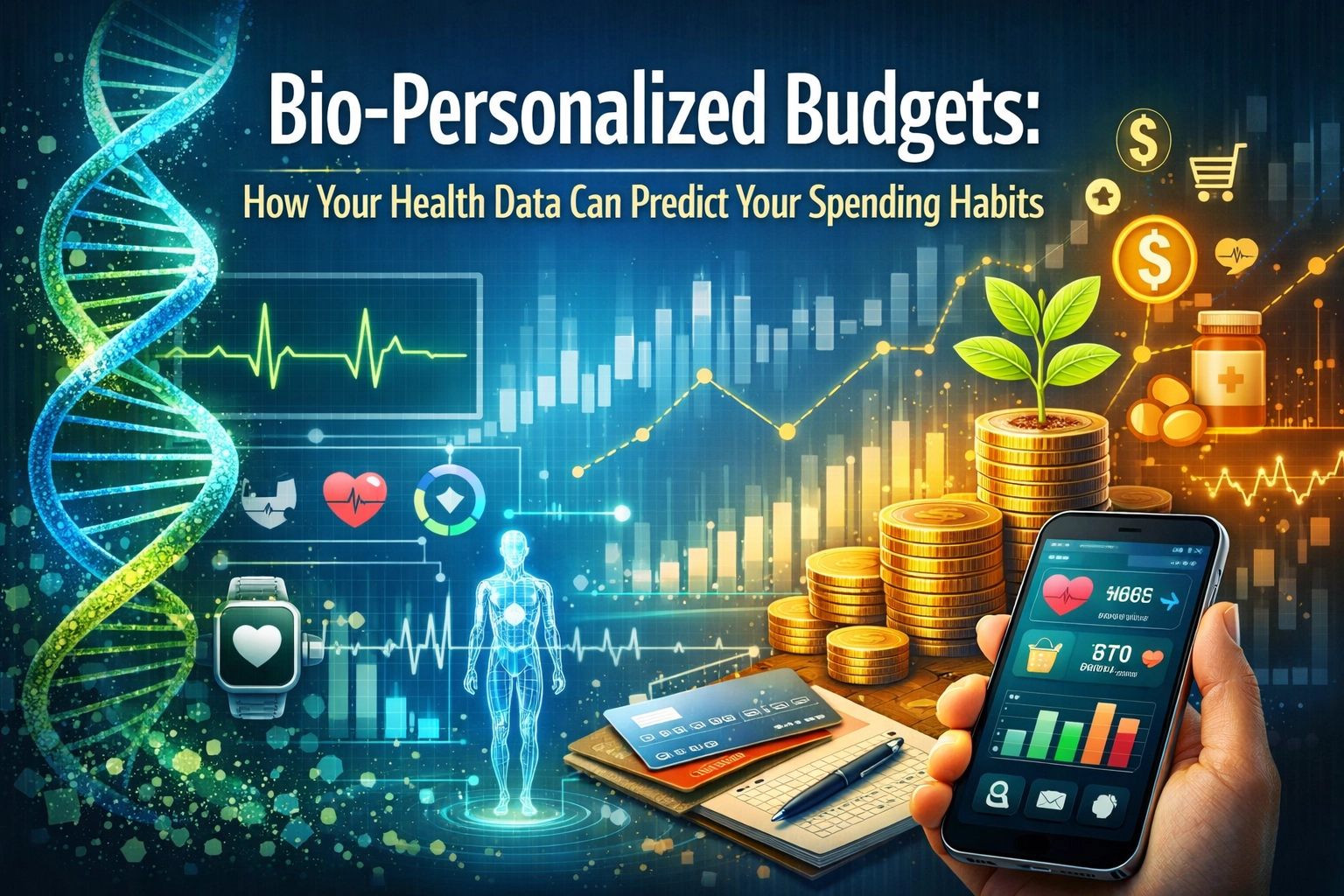
By March 2026, the wall between our physical bodies and our digital bank accounts hasn't just thinned: it has effectively vanished. We’ve moved past the era of simple "budgeting apps" that tell you what you spent yesterday. Today, we are entering the age of Bio-Personalized Budgeting, a convergence of fintech and health-tech that uses your real-time physiological data to predict: and prevent: financial decisions before they even happen.
If you’ve ever wondered why you’re more prone to making high-risk crypto trades at 2:00 AM or why a stressful day at the office consistently leads to a $200 Amazon spree, the answer isn't just "lack of willpower." It's your biology. For the first time, we have the tools to map those biological markers to our financial behavior.
The Science of Neuro-Finance: Why Your Cortisol Owns Your Credit Card
Traditional personal finance advice treats humans like rational calculators. We are told to "just stick to the budget." But as any behavioral economist will tell you, the human brain in 2026 is still running on hardware designed for the Pleistocene.
The primary driver of modern impulsive spending is Cortisol, the stress hormone. When your body is under chronic stress, your prefrontal cortex: the "CEO" of your brain responsible for long-term planning: effectively goes offline. Your amygdala takes over, seeking immediate rewards to counteract the stress. In the digital age, that reward is often a hit of dopamine triggered by a "Buy Now" button.
Data from the 2025 Global Bio-Financial Report showed a 74% correlation between elevated resting heart rates (a proxy for stress) and "non-essential checkout events" within the following two-hour window. Essentially, your Oura ring or Apple Watch knows you’re going to overspend before your brain has even rationalized the purchase.

How the 2026 Tech Stack Connects Your Pulse to Your Portfolio
The infrastructure for bio-personalized budgeting relies on three specific technologies that have reached maturity this year:
- Wearable Biometrics (The Sensor Layer): Devices now track Heart Rate Variability (HRV), Galvanic Skin Response (GSR), and interstitial glucose levels in real-time. These metrics provide a high-fidelity map of your emotional state.
- Open Banking APIs (The Execution Layer): Modern banking standards allow AI agents to view pending transactions and temporarily "freeze" accounts or trigger notifications based on external triggers.
- Agentic AI (The Intelligence Layer): This is the "glue." AI agents like the ones we use in 2026 don't just show you a graph; they execute logic. If [HRV < Threshold] and [Location = Shopping Mall], then [Enable Transaction Friction].
The "Biological Circuit Breaker"
Imagine this: You’ve had a grueling day. Your wearable detects that your HRV is in the gutter and your cortisol is spiking. As you open a high-end clothing app, your AI-powered financial assistant sends a haptic buzz to your wrist.
"Malibongwe, your stress levels are currently in the 90th percentile. Your 'impulse spending' probability is high. I have placed a 30-minute lock on all non-essential transactions to allow your nervous system to regulate."
This isn't science fiction anymore. By integrating health data with banking, we are building "biological circuit breakers" that protect our future selves from our present physiology.
Predictive Spending Patterns: What Your Sleep Data Says About Your Risk Tolerance
It isn't just stress. Sleep deprivation is perhaps the most significant predictor of financial "fat tail" risks: those rare but catastrophic decisions that can ruin a retirement plan.
A 2026 study by the Institute for Financial Wellness analyzed over 500,000 anonymized sleep logs and trading accounts. The results were staggering: individuals with less than six hours of REM sleep were 45% more likely to engage in "revenge trading" (trying to quickly win back losses) and 30% less likely to notice hidden fees in service contracts.
Bio-personalized budgets use this data to adjust your daily "Risk Ceiling." On days when your "Readiness Score" is low, your investment platform might automatically disable margin trading or high-leverage positions. You are essentially "biologically blacklisted" from high-stakes decisions until your cognitive function recovers.
The Ethics of the "Bio-Loan": A New Frontier in Credit Scoring
As we move deeper into 2026, the financial industry is looking at health data through a more controversial lens: The Bio-Loan.
Traditionally, creditworthiness was based on your history of paying bills (FICO). But lenders are beginning to realize that health data is a leading indicator, while credit scores are lagging indicators. A person who maintains a high "Wellness Index": consistent exercise, stable sleep patterns, and low stress markers: is statistically more likely to maintain steady employment and make rational financial decisions.
While this offers lower interest rates for the "bio-optimized," it raises massive ethical questions. Are we moving toward a "Gattaca-style" financial system where your DNA or your stress levels determine your mortgage rate?
For the "Solopreneur" and the "Fractional Workforce," however, this data is a superpower. By sharing anonymized health trends with insurers or lenders, professionals in high-stress roles can prove they are managing their "human capital" effectively, potentially lowering their insurance premiums or business loan rates.
Privacy and Data Sovereignty: Keeping Your Body Out of the Hands of Big Tech
The biggest hurdle to bio-personalized budgeting is, understandably, privacy. You don't want your bank knowing you have a chronic illness, and you don't want your doctor knowing about your gambling habit.
The solution emerging in 2026 is Sovereign Cloud Computing and Zero-Knowledge Proofs (ZKPs).
With ZKPs, your health app can "prove" to your banking app that you are in a high-stress state without actually sharing your heart rate or medical data. The calculation happens locally on your device. The bank only receives a "True/False" signal to enable or disable a spending limit. This "Privacy-First" architecture is essential for the mass adoption of bio-finance.

How to Set Up Your Own Bio-Personalized Budget Today
If you want to stay ahead of the curve, you don't have to wait for your bank to offer these features. You can build a DIY version using the tools available right now:
- Hardware: Use a high-quality wearable that provides an open API (like Oura or Garmin).
- Automation: Use a platform like Zapier or Make.com to connect your health data to your financial notifications.
- The Logic: Set up a "Stress Alert." For example, "If my Daily Stress Score exceeds 70, send a Slack message to my partner/accountant and turn off notifications from shopping apps."
- The "Dopamine Delay": Use browser extensions that require a "physiological check-in" (like a 1-minute breathing exercise) before allowing access to checkout pages.
The Bottom Line: Finance is Physical
The mantra of the 2026 economy is that wealth is a byproduct of health. We can no longer afford to treat our bank accounts as separate from our bodies. By embracing bio-personalized budgets, we aren't just saving money; we are gaining a deeper understanding of how our biology drives our destiny.
As we continue to navigate a world of "AI-driven everything," the most successful individuals will be those who use technology to bridge the gap between their primitive instincts and their long-term financial goals.
About the Author: Malibongwe Gcwabaza
Malibongwe Gcwabaza is the CEO of blog and youtube, a leading digital hub dedicated to the intersection of emerging technology, personal finance, and the future of work. With over a decade of experience in tech strategy and a passion for "Human-in-the-Loop" AI systems, Malibongwe helps professionals navigate the complexities of the 2026 landscape. When he isn't analyzing the latest trends in neuro-finance, he's exploring the potential of sovereign clouds and decentralized education.
About the Author