In the world of content marketing for small business, there is a common misconception that more is always better. Small business owners often find themselves on a relentless treadmill, trying to churn out three new blog posts a week while managing operations, customer service, and product development. This approach is not only exhausting; it’s inefficient.
The reality of digital marketing in 2026 is that the internet is saturated. Creating more "average" content doesn't move the needle. The real competitive advantage lies in leverage. Instead of constantly building new assets, the most successful small businesses are looking backward to move forward. They are using a strategy called content refreshing.
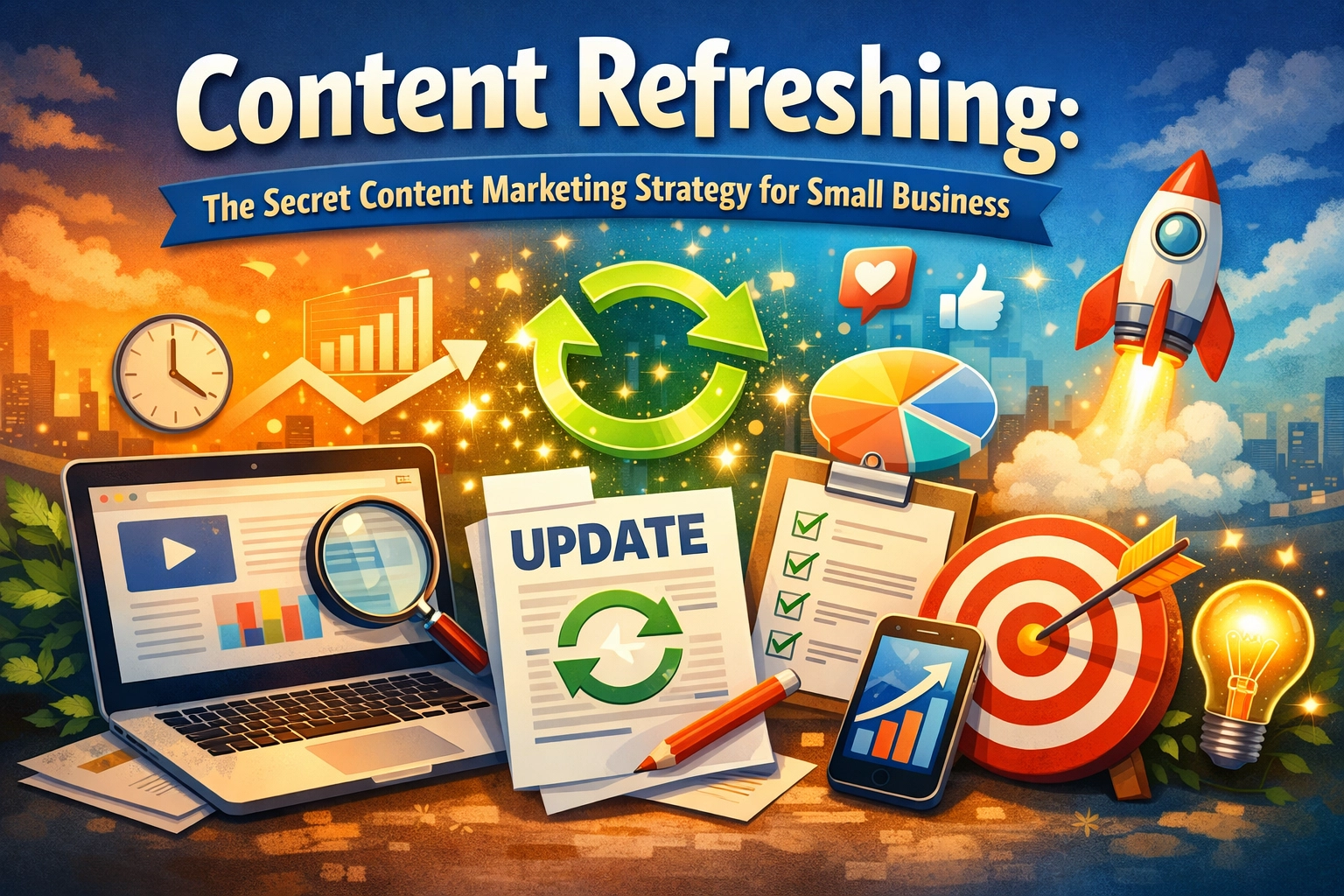
Content refreshing is the process of taking existing, older content and updating it to improve its accuracy, SEO performance, and user experience. It is the secret weapon for small businesses that need to compete with larger corporations without having a massive production budget.
Why Content Refreshing is Critical for Small Businesses
Small businesses operate under constraints that large enterprises don't have. You likely don’t have a dedicated team of ten writers and a six-figure monthly SEO budget. You need every piece of content to work hard for its keep.
Combatting Content Decay
Every piece of content has a shelf life. As soon as a blog post is published, it begins to decay. Facts change, new competitors enter the search rankings, and Google’s algorithms evolve. "Content decay" is the predictable decline in organic traffic that happens over time. By refreshing content, you effectively "reset" the clock, signaling to search engines that the information is current and relevant.
Maximizing ROI with Less Effort
Writing a 1,500-word deep dive from scratch can take six to ten hours of research and writing. Refreshing that same post might only take two hours, yet it can yield a 50% to 100% increase in traffic. For a small business, this is the ultimate hack for resource management. You are building on an existing foundation rather than digging a new hole every time.
Improving Brand Authority
Nothing hurts a brand’s credibility more than a potential customer landing on a blog post from 2021 that references "upcoming trends" that have already passed. Keeping your content fresh ensures that when someone finds your business through search, they see you as a modern authority who is on top of their game.

How to Identify Which Content to Refresh
You shouldn't refresh every single post on your site. Some posts were written for a specific moment in time (like a 2023 holiday announcement) and aren't worth the effort. To find the "low-hanging fruit," you need to look at your data.
The Content Refresh Priority Matrix
| Post Type | Performance Status | Action |
|---|---|---|
| The Falling Star | High historical traffic, currently declining | High Priority: Refresh immediately to stop the bleed. |
| The Almost-Winner | Ranking on Page 2 (Positions 11–20) | High Priority: Optimize SEO to push it to Page 1. |
| The High Converter | Low traffic but high conversion rate | Medium Priority: Update to drive more traffic to this "money" page. |
| The Hidden Gem | High impressions but very low Click-Through Rate (CTR) | Medium Priority: Update title tags and meta descriptions. |
| The Zombie | Zero traffic and zero conversions for 2+ years | Low Priority: Delete or redirect to a more relevant post. |
To find these, use Google Search Console. Look for pages where the "Average Position" is between 10 and 15. These are posts that Google likes, but doesn't quite "love" yet. A refresh is often the nudge they need to break into the top five results.
The Ultimate Content Refreshing Checklist
Once you’ve identified a post that needs a facelift, don’t just change a few commas and hit update. You need a systematic approach to ensure the refresh actually impacts your SEO and user engagement.
1. Update the Data and Statistics
If your post mentions that "60% of marketers use video," but that stat is from a 2019 study, find a 2024 or 2025 version. Google's "Helpful Content" guidelines prioritize accuracy. Replace old screenshots that look outdated with modern, high-resolution images.
2. Close the Content Gaps
Look at the articles currently ranking in the top three positions for your target keyword. What are they covering that you aren't? Maybe they have a FAQ section, a pricing table, or a video tutorial. Add those missing pieces to your post to make it the most comprehensive resource on the topic.
3. Optimize for New Keywords
Search intent shifts over time. Use tools to see what secondary keywords people are using to find your post. If you notice people are finding your "Guide to Small Business Marketing" by searching for "marketing automation for local shops," add a specific H3 section addressing automation.
4. Enhance the Visuals and User Experience
Readability is a ranking factor.
- Break up long walls of text into shorter paragraphs (2–3 sentences).
- Add bullet points and numbered lists.
- Insert an
 to explain complex concepts.
 - Add internal links to your newer posts to keep users on your site longer.
5. Fix Technical Errors
Broken links are a signal to Google that a site is neglected. Check every outbound link in the post. If the destination page is 404ing, find a new source. Ensure your images have descriptive Alt Text for accessibility.

The "Content Merge" Strategy: Solving Cannibalization
A common problem for small businesses that have been blogging for a few years is keyword cannibalization. This happens when you have three or four different posts all trying to rank for the same keyword. Instead of helping you, these posts compete against each other, and Google ends up ranking none of them well.
The solution is the Power Merge:
- Identify 3-4 "thin" posts on a similar topic.
- Select the one with the best URL and existing backlinks as your "Master" post.
- Combine the best information from all posts into the Master post, expanding it to 2,000+ words.
- Redirect the URLs of the thin posts to the Master post using 301 redirects.
This concentrates all the "link juice" and authority into one powerhouse page that is much more likely to dominate the search results.
Repurposing: The Post-Refresh Boost
Once you have refreshed a high-performing article, don’t just let it sit there. Content marketing for small business is about squeezing every drop of value out of your assets.
Take your newly updated 1,500-word guide and:
- Create a Video: Summarize the key points in a 5-minute YouTube video and embed it back into the blog post.
- Social Snippets: Pull 5–10 "stat cards" or "quote cards" from the text to share on LinkedIn or Instagram.
- Email Newsletter: Resend the post to your email list with a subject line like "Updated for 2026: Our Guide to [Topic]."
This multi-channel approach ensures that your hard work in refreshing the content reaches different segments of your audience.

Measuring the Success of Your Refresh
How do you know if the strategy is working? You need to track specific metrics over a 30 to 60-day window following the update.
- Organic Traffic: Are you seeing an upward trend in unique visitors to that specific URL?
- Average Position: Did your ranking for the primary keyword move from #14 to #4?
- Time on Page: Are people actually reading the new, longer content? If this number goes up, your engagement is improving.
- Click-Through Rate (CTR): If you updated the title and meta description, you should see a higher percentage of searchers clicking your result.
Final Thoughts
Content refreshing isn't a one-time task; it's a cycle. For a small business, it represents the most cost-effective way to grow your digital footprint. By treating your blog as a library of living documents rather than a chronological archive of the past, you build a sustainable marketing engine that keeps producing leads and sales year after year.
Stop worrying about what new thing you have to say today. Look at what you said a year ago, and make it better.
About the Author: Malibongwe Gcwabaza
Malibongwe Gcwabaza is the CEO of blog and youtube, a leading digital strategy firm specializing in helping small businesses scale through high-impact content marketing and video integration. With over a decade of experience in the SEO landscape, Malibongwe focuses on simple, actionable strategies that deliver measurable ROI. When he’s not auditing content libraries, he’s exploring the intersection of AI and creative storytelling to help brands find their unique voice in a crowded digital world.
About the Author