Most businesses are running their marketing and sales in silos, and it’s costing them a fortune. You’ve got your marketing team over here, firing off beautiful newsletters using top-tier email marketing automation tools. Then, you’ve got your sales team over there, living inside a Customer Relationship Management (CRM) platform, trying to track leads and close deals.
The problem? They aren't talking to each other. When your email data lives in a different universe than your sales data, you’re flying blind. You’re guessing what your customers want instead of knowing.
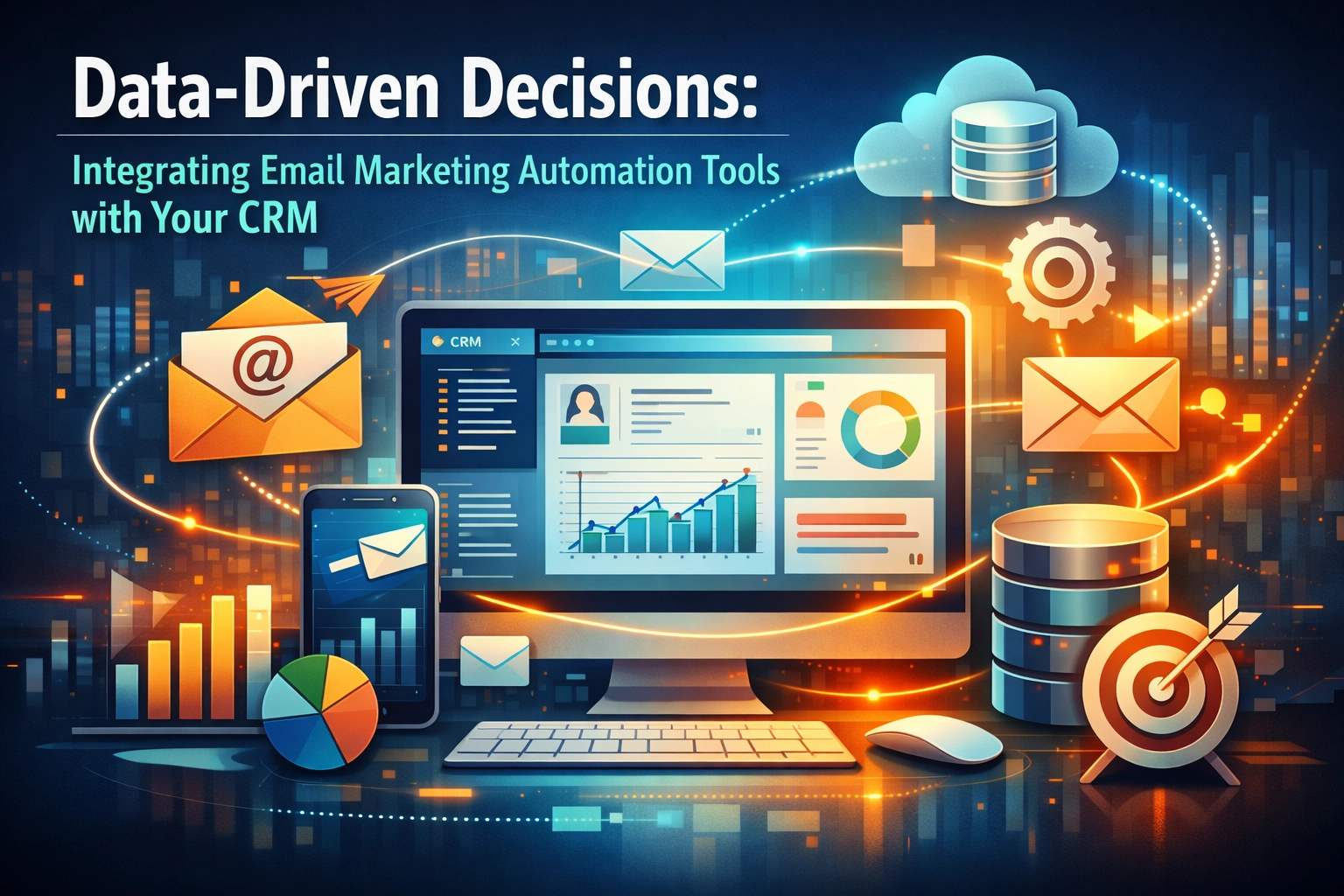
Integrating your email marketing automation tools with your CRM is the bridge that turns "gut feelings" into data-driven decisions. It’s the difference between sending a generic "Buy Now" email and sending a perfectly timed message that addresses a lead's specific pain points. Let’s dive deep into why this integration is the ultimate power move for your business in 2026.
The Fragmented Data Trap
Before we talk about the solution, we have to look at the mess many companies are currently in. If your systems are disconnected, your data is likely:
- Duplicate: You have "John Doe" in your email list and "J. Doe" in your CRM, but your systems think they are two different people.
- Outdated: A customer unsubscribes from a marketing email, but your sales rep calls them five minutes later because the CRM didn't get the memo.
- Incomplete: Your marketing team knows a lead clicked on a link about "Enterprise Pricing," but the sales rep only sees that the lead is "Cold."
This fragmentation creates a disjointed customer experience. In a world where buyers expect personalization, a generic, uninformed approach is the fastest way to get marked as "Spam."

Why Integration is a Game Changer
When you connect your email marketing automation tools to your CRM, you create a "Single Source of Truth." This isn't just about saving time on data entry; it’s about creating a feedback loop that fuels growth.
1. Centralized Data Foundation
Integration eliminates the manual labor of exporting CSV files from one platform to import them into another. Every time a new lead signs up for a webinar or downloads a whitepaper, that info instantly populates in the CRM. According to recent industry benchmarks, companies that integrate these systems save roughly 23% on sales and marketing costs simply by eliminating manual tasks and data redundancy.
2. Hyper-Personalization and Improved Targeting
Generic blasts are dead. Data-driven marketing relies on segments. When your email tool knows exactly where a lead is in the CRM sales pipeline, you can get incredibly specific.
- Example: If a lead is marked as "Proposal Sent" in the CRM, the marketing automation tool can automatically stop sending "Educational" emails and start sending "Trust and Social Proof" emails (case studies, reviews) to help push the deal over the line.
3. Sales and Marketing Alignment (Smarketing)
One of the biggest internal wins is the "handshake" between sales and marketing. When the systems are linked, the marketing team can see which email campaigns actually resulted in closed deals, not just clicks. Conversely, sales reps can see exactly which emails a lead has opened and which links they’ve clicked, giving them a perfect conversation starter for their next follow-up call.
The ROI of Integrated Systems
If you're looking for the bottom-line impact, the numbers are hard to ignore. Research shows that businesses with integrated marketing and sales stacks see a 41% increase in revenue per sale. Why? Because the sales cycle is shorter and the leads are better qualified.
Data Comparison: Isolated vs. Integrated Systems
| Feature | Isolated Systems | Integrated Systems |
|---|---|---|
| Lead Scoring | Based only on email clicks. | Based on clicks, web behavior, and sales interactions. |
| Customer Journey | Fragmented and repetitive. | Seamless and personalized. |
| Data Accuracy | Low (manual updates). | High (real-time syncing). |
| Sales Efficiency | Reps waste time on cold leads. | Reps focus on "Sales Ready" leads. |

How the Integration Works: The Technical Side
You don't need to be a developer to make this happen, but you do need to understand the mechanics. Most modern email marketing automation tools (like HubSpot, Klaviyo, or ActiveCampaign) have native integrations with major CRMs (like Salesforce, Pipedrive, or Zoho).
Step 1: Mapping the Fields
The first step is deciding which data goes where. You’ll map your "Email Address" field in the automation tool to the "Email" field in the CRM. But you should go deeper. Map "Industry," "Job Title," and "Lead Score." This ensures that when a lead updates their profile in an email, it reflects in the CRM immediately.
Step 2: Setting Up Triggers
The real magic happens with triggers. A trigger is an "If This, Then That" (IFTTT) statement.
- Trigger: Lead reaches a score of 50 in the email automation tool.
- Action: Automatically create a "Task" in the CRM for a sales rep to call them.
Step 3: Bi-Directional Syncing
Always opt for bi-directional syncing. This means that if a salesperson changes a lead’s status from "Active" to "Closed-Won" in the CRM, the email marketing tool immediately moves them from a "Prospecting" sequence to a "Customer Onboarding" sequence.

Advanced Lead Scoring: The Secret Sauce
Lead scoring is how you determine who is worth your sales team's time. In an isolated system, lead scoring is weak. A lead might click ten emails but have zero intention of buying.
In an integrated system, you can create a multidimensional lead score:
- Email Open: +2 points
- Clicking a Pricing Link: +10 points
- Downloading a Demo Video: +15 points
- Title matches "Decision Maker": +20 points
- Attending a Webinar: +25 points
Once the lead hits a threshold (e.g., 75 points), the integration sends an alert to your sales team. This ensures that your reps are only talking to people who are genuinely interested, which drastically improves morale and conversion rates.
Best Practices for a Seamless Integration
To avoid "dirty data" and technical headaches, follow these guidelines:
- Audit Your Data First: Don't sync a mess. Clean your email list and your CRM database before you hit the "connect" button. Remove duplicates and bounce-backs.
- Define Your Lead Lifecycle: Clearly define what a "Subscriber," "Lead," "MQL" (Marketing Qualified Lead), and "SQL" (Sales Qualified Lead) looks like. If your teams don't agree on these definitions, the data sync won't matter.
- Start Small: Don't try to sync 50 different data points on day one. Start with the basics: name, email, lead status: and expand as you get comfortable with the workflow.
- Monitor Your API Limits: If you have a massive database, real-time syncing can sometimes hit API limits. Check with your software providers to ensure your plan covers the volume of data being moved.

The Human Element: Training Your Team
Software is only as good as the people using it. Once your email marketing automation tools and CRM are talking to each other, you need to train your sales and marketing teams on how to read the new data.
Marketing needs to learn how to interpret sales feedback to create better content. Sales needs to learn how to use the "Marketing Activity" tab in the CRM to tailor their pitches. When the human element matches the technical integration, that's when the exponential growth happens.
Looking Ahead: The Role of AI in Integration
As we move through 2026, Artificial Intelligence (AI) is becoming the glue in these integrations. Predictive CRM tools are now using email engagement data to predict which customers are likely to churn before they even know they’re unhappy. They can also suggest the "Next Best Action" for a sales rep based on which automated email the prospect engaged with most recently.
By integrating now, you aren't just fixing today's problems: you're building the foundation for the AI-driven marketing strategies of tomorrow.
About the Author
Malibongwe Gcwabaza is the CEO of blog and youtube, a digital growth agency specializing in high-performance content strategies and marketing automation. With over a decade of experience in the tech and media space, Malibongwe focuses on helping businesses bridge the gap between complex data and actionable growth. He believes that the best marketing isn't just about being loud( it's about being right.)
About the Author