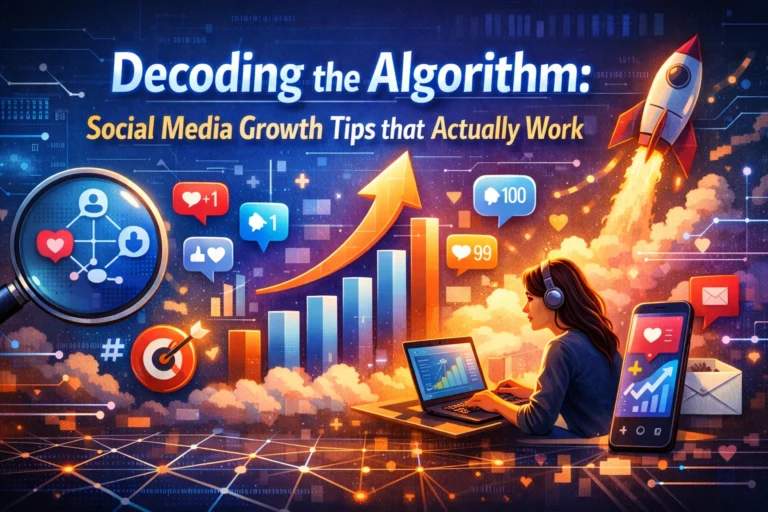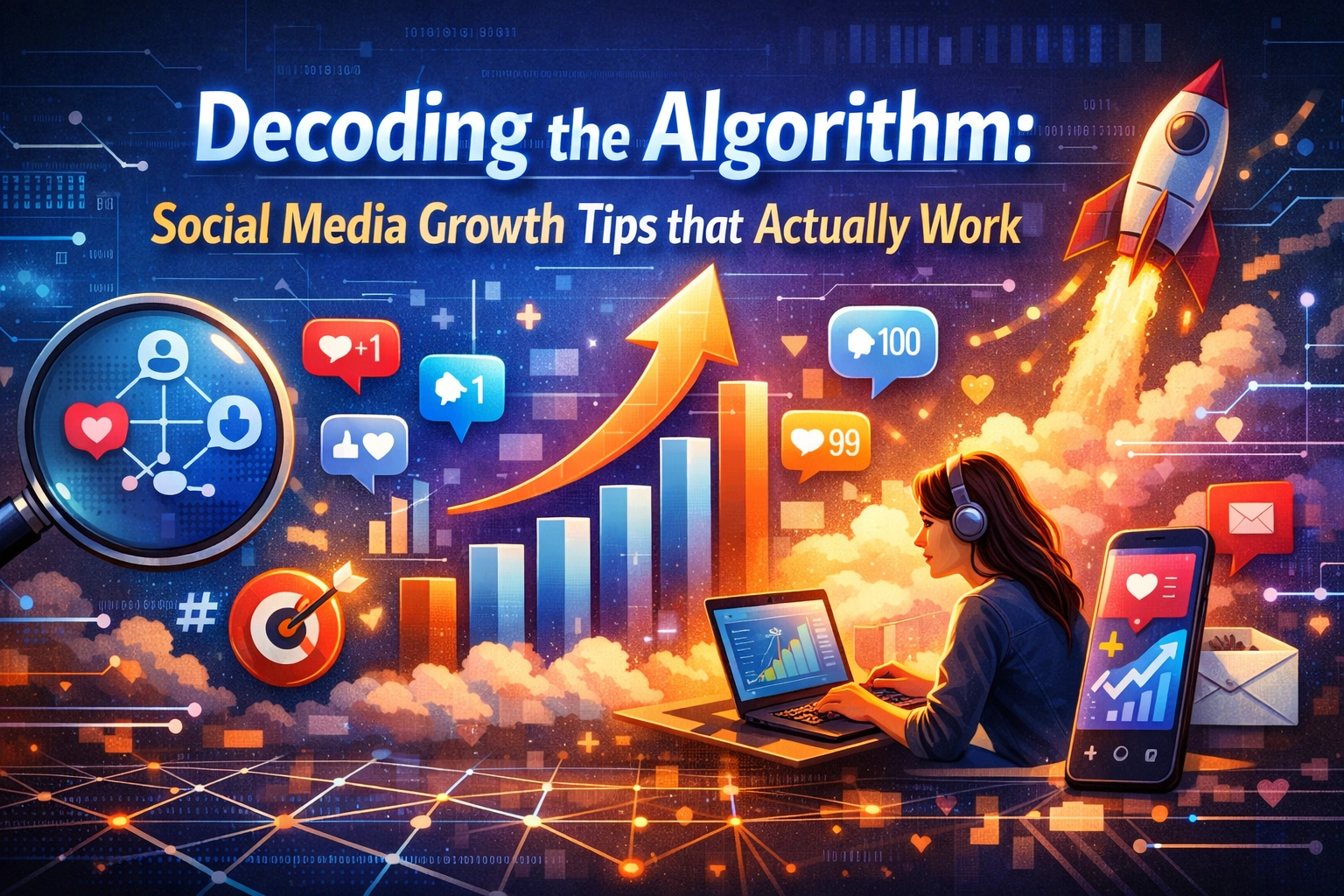
Everyone talks about "the algorithm" like it’s some mysterious, hooded figure in a dark room deciding who gets to be famous and who gets buried in the digital basement. If you’ve spent any time trying to grow a brand or a personal profile, you’ve probably felt that frustration. You post a masterpiece, and it gets crickets. You post a blurry photo of your coffee, and suddenly you’re getting notifications every five seconds.
Here is the truth: the algorithm isn't a lottery. It’s a recommendation engine. Its only job is to keep people on the platform for as long as possible. If your content helps the platform achieve that goal, the algorithm will push it. If it doesn't, it won't.
Growing on social media in 2026 isn't about "hacking" the system; it’s about understanding the psychology of the people using it and the math of the machines running it. Let’s break down the strategies that actually move the needle.
The Foundation: Why Consistency is Non-Negotiable
We hear the word "consistency" so much it has almost lost its meaning, but the data doesn't lie. Research shows that posting at a sustainable rhythm, roughly 5 to 19 times per month, can result in up to a 340% increase in engagement per post compared to sporadic posting.
Why does this happen? It’s two-fold. First, the machine learns your behavior. When you post regularly, the platform’s AI understands who your audience is and when they are likely to engage. Second, it builds a habit for your audience. If your followers know you drop a deep-dive thread every Tuesday or a tutorial every Friday, they start looking for it.
The mistake most people make is starting with a pace they can't keep up. They post every day for a week, get burnt out, and disappear for a month. To the algorithm, you’ve just become "unreliable." It’s better to post twice a week, every week, than to go on a content binge and then ghost your followers.

Stop Ghosting Your Comments
If consistency is the engine, engagement is the fuel. But there is a specific type of engagement that most people ignore: the reply.
When someone comments on your post, they are giving you a gift. They are telling the platform, "This content is worth my time to interact with." If you ignore that comment, you’re telling the platform (and the follower) that you don’t care.
Data from Buffer’s analysis of millions of posts reveals a massive "engagement lift" just from replying to comments. We’re talking about a 42% boost on Threads, 30% on LinkedIn, and 21% on Instagram. When you respond, you trigger a second notification for that user, bringing them back to the post. This often leads to a conversation, which the algorithm reads as "high-value interaction," prompting it to show your post to even more people.
Pro-tip: Don't just reply with an emoji. Ask a follow-up question. Turn a single comment into a five-comment thread. That’s how you signal to the algorithm that your post is a "hot zone" for conversation.
The SEO Shift: Social Search is the New Google
Gen Z and even Millennials are increasingly using TikTok and Instagram as search engines. If they want to find a restaurant in Cape Town or learn how to use a specific Python library, they aren't going to Google; they’re typing it into the search bar of their favorite app.
This means your social media strategy needs to incorporate SEO (Search Engine Optimization) fundamentals:
- Keyword-Rich Captions: Stop using "vibe" captions that say nothing. Use keywords that your target audience is actually searching for. If you’re a fitness coach, your caption should include phrases like "weight loss tips," "home workout routine," or "high-protein meal prep."
- Bio Optimization: Your profile name and bio should be searchable. If your name is John Doe but you teach SEO, your profile name should be "John Doe | SEO Expert."
- Alt Text and Descriptive Text: Most platforms allow you to add alt text to images for accessibility. The algorithm uses this text to categorize your content. Don't leave it blank.

Platform-Specific Playbook for 2026
You cannot post the same piece of content the exact same way across every platform and expect it to work. Each app has its own "culture" and its own preferred format.
Instagram: The Hybrid Hub
Instagram is no longer just a photo-sharing app. To grow here, you need a mix:
- Reels: These are your primary tool for reach. They get shown to people who don't follow you.
- Carousels: These are for your existing followers. They have a "double-dip" effect; if a follower scrolls past the first slide, Instagram will often show them the second slide later in the day.
- Stories: This is where you build the relationship. This is where the sales happen.
TikTok: The Entertainment Engine
TikTok doesn't care about your aesthetic. It cares about the "hook." If you don't grab attention in the first 1.5 seconds, you’ve lost. Use trending sounds but put your own unique spin on them. TikTok rewards raw, authentic content over highly polished production.
LinkedIn: The Authority Network
LinkedIn has moved away from "corporate speak." The posts that go viral now are personal stories mixed with professional insights. Use long-form text posts and "document" style PDFs (carousels). LinkedIn loves "dwell time", the amount of time someone spends reading your post.
X (Twitter) & Threads: The Conversation Starters
These platforms are about speed and opinion. "Threads" (the format, not the app) are still the best way to grow. Break down a complex topic into 5-10 short, punchy posts.
Solving the Distribution Problem
If you feel like your growth has hit a wall, you likely don't have a content problem; you have a distribution problem. You’re telling the same story to the same 500 people every day.
To break out of your current bubble, you need to go where new audiences live. This can be done through:
- Collabs: Partner with someone in a tangential niche. If you’re a web designer, collaborate with a copywriter. You both share each other's audiences.
- Niche Communities: Spend time in the comments of the "big" accounts in your industry. Don't spam your link; provide actual value. If people see you consistently giving great advice in the comments of a leader, they will eventually click on your profile.
- Repurposing: One long-form YouTube video can become five TikToks, three LinkedIn posts, and a newsletter. This ensures your message hits multiple touchpoints without you having to be a content-creation slave.
The Myth of High Production Value
Stop waiting until you have a $2,000 camera to start. In the current social media landscape, "lo-fi" content often performs better because it feels more human and less like an ad. Your smartphone is more than enough. What matters more than the pixels is the value.
Ask yourself before every post:
- Does this teach something?
- Does this entertain someone?
- Does this spark a conversation?
If the answer to all three is "no," don't post it. Quality over quantity is a lie if you only post once a month, but "high quality" doesn't mean "expensive." It means "useful."
Summary Checklist for Growth
| Strategy | Action Item | Frequency |
|---|---|---|
| Consistency | Pick a schedule (e.g., 3x a week) and stick to it for 90 days. | Ongoing |
| Engagement | Reply to every single comment within the first hour of posting. | Daily |
| SEO | Research 5-10 keywords in your niche and add them to your bio. | Once |
| Video | Post at least one vertical short-form video (Reels/TikTok) per week. | Weekly |
| Analysis | Check your "Shared" and "Saved" counts (these matter more than likes). | Monthly |
Growth on social media is a marathon, not a sprint. The "overnight success" stories you see are usually the result of three years of posting to nobody, followed by one month where everything clicked. Stay the course, keep talking to your audience, and let the algorithm do its job while you do yours.
About the Author
Malibongwe Gcwabaza is the CEO of blog and youtube. With years of experience navigating the shifting tides of digital marketing and content creation, Malibongwe focuses on simplifying complex growth strategies for creators and businesses alike. He believes that authenticity and data-driven consistency are the only two "hacks" that actually matter in the long run. When he's not decoding algorithms, he's looking for new ways to bridge the gap between human creativity and AI efficiency.
About the Author