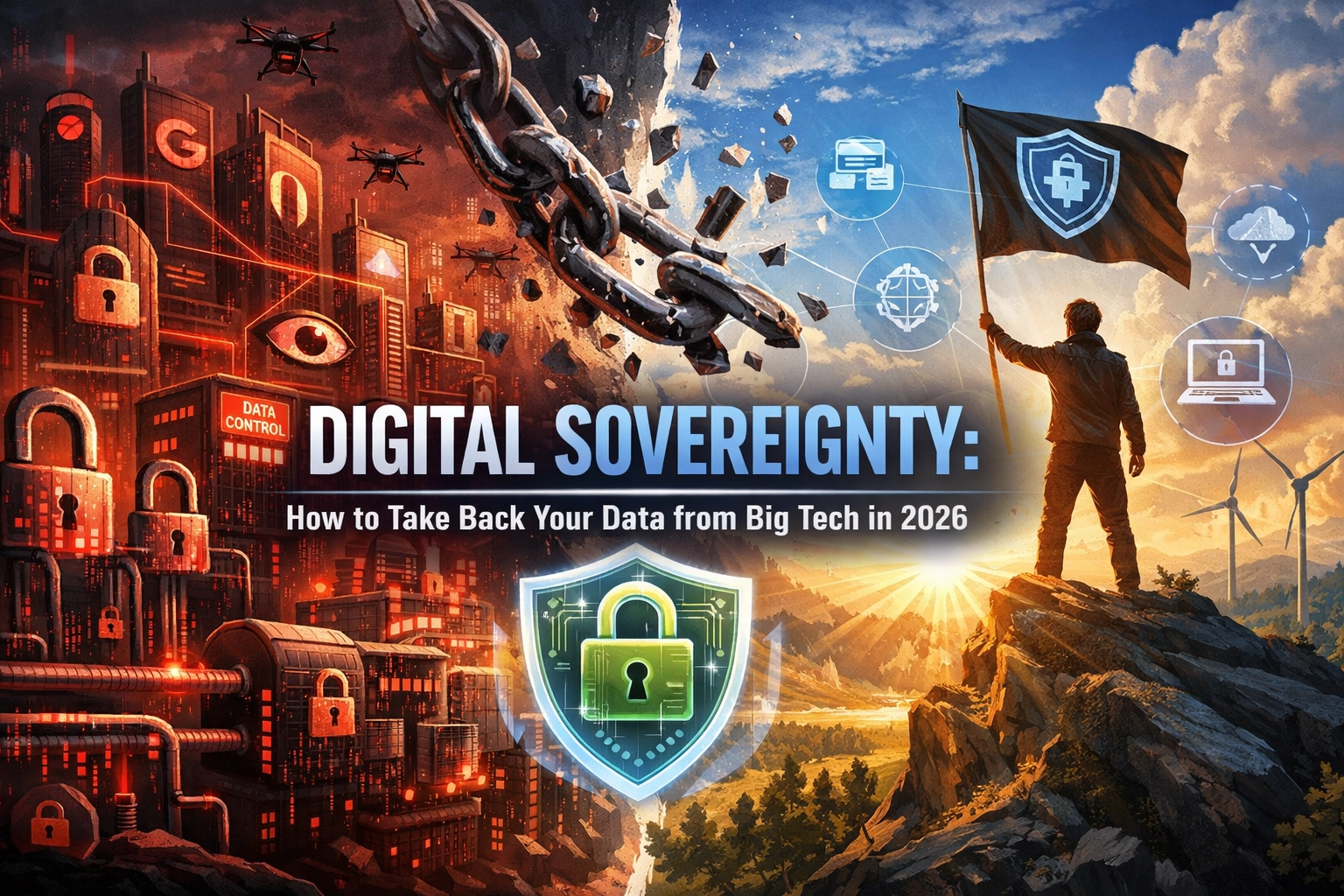
![[HERO] Digital Sovereignty: How to Take By Your Data from Big Tech in 2026](https://cdn.marblism.com/E3lp3Qd1R0E.webp)
By mid-2026, the concept of "privacy" has shifted from a luxury to a technical requirement. We’ve moved past the era where a simple VPN and an ad-blocker were enough to stay off the radar. Today, our data isn't just being sold to advertisers; it’s being fed into massive Large Language Models (LLMs) to train the very AI agents that might eventually replace us in the workforce.
Digital sovereignty is no longer just a buzzword for European regulators or privacy activists: it’s a survival strategy for the modern professional. If you don’t own your data, you don’t own your digital identity, and in 2026, your digital identity is your most valuable asset.
The State of the Data Monopoly in 2026
For decades, we traded our data for convenience. We gave Google our emails, Meta our social graphs, and Amazon our spending habits. In exchange, we got "free" services. But the cost has compounded. In 2026, "Big Tech" has evolved into "Big AI." The data they’ve collected for twenty years is now being used to build predictive models that can anticipate your moves before you make them.
According to 2025 industry reports, the market for sovereign cloud solutions grew by 35% year-over-year. This isn't just because people are paranoid; it’s because businesses and individuals have realized that "vendor lock-in" is a trap. If your entire business runs on a proprietary AI stack, you are at the mercy of their pricing, their ethics, and their uptime.

What Does Digital Sovereignty Actually Mean?
Digital sovereignty is the ability to have full control over your digital life. This breaks down into three core pillars:
- Data Residency: Knowing exactly where your data is stored geographically and which laws govern it.
- Access Control: Ensuring that you: and only you: decide who can see, use, or train models on your information.
- Technological Independence: Using open-source tools and standards so you can move your data from one provider to another without losing functionality.
The Architecture of Autonomy: Moving to a Sovereign Stack
If you’re serious about taking back control, you need to look at your "stack." Most people have a stack dominated by three companies. Reclaiming sovereignty requires a phased approach to decentralization.
1. The Rise of the "Personal AI Server"
In 2026, the biggest trend in tech-wellness and productivity is the home-based AI server. Instead of sending every prompt to a centralized cloud, savvy users are running local LLMs (like Llama 4 or Mistral variants) on consumer-grade hardware equipped with dedicated AI NPU chips.
By running your AI locally, your sensitive documents, personal journals, and business strategies never leave your local network. You get the power of automation without the privacy tax.
2. Customer-Managed Keys (CMK) and Zero-Knowledge Encryption
Standard encryption is no longer enough. If a cloud provider holds your encryption keys, they have a "skeleton key" to your life. Digital sovereignty in 2026 relies on Zero-Knowledge Architecture.
Services like Proton or Signal have paved the way, but we’re seeing this expand into file storage and project management. When you use your own keys (BYOK – Bring Your Own Key), the provider only sees encrypted "blobs" of data. Even if they are subpoenaed or hacked, your data remains unreadable.
3. Sovereign Clouds vs. Public Clouds
For professionals and solopreneurs, moving away from "The Big Three" (AWS, Azure, Google Cloud) toward sovereign cloud providers is the new gold standard. These providers operate under strict jurisdictional rules (like the EU’s Data Act of 2025) that prevent foreign governments from accessing data without local legal oversight.

Practical Steps to Reclaim Your Data Today
You don't have to go "off-grid" to achieve digital sovereignty. It’s about making intentional shifts in where your data lives.
Audit Your Data Flows
You can't protect what you can't see. Start by mapping out where your most sensitive data resides.
- Financial records: Are they sitting in a Gmail inbox?
- Intellectual property: Is your "second brain" (Obsidian, Notion, etc.) syncing to a proprietary cloud?
- Biometrics: Where is your health data from your wearable tech being stored?
Move to Open Standards
The biggest weapon Big Tech uses against us is the proprietary file format. If your data is trapped in a .pages or a specific database format that only one app can read, you don't own it.
In 2026, there is a massive push for Open Social Graphs and Portable Identity. Using tools that support Markdown, JSON, and decentralized identity (DID) standards ensures that you can take your "digital self" anywhere.
Implement Edge Processing
Stop sending raw data to the cloud for processing. Whether it’s photo editing, voice-to-text, or data analysis, use tools that leverage Edge Computing. This means the "thinking" happens on your device (the edge) and only the final result is synced.

The Economic Argument: High-CPC and the Value of Sovereignty
From a financial perspective, digital sovereignty is an investment. Data breaches in 2025 cost an average of $4.9 million per incident. For a freelancer or small business, a single leak of client data can be a terminal event.
Furthermore, "Sovereign Tech" is a high-growth sector. Companies are looking for "AI Ethics Officers" and "Data Sovereignty Architects" who can navigate the complex web of NIS2 and GDPR compliance. Mastering these tools isn't just about privacy; it's a high-value skill set in the 2026 job market.
Sovereignty Washing: What to Watch Out For
As digital sovereignty becomes more popular, "sovereignty washing" is becoming a major issue. This is when a company claims to be "sovereign" or "private" but still uses sub-processors located in jurisdictions with weak privacy laws.
To avoid this, look for:
- Transparent Transparency Reports: Check how often they fight data requests.
- Open Source Codebases: Can their claims be verified by third-party auditors?
- Local Governance: Is the company actually headquartered and operated in a jurisdiction that respects data rights?
The Future: A Post-Big Tech World?
We aren't going to delete our Google accounts overnight. But the trend toward digital sovereignty suggests a future where Big Tech platforms become "dumb pipes": utilities that we use for transport, while our actual data and "intelligence" sit safely in our own sovereign silos.
By taking these steps now: moving to local AI, adopting zero-knowledge encryption, and prioritizing open standards: you are future-proofing your career and your personal life against the volatility of the AI age.
About the Author: Malibongwe Gcwabaza
Malibongwe Gcwabaza is the CEO of blog and youtube, a forward-thinking digital agency focused on the intersection of AI, career strategy, and digital rights. With over a decade of experience in tech leadership, Malibongwe specializes in helping professionals navigate the rapidly shifting landscape of the 2026 economy. He is a firm believer that technical literacy is the ultimate form of empowerment in an automated world. When he’s not auditing data workflows, he’s exploring the latest in decentralized web infrastructure and sovereign computing.
About the Author