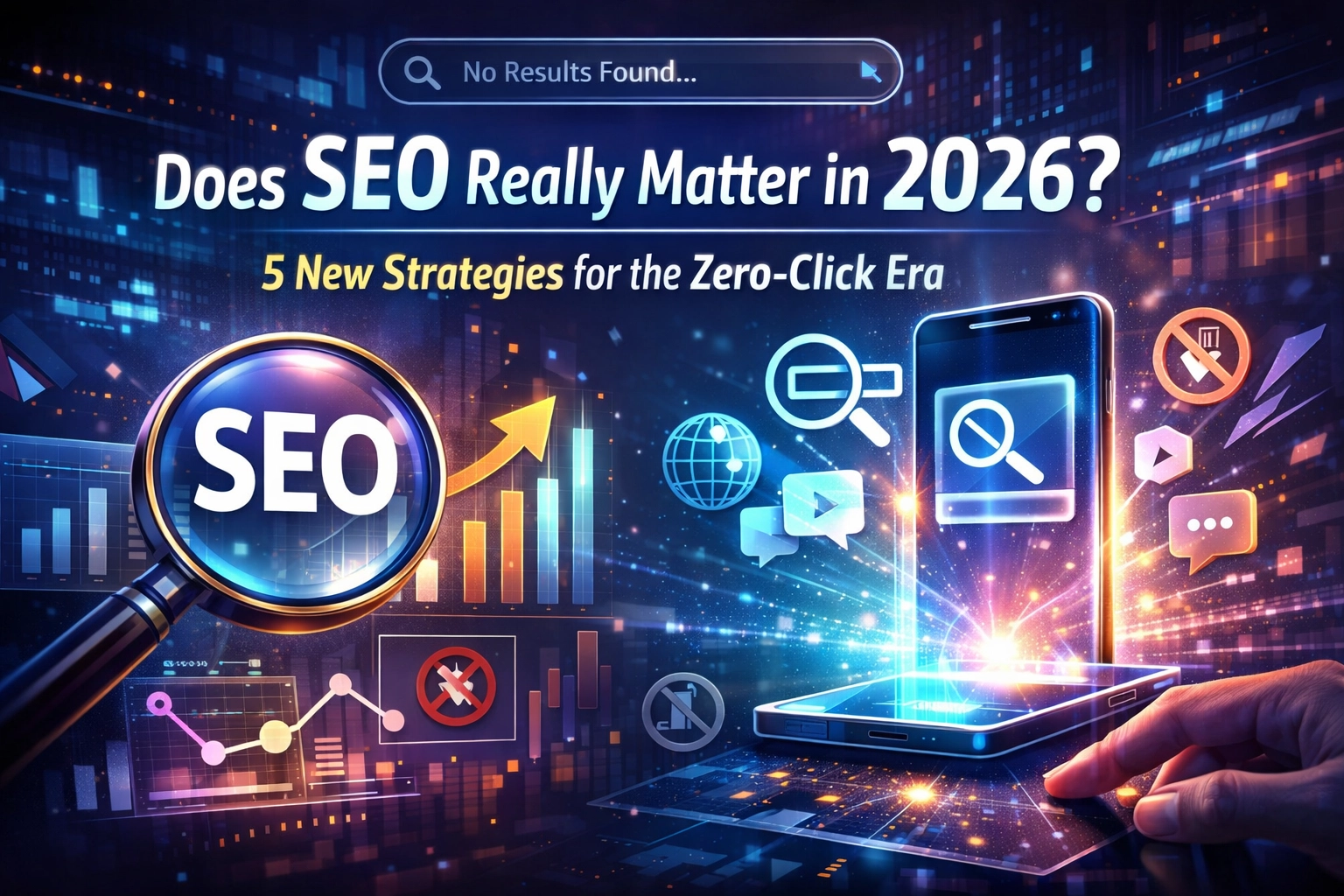
If you’ve spent any time looking at your analytics lately, you’ve probably noticed something unsettling. Your impressions might be holding steady, but your click-through rate (CTR) looks like it’s taking a permanent vacation. You aren't imagining things. By March 2026, we’ve officially entered the "Zero-Click Era," where roughly 60% of searches end without a user ever visiting a website.
Between AI Overviews (formerly SGE), featured snippets, and the rise of Large Language Models (LLMs) acting as personal assistants, the traditional "blue link" organic result is being pushed further down the page.
So, let’s address the elephant in the room: Is SEO dead?
No. But the SEO you practiced in 2022 is definitely in the ground. If you’re still chasing high-volume, generic keywords and hoping for a traffic flood, you’re fighting a losing battle. In 2026, SEO isn't about volume; it's about authority and intent.
Here is the deep dive into why SEO still matters and the five strategies you need to survive and thrive in this new landscape.
Why SEO Still Matters (The Data Doesn't Lie)
Despite the "zero-click" panic, the global SEO market is currently valued at over $72 billion. Why? Because while the quantity of clicks is changing, the quality is skyrocketing.
Data shows that users who arrive at your site through AI-powered search systems convert at 4.4x higher rates than traditional organic visitors. They stay on the site 38% longer. Why? Because the AI has already done the "filtering" for them. By the time they click your link, they aren't just browsing: they’re looking for a specific solution that only you provide.
Organic search still drives nearly 47% of all web traffic. The goal has shifted from being a "traffic magnet" to being the "authoritative source" that AI systems trust and cite.
1. Build Entity Clarity and Content Precision
In the old days, we optimized for keywords. In 2026, we optimize for entities.
An entity is a well-defined object or concept: a person, a place, a brand, or a specific technical process. Search engines no longer just look at the words on your page; they look at the relationships between those words.
How to execute this:
Stop writing "thin" content that tries to rank for a broad term like "marketing." Instead, focus on Content Precision. Your content needs to answer specific, complex queries that AI can’t fully summarize in a three-sentence snippet.
Use structured data (Schema markup) to tell search engines exactly who you are and what you do. If you’re a small business, your content marketing for small business strategy should involve creating "Topic Clusters." Build a pillar page about your core service and surround it with 10–15 hyper-specific sub-articles that link back to the main hub. This creates a web of authority that tells AI, "This site is the definitive expert on this specific entity."

2. Prioritize Content Freshness and The "Update" Cycle
The internet is currently being flooded. AI-generated content now makes up over 17% of top search results, and much of it is repetitive or outdated. Search engines have responded by aggressively favoring Freshness.
In 2026, a "set it and forget it" content strategy is a death sentence. You need a systematic process to refresh your top-performing posts every 3 to 6 months.
The 2026 Refresh Checklist:
- Update the data: Replace 2024 or 2025 stats with the latest 2026 figures.
- Check the intent: Does the search result still show the same kind of content? If the SERP has shifted from "how-to" videos to "product comparisons," you need to pivot your content type.
- Fix broken links: AI crawlers penalize "ghost" pages that lead to 404s.
- Add "Human" insights: Add a section on "What we learned this month" to signal to Google that a real person is behind the keyboard.
3. Double Down on E-E-A-T (Experience is Everything)
Google’s E-E-A-T (Experience, Expertise, Authoritativeness, Trustworthiness) is no longer a suggestion; it’s the primary filter. Since AI can generate "Expertise" by scraping the web, the most valuable letter in that acronym is now the first one: Experience.
Search engines are looking for "Proof of Life." They want to see that you’ve actually used the email marketing automation tools you’re recommending. They want to see original photos, case studies, and unique data.
How to show Experience:
- Case Studies: Don't just say "PPC is good." Show a breakdown of your PPC best practices for 2026 and the actual ROI you saw in a specific campaign.
- First-Person Narrative: Use "I" and "We." Describe the mistakes you made. AI is notoriously bad at admitting failure or describing personal growth.
- Author Transparency: Every post should be tied to a real person with a verified LinkedIn profile and a history of writing on the topic.
4. Invest in Branded Search Over Non-Brand Keywords
This is a bitter pill for many: chasing high-volume, non-branded keywords (like "best coffee") is becoming a waste of money for most small businesses. Why? Because AI Overviews usually take the top spot for those queries, giving the user the answer without them needing to click.
The solution? Branded Search.
When someone searches for your specific company name, you own that SERP. There is no zero-click threat because the user is looking for you.
In 2026, your SEO strategy must be integrated with your social media growth tips. Use platforms like LinkedIn, YouTube, and X to build a brand presence that drives people to search for your name specifically. Content marketing is no longer just about ranking; it's about building a brand that people remember when they're ready to buy.
5. Hyper-Local Optimization
AI search is getting scarily good at "Micro-Market" visibility. It’s no longer enough to rank for "Marketing Agency in London." You need to rank for the specific district, neighborhood, or even the block.
Hyper-local SEO involves:
- Real-time inventory/availability: If you’re a service business, showing real-time availability in search results.
- Hyper-local reviews: Encouraging reviews that mention specific locations or neighborhoods.
- Local Entity Links: Getting mentions from other local businesses, community boards, and local news outlets.
The 2026 Marketing Stack: Connecting the Dots
SEO doesn't exist in a vacuum. To win in the zero-click era, you have to treat your website as the "Home Base" for a multi-channel operation.
Social Media Growth Tips
Social media is the new discovery engine. In 2026, many users start their "search" on TikTok or Instagram. Your social media growth tips should focus on "Search-Optimized Social." Use keywords in your captions and alt-text on images. This ensures that when someone looks for a solution on social, they find you, which eventually leads to a branded Google search.
Email Marketing Automation Tools
Since you’re getting fewer clicks, you must make every click count. Once a user lands on your site, your goal is to get them off the "rented land" of search engines and onto your "owned land": your email list. Use modern email marketing automation tools to set up personalized drip campaigns. If someone reads an article on SEO strategies, they should automatically receive a follow-up guide 2 days later.
PPC Best Practices for 2026
Pay-per-click is the perfect bridge for the gaps left by organic search. PPC best practices for 2026 focus on "Search Themes" rather than exact-match keywords. Use AI-driven campaigns to capture the high-intent traffic that AI Overviews might be siphoning off, but keep your bidding focused on conversion-ready terms rather than top-of-funnel awareness.
Summary: The New SEO Blueprint
| Old SEO (2022) | New SEO (2026) |
|---|---|
| Keyword Frequency | Entity Clarity & Relationships |
| Traffic Volume | Conversion Intent & Citations |
| Set and Forget | Continuous Freshness Updates |
| General Expertise | Lived Experience (E-E-A-T) |
| Non-Branded Focus | Branded Search Dominance |
The "Zero-Click Era" isn't the end of the world: it’s just the end of lazy marketing. If you focus on building a real brand, providing genuine experience-based value, and keeping your content fresher than your competitors, you won't just survive 2026; you'll dominate it.
About the Author: Malibongwe Gcwabaza
Malibongwe Gcwabaza is the CEO of blog and youtube, a digital growth firm dedicated to helping businesses navigate the complexities of modern content marketing. With over a decade of experience in the shifting sands of search engine algorithms, Malibongwe focuses on "Simple Growth": cutting through the technical noise to deliver strategies that actually move the needle for small businesses. When he’s not dissecting the latest Google core update, you can find him exploring the intersection of AI and human creativity.
About the Author