Does SEO Strategy Really Matter in 2026? (The Truth About Ranking Now)
![[HERO] Does SEO Strategy Really Matter in 2026? (The Truth About Ranking Now)](https://cdn.marblism.com/YFmTLpaRHW1.webp)
Let’s get the elephant out of the room right away: SEO isn’t dead. It hasn’t been “killed” by AI, and it hasn’t been replaced by TikTok. But if you’re still using the same SEO strategies from 2022: or even 2024: you’re basically trying to win a Formula 1 race with a horse and carriage.
By 2026, the game has shifted from “tricking the algorithm” to “becoming the authority.” Search engines like Google and Bing aren’t just looking for keywords anymore; they are sophisticated AI systems designed to provide the best possible answer to a human problem.
So, does SEO strategy still matter? Absolutely. But the “how” has changed forever. Here is the ground truth about ranking in 2026 and why your old playbook belongs in the recycling bin.
The AI Search Revolution: Beyond the Blue Link
In 2026, search isn’t just a list of ten blue links. We are living in the era of SGE (Search Generative Experience) and AI-led discovery. When a user types a query, the search engine often synthesizes an answer directly on the results page using information pulled from various sources.
This has led many to panic. “If the AI gives the answer, why will anyone click my site?”
The answer is simple: Source Credibility. AI search engines don’t just pull facts from thin air; they cite sources. Your goal in 2026 isn’t just to rank #1; it’s to be the primary source that the AI trusts enough to cite. If you are the cited authority, your click-through rate (CTR) from high-intent users actually increases, because people who click through are looking for the “deep dive” that an AI summary can’t provide.

Intent Density: The New Keyword Research
We used to talk about keyword density: the number of times a specific phrase appeared on a page. In 2026, that metric is completely irrelevant. Today, we focus on Intent Density.
Intent density is about how efficiently you satisfy the user’s “why.” Search engines now use Large Language Models (LLMs) to understand the context of a query. They can tell the difference between someone looking for a quick definition and someone looking for a technical tutorial.
How to Optimize for Intent Density:
- Stop Fluffing: If someone asks “How to change a tire,” don’t start with the history of the wheel. Give them the steps immediately.
- Answer the “Next” Question: Great content anticipates what the user will ask after they finish your article.
- Use Semantic Richness: Instead of repeating your target keyword, use related concepts, technical jargon, and synonyms that prove you actually understand the topic.
Technical SEO in 2026: The “API-Ready” Website
Technical SEO used to be about meta tags and sitemaps. While those still exist, the 2026 landscape requires your site to be “readable” by more than just human eyes. Your site needs to be structured in a way that AI agents can crawl and understand your data instantly.
The New Technical Checklist:
- Structured Data (Schema 2.0): You need robust schema markup for everything: articles, products, FAQs, and even your “About Me” page. This helps search engines connect the dots between your brand and your expertise.
- Sub-Second Load Times: Speed is no longer a “nice-to-have.” With the rise of 5G and high-speed fiber, users (and bots) have zero patience. If your site takes more than 1.5 seconds to become interactive, you’re losing rank.
- Semantic HTML: Using
<div>tags for everything is a sin. Use proper<article>,<section>, and<aside>tags to help AI understand the hierarchy of your information.
| Factor | 2020 Standard | 2026 Reality | ||
|---|---|---|---|---|
| Primary Focus | Keyword Density | Intent Density & UX | ||
| Content Volume | Weekly “OK” blog posts | High-authority “Epic” guides | ||
| Links | Quantity & Domain Authority | Relevance & Real Traffic | ||
| Technical | Site Speed / Mobile-friendly | API-ready data / Semantic Schema | ||
| Measurement | Keyword Rankings | Brand Authority & Citations | ||
Topic Clusters: Why Depth Beats Breadth
One-off blog posts are essentially useless in 2026. If you want to rank for “SEO strategies 2026,” you can’t just write one article and call it a day. You need to build a Topic Cluster.
A topic cluster consists of a “Pillar Page” (a massive, comprehensive guide) and several “Cluster Content” pieces (detailed articles on sub-topics). This signals to search engines that you aren’t just a casual observer; you are a subject matter expert.
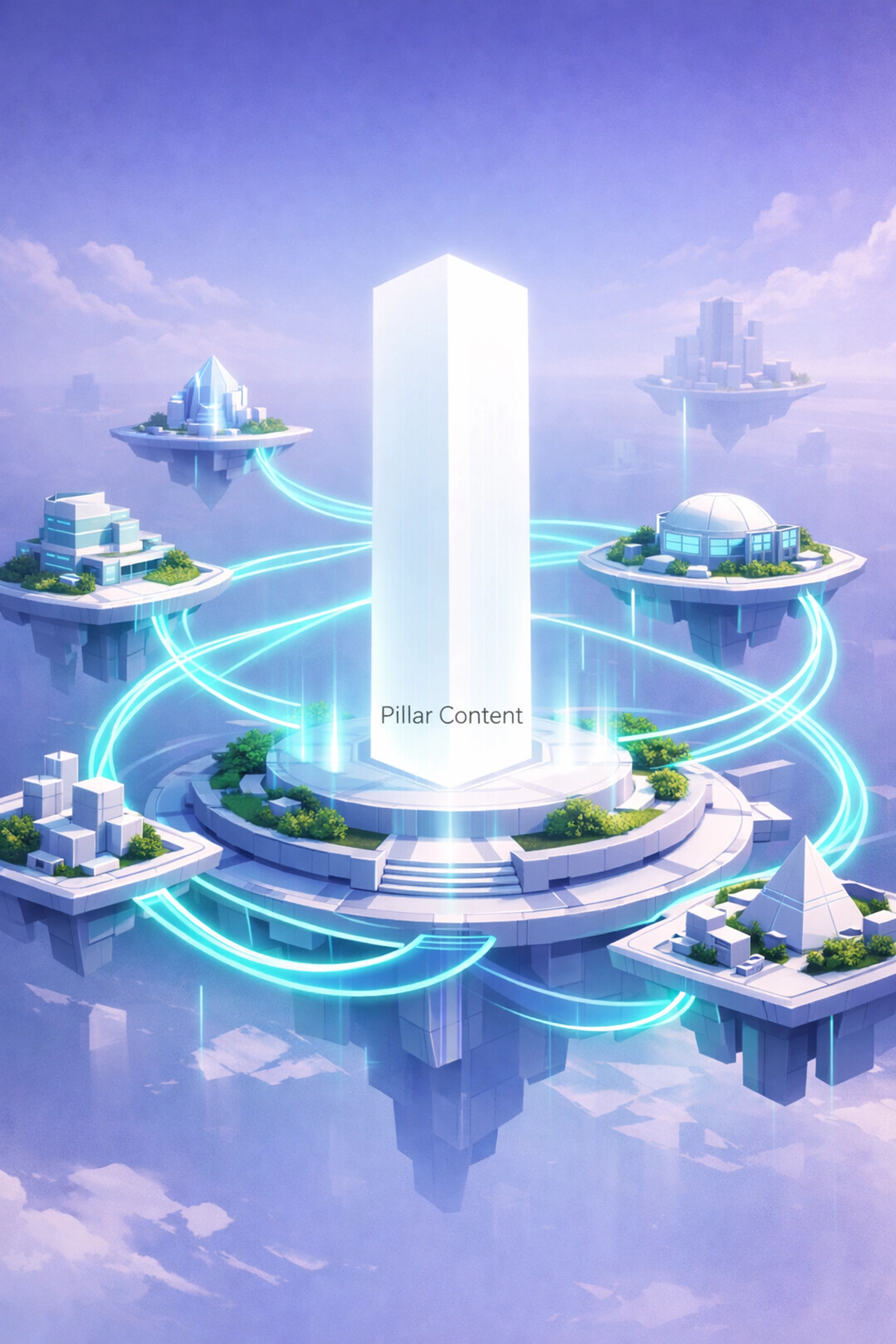
For example, if your pillar is “Digital Marketing,” your clusters should cover:
- Email automation workflows
- AI-driven ad targeting
- Zero-click search optimization
- The psychology of social proof
By linking these together, you create a “web of authority” that is incredibly hard for competitors to displace.
The Human Factor: E-E-A-T is the Only Moat
As AI-generated content floods the internet, search engines have doubled down on E-E-A-T (Experience, Expertise, Authoritativeness, and Trustworthiness).
In 2026, the “Experience” part is the most critical. AI can write a guide on “how to fly a plane” by scraping the web, but it can’t tell you how it felt when the engines stalled over the Rockies. Search engines are prioritizing content that includes:
- Personal anecdotes and case studies.
- Original data and research.
- First-hand photos and videos.
- A clear, verified author bio.
If your content looks like it could have been written by a generic AI prompt, it will eventually be buried. You must inject personality and “lived experience” into every piece.
Zero-Click Searches: Winning Without the Visit
It sounds counterintuitive, but a successful SEO strategy 2026 involves winning “zero-click” searches. This is when the user gets their answer directly from the SERP (Search Engine Results Page) without clicking a link.
Why would you want this? Because of Brand Salience. When a user sees your brand name cited as the source of the answer ten times in a row, who are they going to go to when they are finally ready to buy a product or hire a consultant? They’re going to go to you.
Being the “knowledge source” builds a level of trust that no amount of paid advertising can buy. In 2026, SEO is as much about PR and brand building as it is about traffic.

2026 Ranking Factors: What Actually Moves the Needle?
If you want to move the needle this year, focus on these three pillars:
1. Engagement Signals (User Experience)
Search engines are looking at how users interact with your site. Do they stay and read? Do they click on your internal links? Or do they “bounce” back to the search results immediately? High dwell time is a massive ranking signal. If your content is boring or hard to read, your technical SEO won’t save you.
2. Backlink Quality over Quantity
The days of buying 500 links on Fiverr are over (and have been for a while). In 2026, one link from a high-traffic, relevant industry site is worth more than 10,000 links from “link farms.” Search engines can now track whether a link actually sends real human traffic. If a link doesn’t get clicked, its value is nearly zero.
3. Visual and Video Integration
A wall of text is a death sentence. Your articles need to be multi-modal. Including a short video summary, an infographic, or interactive elements not only helps with SEO but also keeps users engaged. Google’s “Perspective” filter and YouTube’s integration into search mean that your video content is now a direct ranking factor for your text content.
The Verdict: Does Strategy Matter?
Strategy matters more than ever because the “low-hanging fruit” is gone. You can no longer just “do SEO” as an afterthought. It has to be baked into your entire business model.
In 2026, SEO is the art of aligning your brand’s expertise with the specific needs of your audience, while making it as easy as possible for AI systems to verify your claims. It’s about being the most helpful, most trusted, and most accessible resource in your niche.
If you commit to building authority through topic clusters, prioritizing intent density, and proving your E-E-A-T, you won’t just survive the AI revolution: you’ll lead it.
About the Author: Malibongwe Gcwabaza
Malibongwe Gcwabaza is the CEO of blog and youtube, a forward-thinking digital agency specializing in high-performance content strategy and search visibility. With over a decade of experience navigating the shifts in digital marketing, Malibongwe focuses on simple, actionable strategies that help businesses scale without the fluff. When he’s not dissecting algorithm updates, he’s mentoring the next generation of digital creators.
About the Author