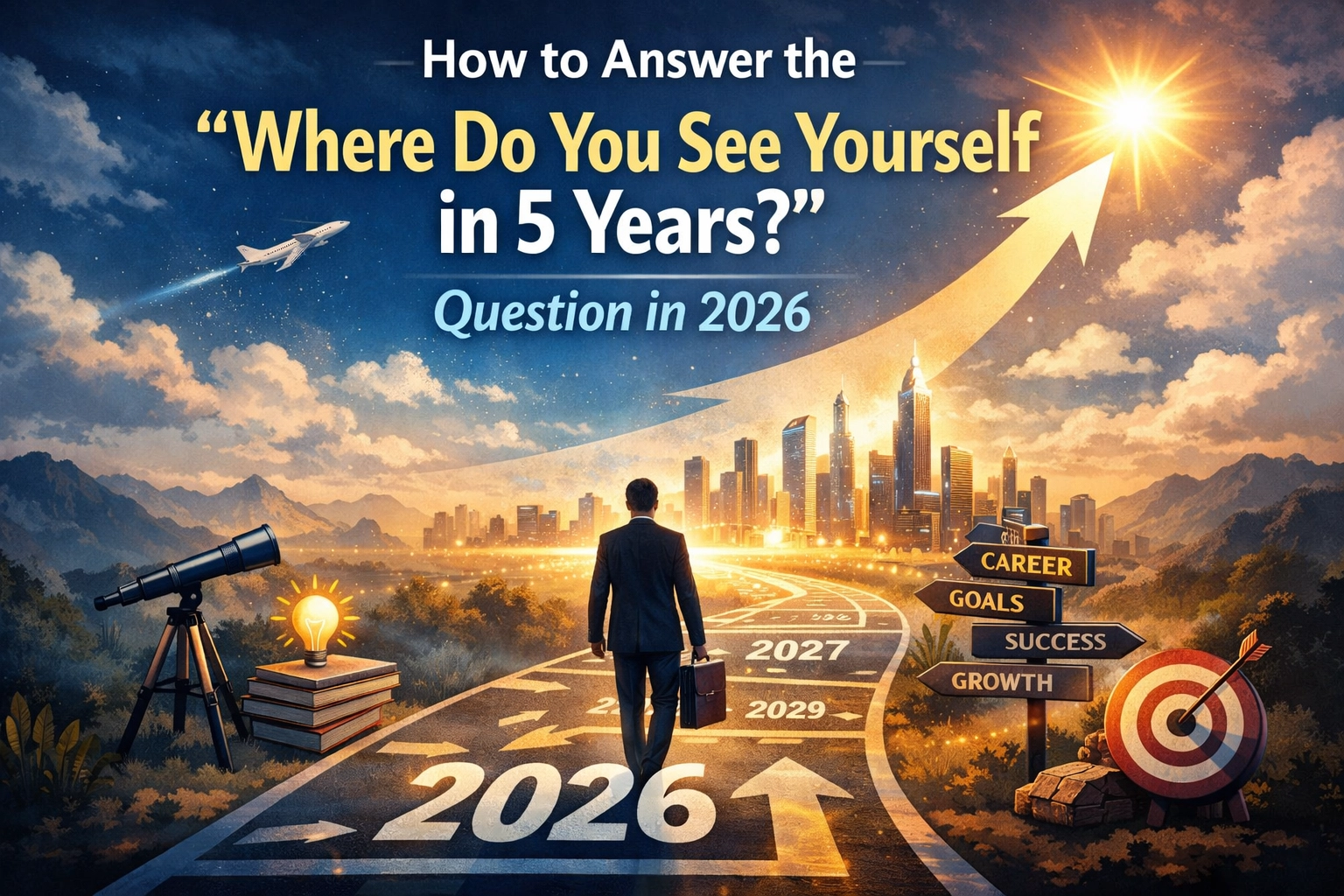
In 2026, the traditional "five-year plan" is officially a relic. With the shelf-life of technical skills shrinking to less than 2.5 years and Agentic AI transforming how we execute daily tasks, an interviewer asking "Where do you see yourself in five years?" isn't actually looking for a destination. They are looking for a strategy.
If you give a 2021-style answer: "I hope to be in a senior management role leading a large team": you might actually hurt your chances. Why? Because in a lean, AI-augmented workforce, "large teams" are becoming rarer, and "management" looks nothing like it used to. Today, employers are testing your Learning Agility (LA) and your ability to remain relevant in a market that pivots every quarter.
Here is how to deconstruct and dominate this question in the current landscape.
Why the Question Has Changed: The 2026 Context
Before you answer, you need to understand the underlying mechanics of the 2026 job market. We are currently in the era of Skills-Based Hiring. According to recent industry shifts, 70% of Fortune 500 companies have removed degree requirements for mid-level roles, focusing instead on "verifiable competencies."
When a hiring manager asks about your five-year outlook, they are scanning for three things:
- AI Orchestration Capability: Will you be someone who uses AI to do 10x the work, or will you be replaced by someone who does?
- Strategic Adaptability: How do you handle "Black Swan" events in tech?
- ROI Alignment: Does your growth path actually help the company’s bottom line, or is it just a personal hobby?

The "Adaptive Architect" Framework
Instead of a linear path, your answer should follow what we call the Adaptive Architect framework. This moves away from job titles and focuses on "impact layers."
1. The Technical Mastery Layer (Years 1-2)
Start by discussing the specific technical trajectory you’re on. In 2026, this usually involves moving from "user" to "orchestrator."
Example: "In the next two years, my goal is to transition from managing standard LLM outputs to architecting custom Agentic workflows that automate our department's data pipeline. I'm currently finishing a certification in GEO (Generative Engine Optimization) to ensure our brand remains visible as search shifts away from links and toward synthesized answers."
2. The Influence and Leadership Layer (Years 3-4)
Leadership in 2026 isn't just about "people management"; it's about "system management."
Example: "By year three, I see myself leading cross-functional initiatives. As the line between marketing and engineering blurs, I want to be the bridge that ensures our AI-driven customer journeys are both technically sound and ethically compliant."
3. The Value Innovation Layer (Year 5)
This is where you show the ROI. How does your existence in the company five years from now make them more money or save them more time?
Example: "Ultimately, in five years, I want to have developed a proprietary framework for [Industry-Specific Task] that reduces our operational overhead by 30%. I want to be known as the person who scaled this department's output without needing to scale the headcount proportionally."
Dealing with the "AI Replacement" Anxiety
There is a subtext to this question in 2026: Will this job even exist in five years?
Smart candidates acknowledge the elephant in the room. If you’re applying for a role in data entry, accounting, or junior copywriting, a "five-year plan" that doesn't mention AI evolution sounds delusional.
To stand out, emphasize your "Human Moat." These are the skills AI still struggles with in 2026:
- High-Stakes Negotiation: AI can suggest scripts, but it can't read the "vibe" in a room of stakeholders.
- Complex Empathy: Navigating internal office politics or sensitive client crises.
- Novel Problem Solving: Solving a problem that has no historical data for an AI to train on.

Sample Answers for Modern Roles
For an AI Product Manager
"In five years, the concept of a 'Product' will likely be a dynamic, personalized AI agent rather than a static app. My goal is to move from managing features to managing 'Agentic Ecosystems.' I plan to have mastered the balance between rapid deployment and AI safety protocols, ensuring that our products don't just solve problems but do so within the evolving global regulatory frameworks like the 2025 AI Accord."
For a Digital Marketing Specialist
"SEO is dead; GEO is the future. In five years, I see myself as a Master of Generative Engine Optimization. I want to have moved beyond keyword research into 'Intent Architecture': ensuring our brand is the primary source cited by every major AI model. I’m also looking to integrate neuro-marketing data into our automated campaigns to maintain a high conversion rate in an increasingly 'noisy' digital world."
For a Cybersecurity Analyst
"Threat actors are using quantum-assisted attacks now, so in five years, I see myself as a leader in Post-Quantum Cryptography (PQC). I’m not just looking to patch vulnerabilities; I want to build self-healing security infrastructures. My five-year goal is to reduce our 'Mean Time to Detect' (MTTD) to near-zero using autonomous defensive agents."
The "Red Flags" to Avoid in 2026
- The "Static" Answer: "I want to be doing exactly what I'm doing now, just better." (Translation: You aren't prepared for the inevitable industry shifts).
- The "Exit Strategy" Answer: "I want to start my own company." (While honest, it tells the employer you are using them as a paid bootcamp).
- The "Title-Obsessed" Answer: "I want to be a VP." (In 2026, flat organizational structures are the norm. Focus on what you’ll do, not what you’ll be called).

Data-Driven Growth: The Power of Micro-Credentials
In your answer, mention specific learning paths. In 2026, saying "I plan to learn more" is weak. Saying "I am currently stacking micro-credentials from IIM and Google in AI-Powered Digital Marketing to hit my Year 3 competency goals" is powerful.
Data from the Global Skills Report 2025 shows that employees who mention specific "stackable" certifications during interviews are 40% more likely to be perceived as "high-potential" (HiPo) candidates. It proves you have a roadmap for yourself, which means the company won't have to build one for you.
Connecting Your Growth to Company OKRs
The best way to wrap up your five-year answer is to tie it back to the company you’re sitting in.
"I've followed [Company Name]'s recent pivot into [Specific Market]. In five years, as that market matures, I see myself being the subject matter expert who helped navigate that transition. My growth is designed to mirror the company’s expansion into [Region/Technology]."
This shows you’ve done your homework. You aren't just looking for a job; you’re looking for this career at this company.

Summary Checklist for Your Answer
- Year 1-2: Focus on mastering the current toolstack and integrating AI efficiencies.
- Year 3-4: Focus on cross-departmental influence and "Human Moat" skills.
- Year 5: Focus on long-term ROI and becoming an "Orchestrator" of systems.
- The Pivot: Acknowledge that the industry moves fast and you are built for agility.
The "Where do you see yourself" question isn't a trap; it's an opportunity to show you are a forward-thinking professional who understands that in 2026, the only constant is change. If you can prove that you’ll be more valuable in five years because of your ability to evolve, you’ve already won the interview.
About the Author: Malibongwe Gcwabaza
Malibongwe Gcwabaza is the CEO of blog and youtube, a premier digital media and career development platform. With over a decade of experience in tech leadership and human capital strategy, Malibongwe focuses on the intersection of AI and the future of work. He is a frequent speaker on "Agentic Workflows" and "Skills-Based Hiring," helping thousands of professionals navigate the complexities of the 2026 job market. Under his leadership, blog and youtube has become a go-to resource for high-quality, data-driven career insights.
About the Author