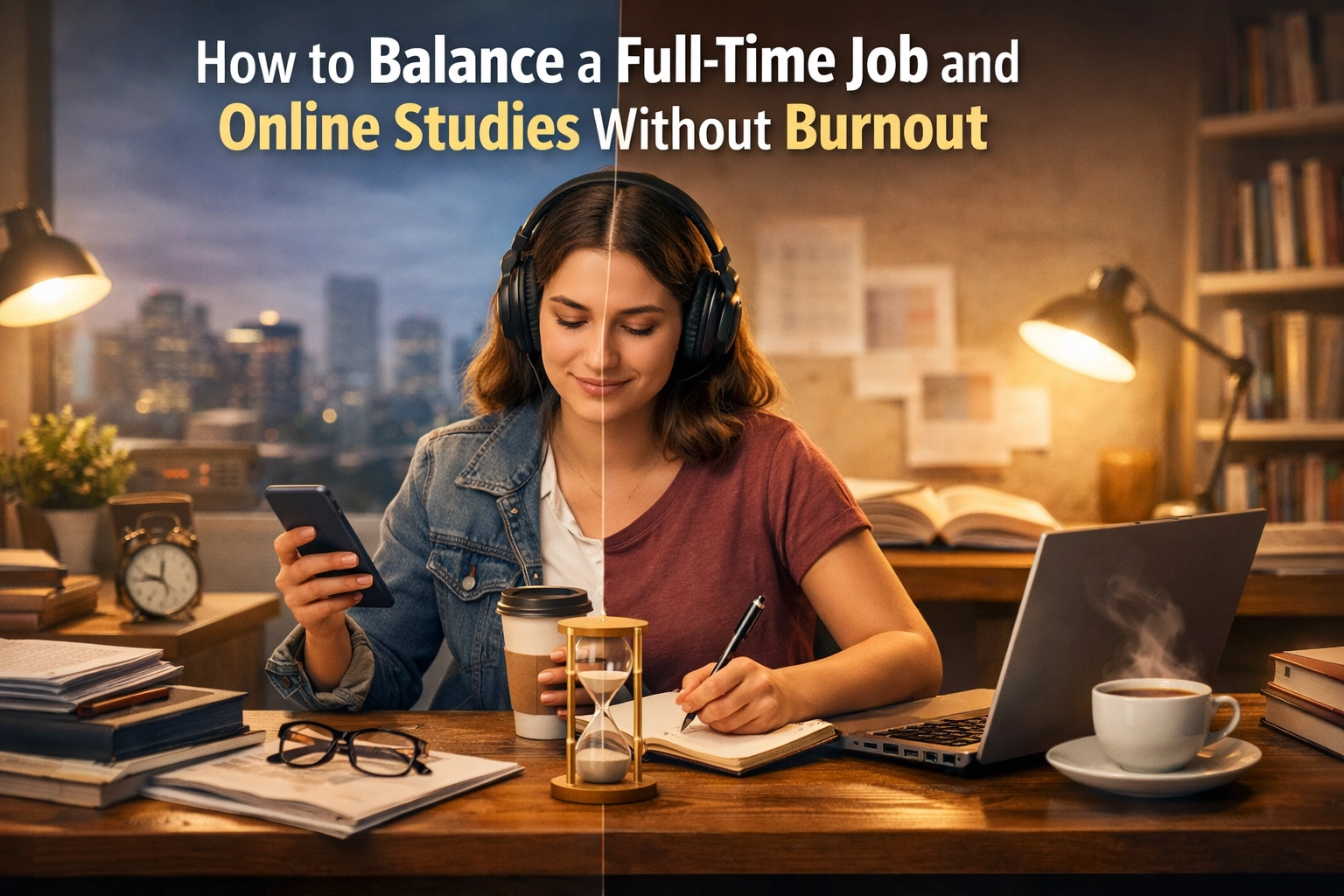
In 2026, the traditional boundary between "working years" and "university years" has effectively dissolved. With the rise of the "stackable credential" economy, more than 70% of online learners are now balancing full-time employment with high-stakes certification or degree programs. However, this shift has brought a hidden crisis: cognitive overload.
The primary reason students fail online programs isn't a lack of intelligence; it’s a failure to manage the transition between professional output and academic intake. When you work 40 to 50 hours a week and then attempt to engage in deep learning, you aren't just battling time: you are battling the biological limits of your prefrontal cortex.
To survive and thrive in this environment, you need a system that treats your energy as a finite resource, much like a data center manages its power load. Here is the technical roadmap to balancing a career and education without hitting the wall of burnout.
The Science of Context Switching and "Attention Residue"
Most working students make the mistake of trying to "squeeze in" study sessions during lunch breaks or immediately after a stressful meeting. According to Dr. Sophie Leroy’s research on "Attention Residue," when you switch from Task A (your job) to Task B (your studies), a part of your brain remains stuck on Task A. This residue significantly reduces your cognitive capacity for learning complex new concepts.
To combat this, you must implement "Buffer Blocks."
A Buffer Block is a non-negotiable 15-minute period between your workday and your study session. During this time, you should engage in a "sensory reset": stepping away from all screens, practicing box breathing, or doing a quick physical stretch. This signals to your brain that the professional context is closed and the academic context is open. Without this reset, you are trying to upload new data into a hard drive that hasn't finished its previous processing task.

Strategic Scheduling: The 168-Hour Audit
To avoid burnout, you have to move past "to-do lists" and move toward "capacity planning." Every person has 168 hours in a week. If you work 40 hours, sleep 56 hours (8 hours a night), and spend 10 hours on chores/commutes, you have 62 hours left.
The problem arises when students try to fill all 62 remaining hours with studying. This is a recipe for adrenal fatigue.
The 50/10 Method for Online Learning
For 2026, we recommend the 50/10 Study Framework. Unlike the Pomodoro Technique (which can be too short for deep technical subjects), the 50/10 method aligns better with adult learning cycles:
- 50 Minutes of Deep Work: Focus exclusively on one technical module. Use a site blocker to kill LinkedIn and Slack.
- 10 Minutes of Active Recovery: Do not check your phone. Stand up, hydrate, or look out a window to reset your visual focus (averting Digital Eye Strain).
By capping your nightly study sessions at two 50/10 cycles (roughly 2 hours total), you ensure that your brain actually encodes the information into long-term memory rather than just "skimming" while exhausted.
Leveraging Agentic AI for Curriculum Management
One of the greatest advantages for students in 2026 is the use of Agentic AI: AI systems that can execute tasks rather than just answer questions. You shouldn't be spending hours organizing your syllabus.
Use AI tools (like specialized Gemini wrappers or Notion AI) to:
- Deconstruct the Syllabus: Feed your course PDF into the AI and ask it to create a "Study Backlog" based on your available hours.
- Synthetic Flashcards: Have the AI generate Anki-style flashcards from your lecture transcripts.
- Gap Analysis: If you’re struggling with a concept like "Neural Network Architecture," ask the AI to explain it using an analogy from your current professional field (e.g., "Explain this like a supply chain manager would understand it").
This reduces the "administrative drag" of being a student, allowing your limited energy to stay focused on high-value learning.

Employer Synergy: Turning Study into "Professional Development"
Burnout often stems from the feeling that your job and your studies are in competition. To win, you must make them collaborators.
Many modern companies in 2026 offer Educational Reimbursement or Learning Hours. If you haven't checked your employee handbook lately, you might be missing out on "L&D" (Learning and Development) time.
How to Negotiate "Study Integration"
If your degree is relevant to your job: for example, an AI Ethics Certification while working in Finance: approach your manager with a "Value-Exchange Proposal":
- The Ask: 3 hours of dedicated "Deep Learning" time on Friday afternoons.
- The Give: A monthly "Knowledge Share" presentation where you teach your team the top 3 insights you learned that month.
When your employer sees your education as an asset to their bottom line, the pressure to "hide" your studies disappears, drastically reducing your stress levels.
The Physicality of Burnout: Ergonomics and Neuro-Nutrition
Online learning is a sedentary marathon. You cannot expect to sit in an office chair for 8 hours and then sit at a kitchen stool for 3 hours of studying without physical repercussions.
The "Third Space" Rule
To prevent mental fatigue, do not study in the same place where you work. If you work at a desk, study on the couch with a laptop stand, or go to a library. If you work from home, the "context shift" of moving to a different room is a powerful psychological trigger that tells your brain, "The workday is over; now we are growing."
Nutritional Support for the Working Student
The "caffeine and sugar" cycle is the fastest way to burnout. High glucose spikes lead to "brain fog" during your study hours.
- L-Theanine & Caffeine: If you use coffee to stay up, pair it with L-Theanine to prevent jitters and maintain focus.
- Omega-3s: Essential for neuroplasticity (the brain's ability to form new connections).
- Magnesium Glycinate: Take this before bed to ensure that even if you only get 6 hours of sleep, it is high-quality, restorative REM sleep.

The "Living Resume" Mindset
Finally, remember that the goal of online study in 2026 is no longer just the degree: it's the application. In the current job market, a "static PDF" resume is dying.
Instead of seeing your coursework as "homework," see it as a "Portfolio Build." Every project you do for your online course should be uploaded to GitHub or a personal portfolio site. When you see your studies as "career-building" rather than "chore-doing," your intrinsic motivation increases. High intrinsic motivation is the most effective natural defense against burnout.
Summary Checklist for the Working Student
- Schedule 15-minute Buffer Blocks between work and study.
- Audit your 168 hours; leave at least 15% for "white space" (doing nothing).
- Use AI to automate your study notes and syllabus management.
- Move your body; learning is a physical process as much as a mental one.
- Communicate with your manager to align your studies with company goals.
About the Author: Malibongwe Gcwabaza
Malibongwe Gcwabaza is the CEO of blog and youtube, a leading digital platform dedicated to the intersection of AI, career evolution, and modern education. With over a decade of experience in executive leadership and a passion for lifelong learning, Malibongwe specializes in helping professionals navigate the complexities of the 2026 labor market. He believes that with the right systems, anyone can master new technologies while maintaining a high-performance career.
About the Author