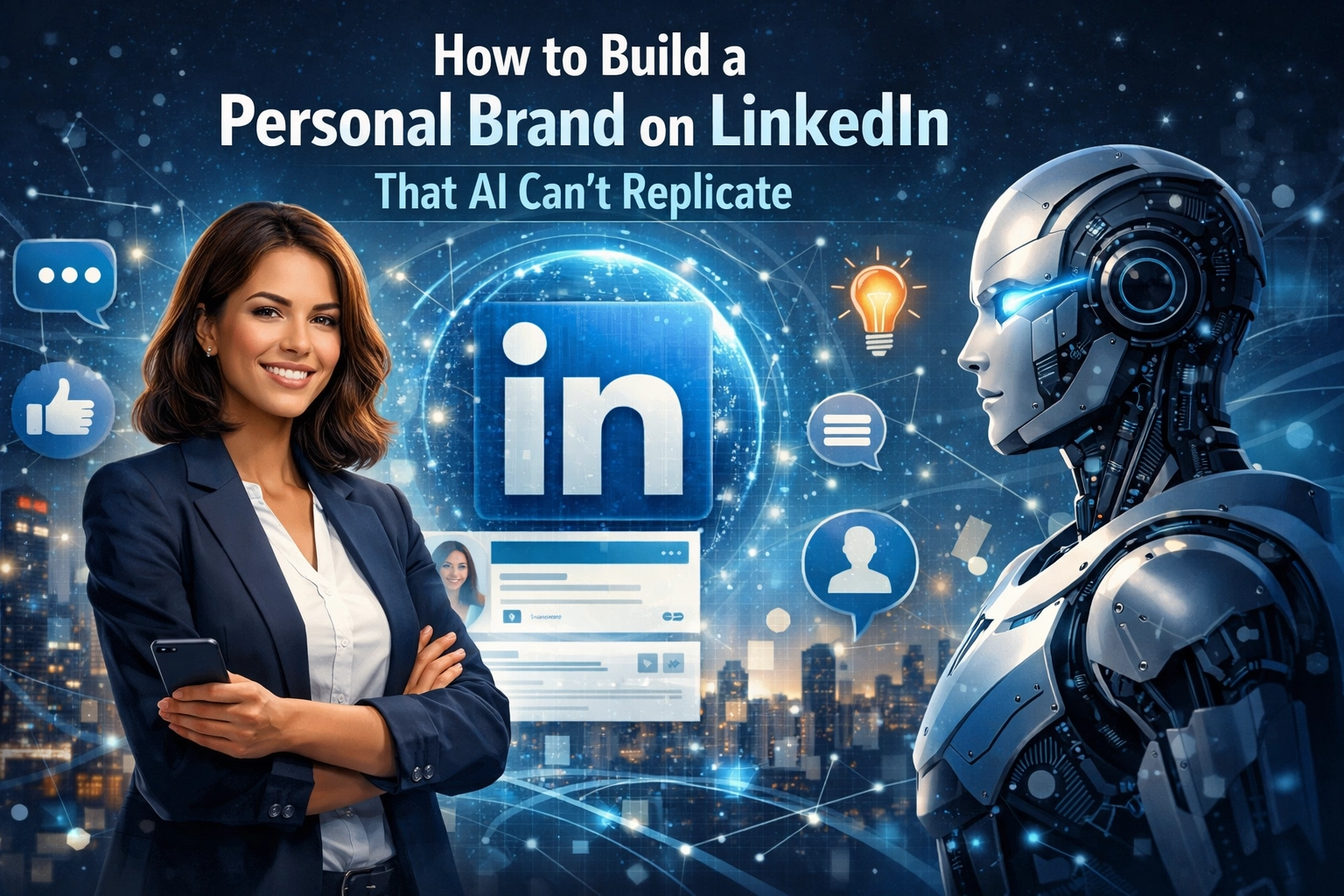
By March 2026, the "Dead Internet Theory" has moved from a fringe conspiracy to a daily reality for most professionals. If you scroll through your LinkedIn feed right now, about 70% of the "thought leadership" you see was likely synthesized by an LLM in under six seconds. We’ve reached a point where perfect grammar, logical structuring, and generic advice are no longer signs of expertise: they are signs of a well-crafted prompt.
For high-level professionals, this creates a massive problem. When everyone can sound like a Rhodes Scholar with a few clicks, how do you signal your actual value? How do you build a personal brand that commands a high CPC (Cost-Per-Click) in the attention economy and catches the eye of recruiters looking for $250k+ roles?
The answer isn't to work harder; it’s to be more human. In an era of infinite synthetic content, "un-AI-geable" authenticity is the only currency that still appreciates.
The Commodity of Knowledge vs. The Premium of Experience
In 2026, information is free and infinite. If you post a "Top 10 Tips for Project Management," you are competing with every AI agent on the planet. You will lose. AI can summarize every book ever written on project management in a heartbeat.
To build a brand that AI can't replicate, you have to move from Information to Insight.
Information is: "Here is how a Scrum Master facilitates a sprint."
Insight is: "Here is how I handled a mid-sprint breakdown when my lead developer quit and the client was threatening to pull a $2M contract."
AI cannot simulate the "messiness" of human leadership. It can't feel the sweat on your palms during a board meeting or the nuance of a difficult 1-on-1 conversation. Your brand must be built on the "receipts" of your career: the specific, idiosyncratic, and often non-linear lessons that only come from actually doing the work.

Strategic Vulnerability: The "Anti-AI" Content Pillar
One of the biggest tells of AI-generated content is its relentless positivity or its "safe" corporate tone. AI is programmed to be helpful and harmless. It rarely takes controversial stands, and it never admits to feeling like an imposter.
To stand out in 2026, you need to lean into Strategic Vulnerability. This doesn't mean oversharing your personal life; it means sharing your professional failures and the cognitive dissonance of your industry.
Why Vulnerability Wins in the 2026 Algorithm
LinkedIn’s 2026 algorithm has evolved to prioritize "High-Context Narrative" posts. Because the platform is flooded with synthetic "how-to" guides, the system now rewards content that displays high levels of E-E-A-T (Experience, Expertise, Authoritativeness, and Trustworthiness).
When you write about a mistake you made, you are providing a unique data point that does not exist in a training set. You are signaling to both the algorithm and your human audience that there is a "Ghost in the Machine." This drives engagement rates: specifically "meaningful social interactions": which are the primary drivers for high-intent lead generation and AdSense revenue for creators.
The "Living Resume" and the Rise of Proof-of-Work
In the current market, a static LinkedIn profile is a dead profile. Recruiters are now using AI tools to "sniff out" profiles that have been optimized solely by AI. To counter this, top professionals are moving toward the "Living Resume" model.
This involves:
- Video Commentary: AI video (Deepfakes) is good, but it still struggles with the micro-expressions of a genuine, unscripted technical debate. Posting short, raw video clips of you explaining a complex concept provides "Proof of Personhood."
- The Portfolio Career Mindset: Instead of listing jobs, show "Artifacts of Impact." Link to GitHub repos, design Figmas, or white papers you’ve actually authored.
- Curation with Context: Don't just reshare an article. Curate it. Explain why the data in the article is wrong based on what you’re seeing "on the ground."

Technical GEO: Generative Engine Optimization for Your Brand
Standard SEO is dying. In 2026, we focus on GEO (Generative Engine Optimization). When a recruiter asks an AI agent, "Who are the top experts in Decentralized Finance in South Africa?", you want the AI to name-drop you.
AI agents "learn" who you are by crawling your LinkedIn activity, your mentions in trade publications, and your guest appearances on niche podcasts. To optimize for this:
- Use Specific Keywords in Human Context: Instead of just saying you're an "Expert in AI," say "I implemented a Multi-Agent AI System for a logistics firm that reduced overhead by 22%." The AI needs specific "nodes" of data to associate with your name.
- Semantic Density: Focus your content around a tight cluster of topics. If you talk about everything, the AI sees you as a generalist. If you talk about "Green Hydrogen Infrastructure" consistently for six months, you become a high-authority node in that semantic map.
The Empathy Economy: Why Soft Skills are the New Hard Skills
As we move deeper into 2026, technical skills are increasingly "augmented" by AI. Coding, data analysis, and basic legal drafting are now entry-level tasks. The "Hard Skills" of 2024 have become the "Automated Skills" of 2026.
The new "Hard Skills": the ones that command the highest salaries and the strongest personal brands: are purely human:
- Conflict Resolution: AI can suggest a compromise, but it can't navigate the ego of a CEO.
- Ethical Judgment: AI follows rules; humans navigate gray areas.
- Visionary Synthesis: AI predicts the next word; humans predict the next cultural shift.
Your LinkedIn content should reflect these. Stop talking about the tools you use and start talking about the decisions you make.

Building Your "Moat": Relationships Over Reach
In the old days of LinkedIn (circa 2022), everyone chased "Reach." They wanted millions of views. In 2026, reach is cheap. You can buy a bot farm or use an AI agent to comment on 1,000 posts a day to inflate your numbers.
The real winners are building a "Brand Moat" through High-Fidelity Networking. This means:
- The 10-10-10 Rule: Every day, leave 10 thoughtful comments on industry leaders' posts, send 10 personalized (non-AI) voice notes to new connections, and spend 10 minutes in a niche Discord or Slack community related to your field.
- The "Human-in-the-Loop" Newsletter: If you have a newsletter, make it interactive. Ask questions that require you to personally reply.
When you build a brand based on real relationships, you create a "moat" that no algorithm can cross. People don't follow you because you're a genius; they follow you because they trust your judgment.
Conclusion: The Future belongs to the "Atypical"
The "Rise of the AI Whisperer" is real, but the rise of the Irreplaceable Human is even more significant. As AI continues to flatten the world into a series of predictable, "optimized" outputs, the person who is slightly unpredictable, deeply experienced, and unapologetically human will be the one who wins.
Don't let your LinkedIn profile become a brochure for an AI model. Use the tools to save time, but use your soul to save your brand.
About the Author: Malibongwe Gcwabaza
CEO of Blog and Youtube
Malibongwe Gcwabaza is a forward-thinking leader in the digital content space, specializing in the intersection of AI, career strategy, and the evolving "Solopreneur" economy. With over a decade of experience in building high-authority digital platforms, Malibongwe focuses on helping professionals navigate the complexities of a tech-driven workforce. His insights on the "Fractional" workforce and Generative Engine Optimization (GEO) have helped thousands of experts maintain their competitive edge in an automated world. When he’s not theorizing about the 2026 market, he’s an advocate for "Analog Sundays" and digital sovereignty.
About the Author