By now, you’ve probably used ChatGPT to write a polite email to a difficult client or summarize a meeting transcript that was 40 minutes too long. That’s cute. But in 2026, if that’s all you’re doing with AI, you’re basically using a Ferrari to drive to the mailbox at the end of your driveway.
The real magic: the stuff that actually buys you back your weekends: is happening in the world of Agentic Workflows.
If the term "agentic" sounds like something a Silicon Valley dev would say while drinking a $15 sprouted-almond latte, don’t panic. It’s a fancy word for a simple concept: AI that doesn't just talk, but does. For small business owners, building an agentic workflow is the closest thing to hiring a team of 10 hyper-efficient interns who never complain, never sleep, and definitely don't steal your labeled yogurt from the breakroom fridge.
What on Earth is an "Agentic" Workflow?
In the olden days (like, 2023), automation was linear. You used tools like Zapier to say: "If a new lead fills out this form, then send me a Slack message." It was a simple "If This, Then That" logic. It was useful, but it was rigid. If the lead wrote their phone number in the "name" field, the whole thing broke.
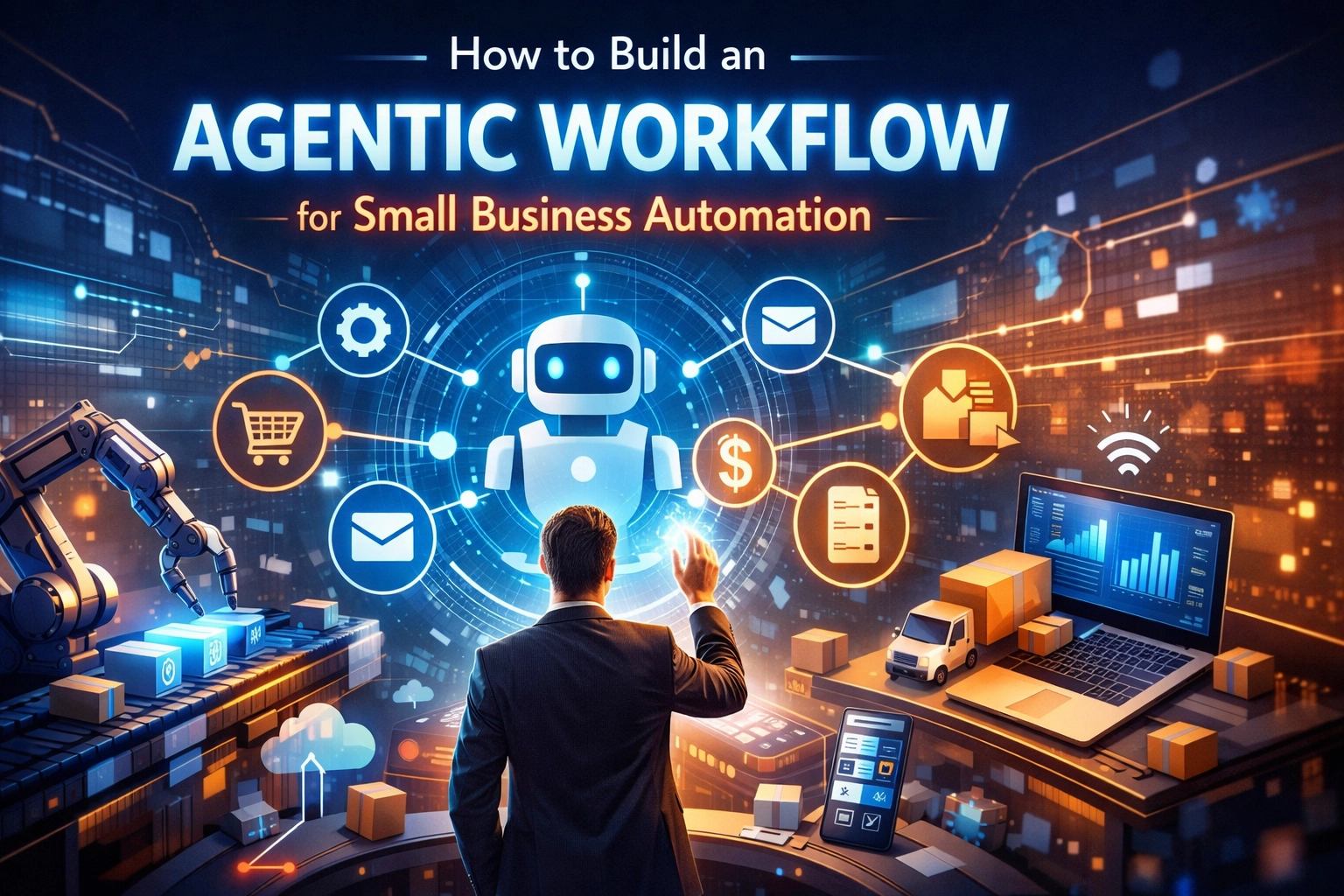
An Agentic Workflow is different. Instead of a single, rigid line of code, you have AI Agents. Think of these agents as specialized digital employees. One agent is your Researcher. Another is your Copywriter. A third is your Fact-Checker.
"Agentic" means these AI models have agency. You give them a goal (e.g., "Onboard this new client"), and they figure out the steps to get there. They talk to each other, correct each other’s mistakes, and use digital tools: like your calendar, email, or CRM: to get the job done.

Why Small Businesses Should Care (The "Why" Factor)
Small business owners are the ultimate "Chief Everything Officers." You’re the HR department, the marketing team, and the person who remembers to buy toilet paper. The promise of agentic workflows is context-aware scale.
- Complexity Handling: Unlike basic automation, agents can handle "fuzzy" tasks. They can read an angry customer email, determine if the person is actually upset or just confused, check your refund policy, and draft a response: or escalate it to you if the dollar amount is over $500.
- Cost Efficiency: You don't need to hire a full-time virtual assistant for data entry. An agentic workflow can scrape leads, verify them, and personalize outreach for a fraction of the cost.
- Consistency: AI agents don't have "off days." They follow your brand voice and business rules every single time, 24/7.
The 4 Pillars of a Successful Agentic System
Before you start building, you need to understand the four components that make an AI "agentic." If you skip one, you don't have a workflow; you just have a very expensive chatbot.
1. The Brain (Reasoning)
This is the core LLM (Large Language Model). In 2026, we have models that are specifically fine-tuned for "reasoning." Instead of just guessing the next word, these models "think" before they speak. They break a big goal into smaller tasks.
2. The Hands (Tool Use)
An agent is useless if it’s trapped in a chat box. It needs "hands": the ability to call APIs. This means your agent can "reach out" and check a Google Sheet, post to Instagram, or send a contract via DocuSign.
3. The Notebook (Memory)
For a workflow to be effective, it needs to remember what happened five minutes ago. If Agent A discovers a client hates the color blue, it needs to write that down in "short-term memory" so Agent B doesn't suggest a blue logo design later in the workflow.
4. The Team (Collaboration)
This is where it gets cool. You don’t just have one giant AI doing everything. You have a "Multi-Agent" setup. You might have a "Manager Agent" that delegates tasks to a "Worker Agent," while a "Critic Agent" reviews the work for quality control.

Step-by-Step: Building Your First Agentic Workflow
Ready to get your hands dirty? You don't need a computer science degree to do this in 2026. Here is the blueprint for building an agentic workflow for your small business.
Step 1: Identify the "Boring-o-Meter" Tasks
Look for tasks that are repetitive but require some level of thinking.
- Bad candidate for AI agents: Calculating 2+2 (just use a calculator).
- Good candidate: Triaging support tickets, generating weekly social media content based on news trends, or managing invoice disputes.
Step 2: Choose Your Orchestrator
In 2026, you don't have to write raw Python code (unless you want to). Tools like LangChain, CrewAI, or even low-code platforms like Make.com (with their 2026 AI Agent updates) allow you to "drag and drop" agents into a flow. Pick a platform that connects to the apps you already use.
Step 3: Define the "Personas"
Don't just say "AI, write a blog post." Instead, define two agents:
- Agent 1 (The Researcher): "Your job is to find the top 3 trending topics in the sustainable fashion industry this week. Provide links and summaries."
- Agent 2 (The Content Creator): "Take the research from Agent 1 and write a 500-word newsletter in a witty, casual tone. Do not use jargon."
Step 4: Set the Guardrails
Agents can be a bit… enthusiastic. If you don't set boundaries, they might try to solve a problem in a way that costs you money.
- Input Guardrails: "Only process emails from existing customers found in our CRM."
- Output Guardrails: "Never offer a discount higher than 15% without human approval."

Real-World Example: The "Zero-Touch" Lead Follow-up
Let’s look at how a local HVAC company or a boutique consulting firm might use this.
The Trigger: A potential client fills out a contact form.
- Agent A (The Qualifier): Scans the inquiry. It looks up the person on LinkedIn to see their company size and checks the CRM to see if they’ve contacted the business before.
- Agent B (The Researcher): If the lead is qualified, Agent B looks at the competitor’s pricing (using a web-search tool) and prepares a "Quick Win" suggestion for the lead.
- Agent C (The Scheduler): Drafts a personalized email saying, "Hey [Name], I saw you're struggling with [Problem]. Based on [Market Trend], we could help. Are you free Thursday at 2 PM?" It checks your actual calendar and inserts a booking link.
- The Human (You): You just get a notification saying, "Meeting booked with a qualified lead."
That’s not just a "bot." That’s a workflow that just did three hours of work in three seconds.
The Tools of 2026: Accessibility is King
We’ve moved past the era where you needed to be a prompt engineering wizard. Most modern small business CRMs (like HubSpot or Salesforce) now have "Agent Builders" baked in.
If you want to go custom, look into "Autonomous Agents-as-a-Service." These are platforms where you can "rent" pre-trained agents for specific niches: like a Legal Assistant agent that knows the current tax laws of your specific region, or a Marketing agent that is pre-trained on your specific brand's past successful campaigns.
| Feature | Old School Automation (Zapier) | Agentic Workflows (2026) |
|---|---|---|
| Logic | Fixed "If/Then" | Dynamic Reasoning |
| Error Handling | It just stops/breaks | It tries a different approach |
| Input | Structured data only | Text, Images, Audio, "Vibes" |
| Human Input | Required at every fork | Only for final approval |
Common Pitfalls (And How to Avoid Them)
While we’re singing the praises of our new AI overlords, let’s be real: things can go wrong.
- The Hallucination Loop: Sometimes Agent A makes a mistake, and Agent B believes it, leading to a spiral of nonsense. The Fix: Always include a "Human-in-the-loop" step for high-stakes decisions (like sending invoices or public-facing posts).
- Over-Automation: Just because you can automate your "Thank You" notes doesn't mean you should. Customers can still smell "fake" empathy from a mile away. Use agents for the heavy lifting, but keep the soul of your business human.
- Security: Giving an agent access to your email and bank account is a big deal. The Fix: Use "Least Privilege" access. Only give the agent the tools it absolutely needs to finish the task.

Conclusion: Start Small, Think Big
You don't need to automate your entire business by next Tuesday. Start with one "agentic" step. Maybe it’s just an agent that summarizes your daily Slack messages so you don't have to read 400 threads.
Once you see the power of an AI that can reason its way through a problem, you’ll never go back to manual clicking again. The goal isn't to replace yourself; it’s to automate the parts of your job that make you feel like a robot, so you can spend your time being the creative, strategic human your business actually needs.
Welcome to the age of the Agentic Small Business. It’s a lot less crowded at the top when you have a digital team doing the climbing for you.
About the Author: Malibongwe Gcwabaza
Malibongwe Gcwabaza is the CEO of blog and youtube, a forward-thinking digital hub dedicated to making complex technology simple for everyone. With a background in business strategy and a passion for AI-driven efficiency, Malibongwe spends his time exploring how emerging tech can level the playing field for small businesses. When he’s not deconstructing agentic workflows, he’s likely looking for the next big trend in digital content or mentoring local entrepreneurs.
About the Author