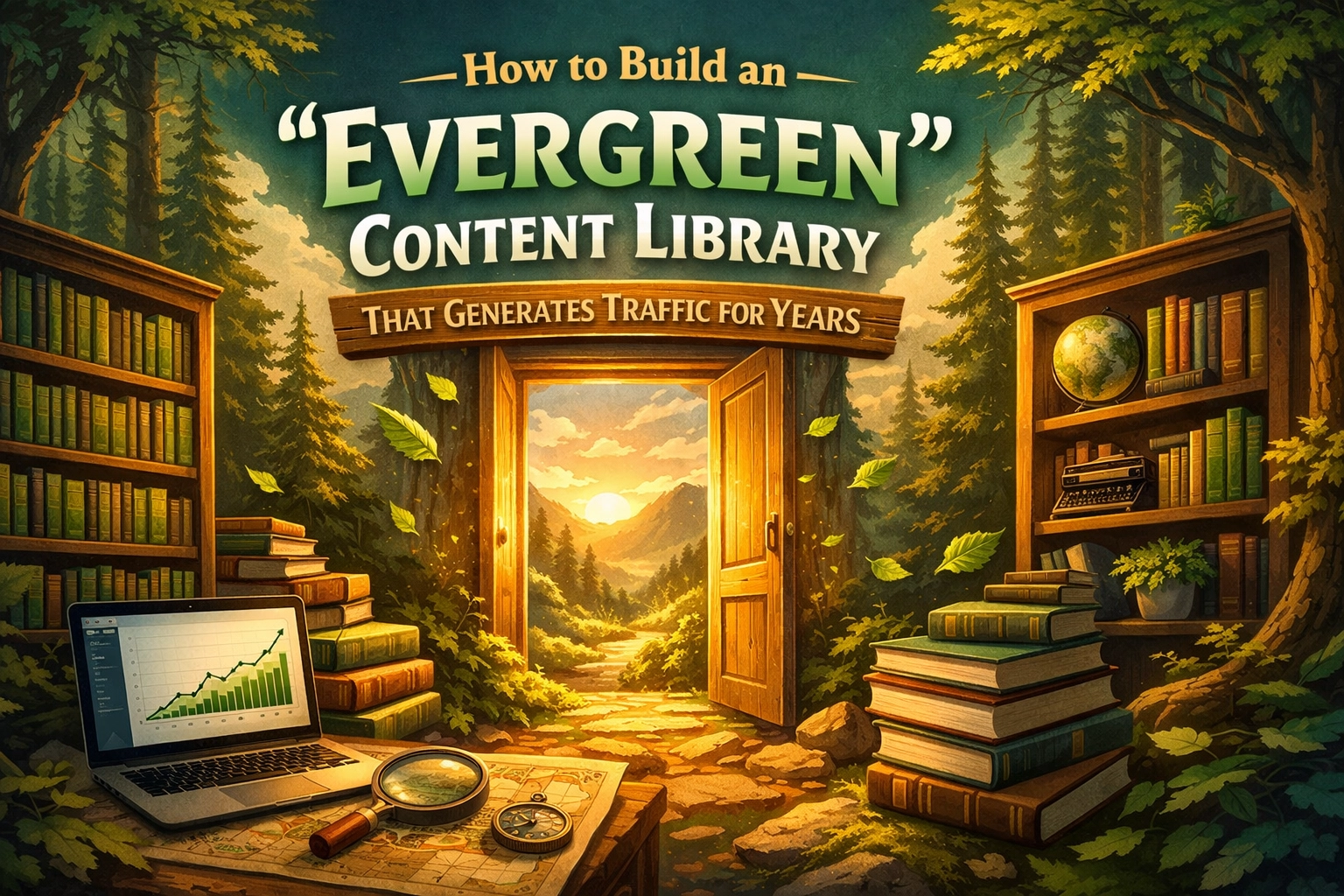
By March 2026, the digital landscape has shifted from "quantity of clicks" to "authority of information." With the rise of Generative Engine Optimization (GEO) and AI-driven search agents, the old strategy of churning out 500-word news snippets is officially dead. If you want to build a digital asset that pays for itself through AdSense and high-ticket lead generation, you need an evergreen content library.
An evergreen library isn't just a collection of blog posts. It is a structured repository of timeless knowledge that remains relevant regardless of the season, the news cycle, or the latest social media trend. In the current economy, where AI can generate mediocre content in seconds, the only way to stay competitive is to build high-moat, high-authority resources that Google and AI LLMs (Large Language Models) view as the "Source of Truth."
The Economics of Evergreen Content in 2026
From a financial perspective, evergreen content is the highest ROI activity for any publisher. When you write a "trending" piece about a tech product launch, its traffic usually spikes for 48 hours and then collapses to zero. The Cost Per Click (CPC) might be high initially, but the lifecycle is too short to recoup the investment of a high-quality writer.
In contrast, an evergreen article on "The Fundamentals of Cloud Architecture" or "Compound Interest Strategies for Solopreneurs" gains momentum over time. As it accumulates backlinks and social signals, its position in the "Knowledge Graph" solidifies.
Data from early 2026 shows that evergreen assets in the Finance, Technology, and Education niches command a 40% higher CPC on AdSense because advertisers are willing to pay a premium to appear next to authoritative, "safe" content that attracts high-intent readers.
The "Decade Test": Selecting Your Topics
The biggest mistake most bloggers make is choosing topics that are "ever-green-ish" but not truly timeless. To build a library that lasts until 2036, every topic must pass the Decade Test: Will a professional in my niche still need to know this in ten years?
1. Fundamental Principles Over Specific Tools
Instead of writing "How to use [Brand Name] SEO Tool," write "The First Principles of Semantic Search and Keyword Intent." Tools change every six months; principles last decades.
2. High-CPC Technical Knowledge
Focus on "How-to" guides that solve expensive problems.
- Bad: "Why I like remote work."
- Good: "How to Manage Cross-Border Tax Compliance for Fractional Workers."
The latter addresses a specific, high-value problem that will exist as long as people work across borders. It attracts a high-income audience, which triggers higher-value ads from financial institutions and legal software companies.
Strategic Portfolio Allocation: The 80/20 Rule
You shouldn't only write evergreen content. A healthy site needs a mix. In 2026, the winning ratio is an 80/20 split:
- 80% Evergreen Foundation: Comprehensive guides, glossaries, and "The Ultimate Guide to…" series.
- 20% Contextual Insights: Opinion pieces, industry reactions, and updates on how new tech (like Quantum computing or new AI models) affects your evergreen foundations.
This 20% acts as the "hook" to get people into your ecosystem, while the 80% serves as the "anchor" that keeps them there and signals your authority to search engines.
Engineering for GEO (Generative Engine Optimization)
In 2026, we are no longer just optimizing for a list of blue links on Google. We are optimizing for AI agents (like Gemini, Perplexity, and OpenAI’s SearchGPT) that summarize the web for the user. To make your content "evergreen" in the age of AI, you must build it with a specific technical structure:
Semantic Depth and Citations
AI models look for "information gain." If your article just repeats what is already on Wikipedia, the AI won't cite you. You must include original data, specific case studies, or a unique technical synthesis that isn't found elsewhere.
Structured Data (Schema.org)
Use advanced Schema markup. This tells the AI exactly what the data represents. For a guide on "Building a Content Library," you should use HowTo schema, Article schema, and TableOfContents schema. This technical layer makes it easier for search engines to parse and feature your content in "AI Overviews."

The "Living Library" Maintenance Strategy
"Evergreen" does not mean "Post and Forget." A library requires a librarian. To maintain high AdSense earnings, you must implement a "Minor Update" cycle.
Every six months, audit your top 20% of traffic-generating posts.
- Check for Link Rot: Ensure all outbound links still work and point to authoritative sources.
- Refresh Data: If you cited a 2024 study, update it with 2025 or 2026 data.
- Add "Current Context" Snippets: Add a small section at the top titled "2026 Update" that explains how recent shifts affect the timeless advice in the post.
This signals to Google that the content is still "fresh" without requiring you to rewrite the entire 2,000-word piece.
Case Study: The "How-To Authority" Blueprint
Let's look at a concrete example of an evergreen post that hits all the high-quality marks for AdSense approval and long-term traffic:
Title: The Definitive Guide to Sovereign Cloud Implementation for Small Businesses (2026 Edition)
- Why it works: It’s technical, addresses a growing 2026 trend (data sovereignty), and targets a B2B audience (high CPC).
- The Structure:
- Introduction: Explaining the need for sovereign clouds in an age of AI data scraping.
- The Technical "How-To": Step-by-step instructions on moving from shared servers to sovereign clouds.
- Cost-Benefit Analysis: Data-driven tables comparing long-term costs.
- FAQ Section: Addressing the most common "long-tail" search queries.

Building Trust with E-E-A-T
Google’s Search Quality Rater Guidelines emphasize Experience, Expertise, Authoritativeness, and Trustworthiness (E-E-A-T). For evergreen content, this is non-negotiable.
To boost your "Trust" score:
- Use Authoritative Citations: Link to .gov, .edu, or major industry research papers.
- Internal Linking: Create "Topic Clusters." If you write about content libraries, link to your other posts about SEO, GEO, and AdSense optimization. This shows the search engine that you are an expert across the entire niche, not just one topic.
- Transparency: Clearly state when the article was last updated and by whom.
Conclusion: The Long Game
Building an evergreen content library is an upfront investment. It takes more time to research, more effort to format, and more technical knowledge to optimize than a standard blog post. However, while other sites are chasing the "viral trend" of the week, your evergreen library will be quietly stacking traffic, building authority, and generating consistent revenue.
In the 2026 digital economy, the most valuable currency isn't just attention: it's trusted information. Build your library today, and you’ll be the one the AI agents turn to for answers.
About the Author: Malibongwe Gcwabaza
CEO, blog and youtube
Malibongwe Gcwabaza is a veteran digital strategist and the CEO of blog and youtube, a leading firm specializing in high-authority content systems and AI-integrated publishing. With over a decade of experience in the evolving search landscape, Malibongwe focuses on bridging the gap between technical SEO and human-centric storytelling. He is a frequent speaker on the "Sovereign Web" and helps businesses build digital assets that survive and thrive through algorithmic shifts. Under his leadership, blog and youtube has helped hundreds of creators optimize their platforms for AdSense and high-impact organic growth.
About the Author