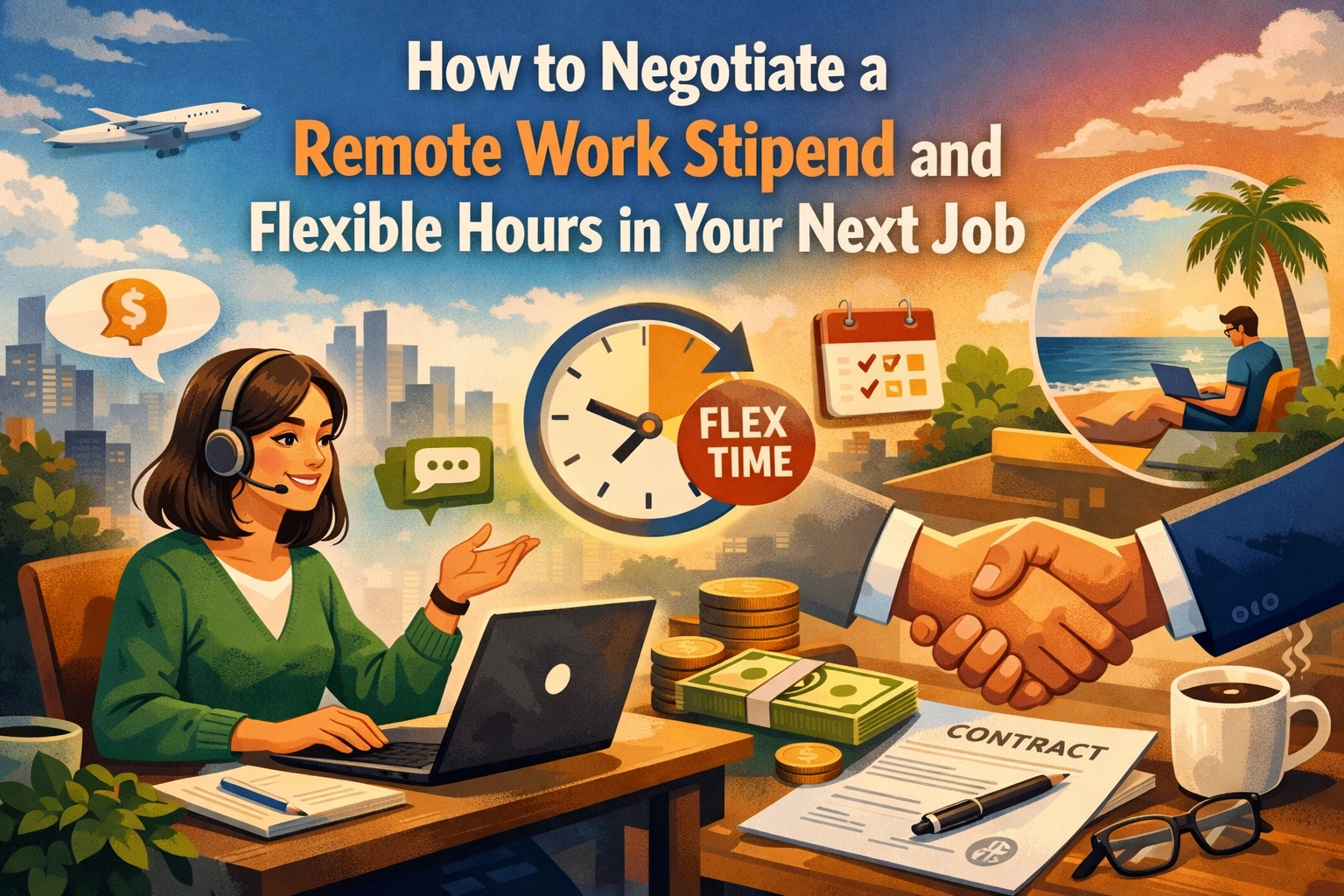
By 2026, the concept of "remote work" has evolved far beyond simply answering emails from a kitchen table. As AI agents handle routine tasks and Generative Engine Optimization (GEO) dominates the digital landscape, the value of a high-performing human employee lies in their ability to perform deep, creative work. To do that, you need more than just a laptop; you need a professional-grade infrastructure.
Negotiating a remote work stipend and flexible hours isn't just about "perks" anymore. It’s about securing the tools and the schedule required to maintain peak cognitive output. If an employer isn't paying for office real estate, they are saving roughly $10,000 to $15,000 per year per employee. Your goal is to negotiate a portion of those savings back into your pocket to fund your home office and protect your time.
The Shift to "Infrastructure as a Service" (IaaS) for Employees
In the current job market, smart candidates view themselves as a "service" that requires specific inputs to generate high-value outputs. When you enter a negotiation, don't frame a home office stipend as a gift. Frame it as a business necessity.
Data from 2025 workplace studies indicates that employees with optimized ergonomic setups and high-speed, redundant internet connections see a 22% increase in technical productivity. In 2026, where "deep work" is the primary currency, a flickering Wi-Fi connection or a cheap chair that causes back pain isn't just an inconvenience, it’s a direct hit to the company’s ROI.
Defining Your Stipend Categories
When you sit down to negotiate, you need to break your requests into two distinct buckets: One-time Setup Costs and Recurring Operational Costs.
- One-time Setup Costs: This includes your ergonomic chair, standing desk, 4K monitors (essential for multi-agent workflows), and noise-canceling hardware.
- Recurring Operational Costs: This covers high-speed internet (or a secondary 5G/6G backup), electricity subsidies (as home energy costs rise), and professional development for AI-integrated tools.

Negotiating the Hardware Stipend: The Technical Approach
Most companies have a standard "equipment" policy where they ship you a laptop and call it a day. In 2026, that isn't enough. If your role involves data science, high-level AI prompt engineering, or complex project management, you likely need a local machine with a high-end GPU or a multi-monitor setup that allows you to monitor several AI streams at once.
The Tactic: Instead of asking for a generic $1,000 stipend, provide a "Technical Requirements Document" (TRD).
- Itemize the tech: "To maintain the 99.9% uptime required for this role, I require a secondary fiber line and a UPS (Uninterruptible Power Supply)."
- Show the ROI: "An ergonomic setup will reduce the risk of repetitive strain injuries, ensuring I don't need to take medical leave during critical sprint cycles."
By being specific and technical, you move the conversation away from "fairness" and toward "efficiency."
The "Utility Offset": Why it Matters in 2026
With the rise of decentralized work, the burden of "running the office" has shifted to the individual. Heating, cooling, and powering a home office for 10 hours a day adds up. In many regions, this can cost an extra $150–$300 a month.
When negotiating, ask if the company offers a "utility subsidy." If they push back, use the "Real Estate Argument." Mention that by working remotely, you are effectively providing them with free office space. Requesting a $200 monthly stipend to cover high-speed internet and power is a fraction of the $1,200 they would pay for a desk in a Tier-1 city co-working space.
Negotiating Flexible Hours: Moving to "Asynchronous Results"
"Flexible hours" is a vague term that often leads to "availability creep", the expectation that you’ll be online from 8 AM to 8 PM just because you’re at home. To negotiate true flexibility in 2026, you need to advocate for an Asynchronous-First Workflow.
The "Core Hours" Strategy
Rather than asking to "work whenever I want," propose a "Core Hours" model.
- The Pitch: "I am most productive for deep work between 7 AM and 11 AM. I propose that our 'Core Collaboration Hours' be from 1 PM to 4 PM EST, where I am available for meetings and synchronous communication. Outside of those hours, I will focus on high-impact deliverables."
This protects your "flow state" while reassuring the hiring manager that you won't be a ghost when the team needs you.

Using the "Trial Period" Leverage
If a recruiter or HR manager seems hesitant about a high stipend or unconventional hours, offer a 90-day trial period. This is a low-risk way for them to say "yes."
The Script:
"I understand the company hasn't standardized a $3,000 home office setup stipend yet. However, given the technical nature of this role, I suggest we include a $1,500 initial setup fee in my signing bonus, with the remaining $1,500 contingent on me hitting my first-quarter KPIs. This way, the investment is tied directly to my performance."
This shows you are confident in your ability to deliver and positions the stipend as a performance incentive rather than a handout.
Calculating Your "Total Rewards" Package
In 2026, your salary is only one part of the equation. A lower base salary with a $500/month recurring stipend, a $5,000 home office budget, and a 4-day workweek might actually be more valuable than a higher salary that requires you to be "on" 24/7.
Use a spreadsheet to calculate the "True Value" of the offer:
- Base Salary
- + Annual Value of Stipends (Internet, Phone, Gym, Wellness)
- + Value of Time Saved (Commute hours × your hourly rate)
- + Utility Savings (If they pay for your power/heat)
Often, you’ll find that a "flexible" role saves you 20 hours a month in commuting and $400 in fuel/transport costs. That’s a "hidden" $15,000 a year raise.

Overcoming the "Company Policy" Objection
You will inevitably hear: "We have a flat $500 stipend for everyone. We can’t change it for you."
In 2026, the best way to bypass this is to ask for a Signing Bonus or a Professional Development Budget instead. Many companies have rigid rules for "stipends" but flexible budgets for "one-time bonuses" or "education." If they won't pay for your $1,200 chair via a stipend, ask for a $2,000 signing bonus to "facilitate a smooth transition into my new workspace."
Summary of Key Negotiation Pillars for 2026
- Data-Driven Requests: Use productivity stats to justify your ergonomic and tech needs.
- Infrastructure as a Service: Frame your home office as a tool for the company's success.
- Asynchronous Alignment: Define "Core Hours" to prevent burnout.
- The Real Estate Swap: Remind them of the overhead costs they are saving.
- Alternative Budgeting: If "stipends" are capped, pivot to "signing bonuses" or "learning credits."
The future of work is decentralized, but it is not "free." By negotiating these terms upfront, you ensure that you aren't just working from home: you're running a professional, high-output operation that is fully funded by the organization that benefits from your expertise.
About the Author: Malibongwe Gcwabaza
Malibongwe Gcwabaza is the CEO of blog and youtube, a leading digital platform focused on the intersection of AI, career evolution, and remote work dynamics. With over a decade of experience in organizational strategy and digital transformation, Malibongwe helps professionals navigate the complexities of the 2026 job market. He is a frequent speaker on "The Future of Asynchronous Leadership" and believes that the right workspace is the foundation of every great career. When he isn't optimizing remote workflows, he's exploring the latest in GEO and AI-driven content ecosystems.
About the Author