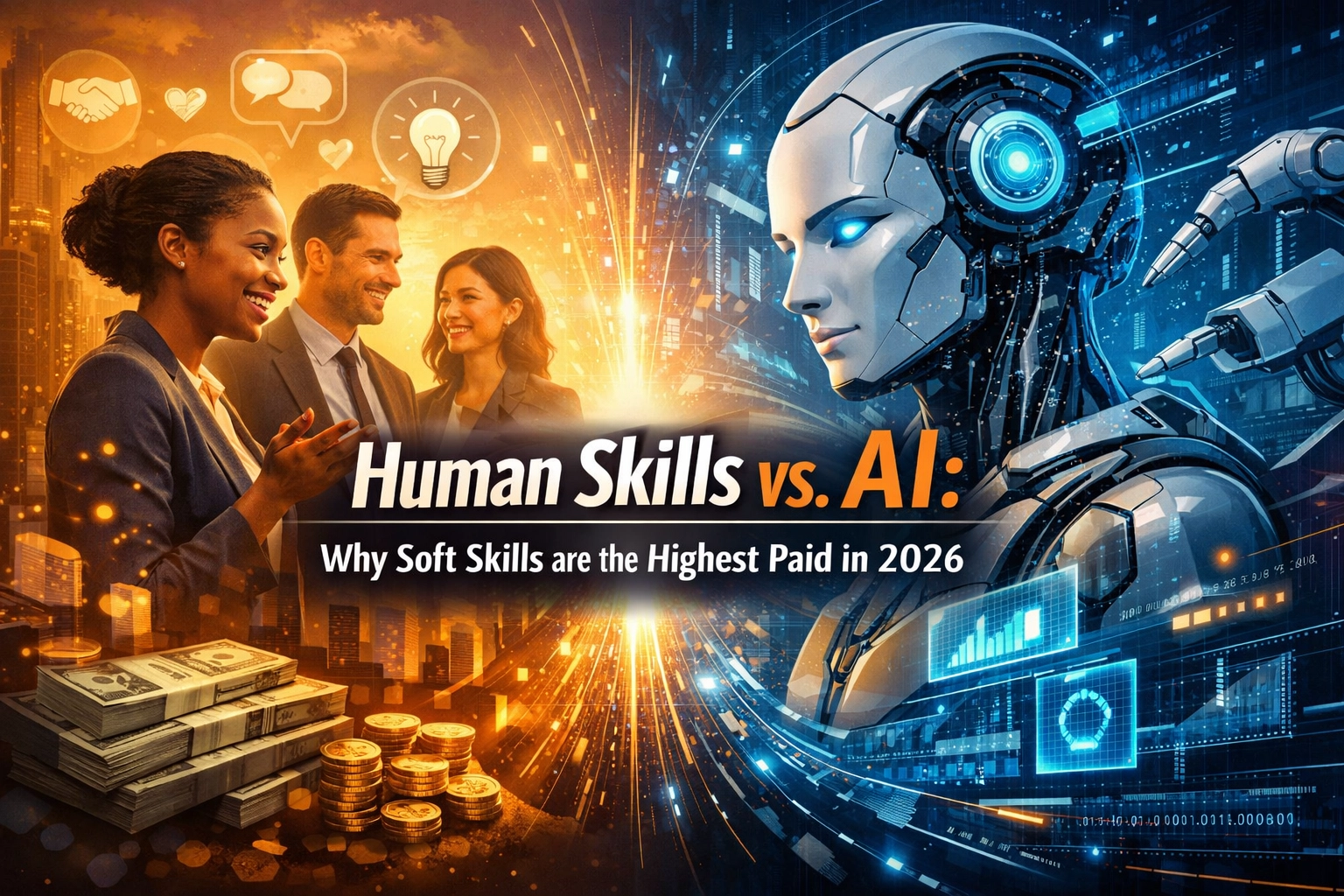
It is March 2026, and the world looks a little different than we imagined five years ago. We didn’t get flying cars (well, most of us didn’t), but we did get AI that can code, write, and analyze data better than the average junior executive. If you walk into any high-end office in Johannesburg or London today, you’ll notice something strange: the people getting the massive bonuses aren’t the ones who stayed up all night debugging code. They’re the ones who know how to talk to people.
We’ve officially entered the era of the "Human Premium."
For decades, we were told that "STEM is king" and that if you didn’t know how to write Python or build a neural network, you’d be left behind. But in 2026, the script has flipped. Technical skills have become a commodity. When everyone has an AI agent in their pocket that can generate a 1,000-line script in three seconds, the value of "knowing how to code" hits a floor.
What’s hitting the ceiling? The stuff a machine can’t do: feeling, leading, and thinking critically. Here is why your "soft skills" are now your biggest financial asset.
The Great Automation Flip: From "Hard" to "Soft"
To understand why empathy is suddenly worth six figures, we have to look at supply and demand. In 2024 and 2025, we saw a massive influx of AI tools that automated the "hard" stuff. Data entry, basic accounting, junior-level coding, and even legal research became tasks that took minutes instead of days.
When a skill becomes easy to automate, its market value drops. It’s basic economics. If a machine can do it for the cost of a monthly subscription, a company isn't going to pay a human $100,000 a year to do the same thing.

However, AI still struggles with what we call "unstructured human chaos." A machine can predict the next word in a sentence, but it can’t tell when a client is lying because they’re nervous about their budget. It can’t inspire a team that just went through a round of layoffs. And it definitely can’t navigate the delicate politics of a boardroom.
This has created a "Soft Skill Gap." Companies are desperate for people who can bridge the gap between the raw output of AI and the nuanced needs of human beings.
The Three Pillars of the 2026 Paycheck
If you want to command the highest salaries in today’s market, you need to master three specific "human-only" domains.
1. High-Stakes Empathy and Emotional Intelligence (EQ)
In 2026, the highest-paid roles are often in Business Development and Sales. According to recent market data, Business Development Managers are pulling in averages of $196,902. Why? Because sales isn't about giving information anymore, AI can give information. Sales is about trust.
Empathy is the ability to understand another person’s perspective and respond appropriately. In a world full of AI-generated emails and synthetic voices, a real human connection has become a luxury good. High-net-worth clients and big corporations want to deal with someone who "gets" them. If you can read a room, de-escalate a conflict, or build deep rapport, you are essentially "robot-proof."
2. Critical Thinking and "Hallucination Auditing"
AI is a notorious liar. It "hallucinates" facts, makes up legal precedents, and gives confident but wrong advice. This has birthed a new high-paying skill: Critical Thinking.
Companies are paying a premium for people who can look at an AI’s output and say, "Wait, this doesn't pass the vibe check." This involves:
- Contextual Awareness: Understanding how a decision fits into the bigger picture of the company.
- Ethical Judgment: Deciding if an automated decision is actually right for the brand's reputation.
- Skepticism: Not taking data at face value just because it came from a "smart" system.
3. Human Orchestration (The New Leadership)
Management has changed. In the past, being a manager meant checking if people were at their desks and meeting deadlines. Today, AI tracks the deadlines. Modern leadership is about Human Orchestration.
This means knowing how to blend AI efficiency with human creativity. A great leader in 2026 knows which parts of a project to give to the robots and which parts need the "soul" of a human designer or writer. They focus on culture, motivation, and vision: things an algorithm can't simulate.

Why the "Soft" vs "Hard" Debate is Over
Let’s look at the numbers. While a specialized AI Engineer might earn $132,000, a Strategic Business Lead who understands how to apply that AI to solve human problems can easily clear $200,000+.
The "hard" skills get you in the door, but the "soft" skills determine how high you climb. We’ve seen a shift in how roles are compensated based on the level of human interaction required.
| Role Type | Primary Skill | 2026 Salary Growth Trend |
|---|---|---|
| Technical Specialist | AI Architecture / Coding | Stable (Highly competitive) |
| Human Interface | Sales / Negotiation / EQ | High Growth |
| Strategic Leadership | Vision / Ethics / Critical Thinking | Very High Growth |
| Administrative | Organization / Data Entry | Declining (Automated) |
The "Vibe Check" Economy
We used to joke about "soft skills" being "fluff." We’d roll our eyes at "team-building exercises" or "active listening" workshops. Nobody is laughing now. In 2026, we live in a "Vibe Check" economy.
Think about it: Why do you still go to a specific hair stylist or a specific consultant? It’s rarely because they are the only person who can do the job. It’s because of how they make you feel. It’s the trust, the conversation, and the shared understanding.
As AI handles the "what" and the "how," humans are left with the "why." Being able to articulate a "why" that resonates with people is the most profitable skill you can have.

How to Invest in Your "Meat-Space" Skills
If you’ve spent the last few years obsessing over technical certifications, it might be time to pivot your self-improvement budget. Here is how to build the skills that are actually fetching the highest salaries right now:
- Practice Conflict Resolution: Don't avoid difficult conversations. The ability to navigate a disagreement and come out with a "win-win" is a high-value skill that AI cannot replicate.
- Study Psychology, Not Just Code: Understanding what motivates people, how they make decisions, and why they feel certain emotions will give you a massive edge in leadership and sales.
- Work on Your Presence: Whether it's public speaking or just how you carry yourself in a Zoom meeting, your "presence" is a signal of authority. AI can be loud, but it can’t be "present."
- Master the Art of the Question: AI is only as good as the prompts it’s given. Learning how to ask the right questions: to both machines and humans: is the ultimate meta-skill.
The Future is More Human, Not Less
There was a fear that AI would turn us all into drones, or worse, make us obsolete. Instead, it has acted as a mirror, showing us exactly what makes us special.
By taking over the repetitive, logical, and data-heavy tasks, AI has cleared the deck for us to do what we were always meant to do: connect, create, and lead. The people who lean into their humanity: who double down on their empathy, their humor, their intuition, and their ability to inspire: are the ones who are winning the 2026 economy.

So, next time you feel "behind" because you don't know the latest AI framework, take a breath. Go talk to a client. Mentor a colleague. Solve a complex team dispute. Those are the moments that are padding your bank account more than any line of code ever could.
The machines have the logic. You have the magic. And in 2026, magic pays very, very well.
About the Author: Malibongwe Gcwabaza
Malibongwe is the CEO of blog and youtube, a forward-thinking digital hub exploring the intersection of technology and human potential. With a background in leadership and a passion for simple, effective communication, Malibongwe helps businesses navigate the rapidly changing landscape of the AI era without losing the "human touch." When not writing about the future of work, he's usually looking for the perfect cup of coffee or mentoring the next generation of creative leaders.
About the Author