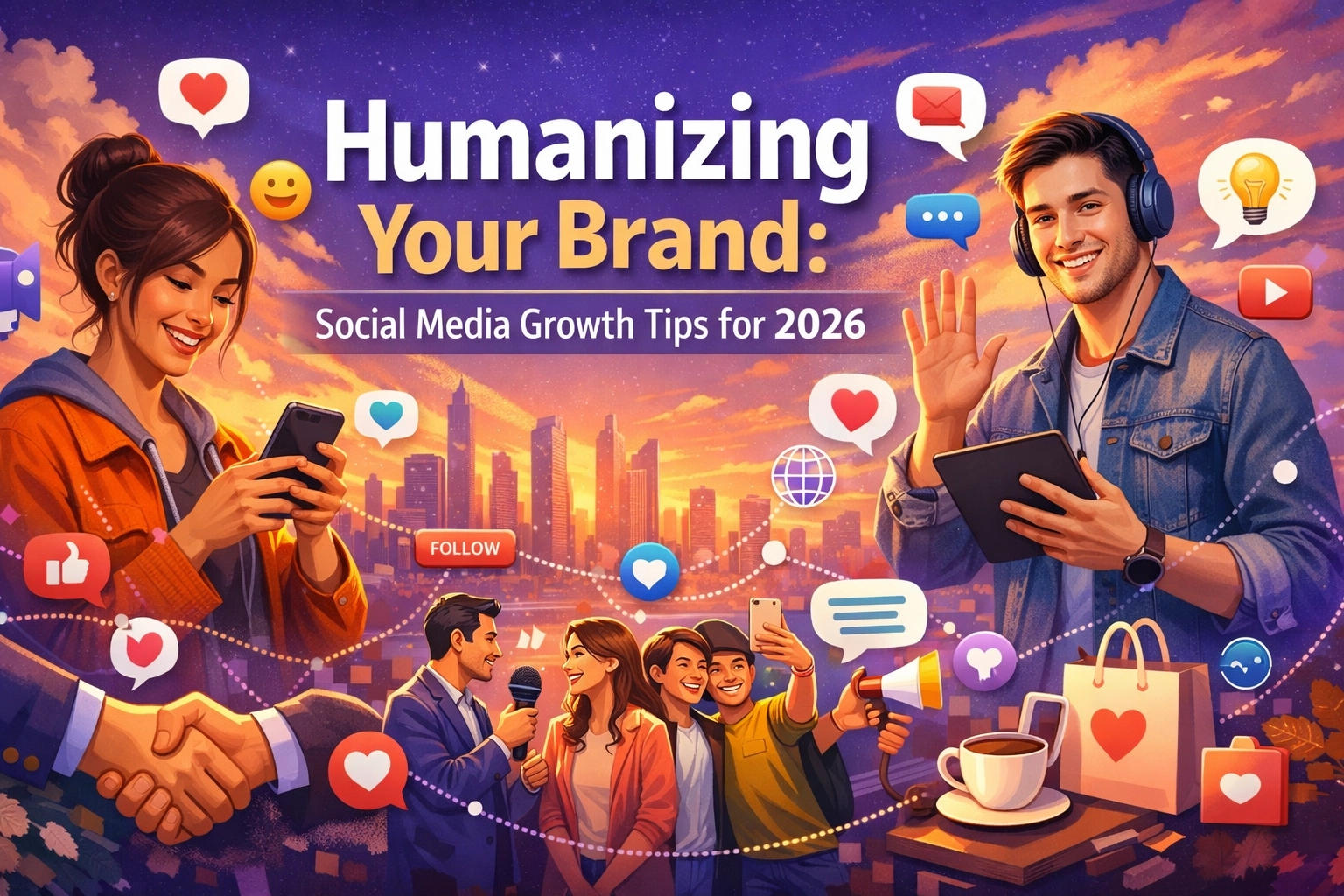
By now, everyone has seen the "dead internet" theory in action. In 2026, social media feeds are flooded with AI-generated images, synthetic influencers, and bot-written captions that feel like they were birthed in a spreadsheet. While the tech is impressive, it’s created a massive hunger for something that’s becoming increasingly rare: actual human connection.
If you want to grow a brand today, you can’t just out-produce the bots. You have to out-human them. The brands winning right now aren't the ones with the biggest budgets or the slickest graphics; they’re the ones that feel like a person you’d actually want to grab a coffee with.
Here is how you humanize your brand and drive real growth in 2026.
The Pivot from Polished to Personal
For a long time, "professional" meant a perfectly curated Instagram grid and high-definition video production. In 2026, that level of polish is often a red flag. To a savvy audience, a "perfect" video looks like a corporate committee spent three weeks sanitizing it of any personality.
Real growth is happening in the "unfiltered" spaces. People want to see the mess. They want to see the office kitchen when the coffee machine breaks. They want to hear the CEO talk about a project that failed and what they learned from it. This isn't just "behind-the-scenes" content; it’s "reality" content.
How to execute this:
- Ditch the teleprompter: Let your team speak naturally. If they stumble over a word or laugh mid-sentence, leave it in.
- Show the process, not just the result: People relate to the struggle. Showing the 15 failed prototypes of your new product creates more loyalty than just showing the finished version.
- Low-fi production: Use your phone. High-end cameras have their place, but for daily engagement, a raw vertical video often performs better because it looks like something a friend would post.

Turning Employees into Creators
The most untrusted person on social media is a corporate logo. The most trusted? An actual employee.
In 2026, employee advocacy has evolved. It’s no longer about asking your staff to "share this corporate LinkedIn post." It’s about empowering them to become creators in their own right. When your lead developer posts about a coding challenge they solved or your warehouse manager shares a "day in the life" video, they are humanizing your brand in a way a marketing department never could.
This works because it breaks the "us vs. them" barrier between a company and its customers. It shows that the brand is made of people with lives, hobbies, and expertise.
Building an Advocacy Culture:
- Lower the stakes: Don't require a 10-step approval process for every post. Give your team "brand guardrails" and then let them run.
- Highlight different departments: Don't just show the sales team. The most interesting stories often come from the people "in the basement" building the product.
- Compensate or incentivize: Content creation is a skill. If an employee is consistently bringing in leads or building brand equity through their personal accounts, recognize that value.
The Rise of Community-First Platforms
Traditional social media (the "Big Three") has become a broadcast medium. It’s great for reach, but it’s terrible for connection. To humanize your brand, you need to go where the conversations are actually happening.
In 2026, we’re seeing a massive migration to "walled gardens": places like Substack, Discord, and Telegram broadcast channels. These platforms allow for a deeper level of intimacy. You aren't fighting an algorithm to be seen; you are talking directly to people who have raised their hand and said, "I want to hear from you."
The 2026 Platform Strategy:
- LinkedIn for Authority: LinkedIn has become the home for long-form, thoughtful human storytelling. Use it to build the "personal brands" of your leadership.
- Substack for Connection: Use newsletters not as a sales tool, but as a diary of the brand’s journey. Share the "why" behind your decisions.
- Bluesky and Threads for Real-Time: These platforms are the new "water coolers." Stop posting links and start starting conversations. Ask questions. Reply to people. Be a human in the comments.

Using AI Without Losing Your Soul
Let’s be real: AI is part of the workflow now. But there is a right way and a wrong way to use it.
The "wrong way" is using AI to generate your entire content strategy, from the idea to the final caption, without any human oversight. This creates "uncanny valley" content that feels slightly off and triggers an immediate "skip" response from users.
The "right way" is using AI as a tool to amplify human creativity. Use it to brainstorm titles, transcribe your raw videos into blog posts, or analyze data to see what topics your audience cares about. But the final layer: the "vibe check": must always be human.
Transparency is the new trust:
If you use AI to create a visual or a segment of a video, be honest about it. In 2026, transparency is a massive trust-builder. Audiences appreciate a brand that says, "We used AI to help us visualize this future concept," rather than trying to pass it off as a real photo.
Cultivating a "Non-Corporate" Voice
Most brands sound like a legal department wrote their tweets. To grow in 2026, you need an "ownable" voice. This means having opinions, using humor, and even being a little bit weird if that fits your brand personality.
Think about the brands you actually follow. They probably have a specific way of speaking. Maybe they use dry wit, or they’re incredibly supportive, or they use a specific type of slang. They don't sound like everyone else.
How to find your voice:
- The "Personify" Exercise: If your brand was a person at a party, who would they be? What would they drink? What would they talk about? Write your content from that perspective.
- Ban the buzzwords: If you find yourself using words like "synergy," "market-leading," or "innovative," delete them. Humans don't talk like that.
- Use "I" and "We": Stop talking in the third person. "The company is happy to announce" sounds like a press release. "We’re so excited to show you what we’ve been working on" sounds like a person.

Micro-Influencers vs. Authentic Creators
The era of the "celebrity influencer" who promotes a different product every week is fading. In 2026, growth comes from partnerships with "niche creators" who have built high-trust communities.
These aren't people with millions of followers; they are people with 5,000 followers who actually listen to what they say. When a brand partners with these creators, the goal shouldn't be a scripted "ad." It should be a collaboration. Give the creator the product and let them talk about it in their own voice, including the things they think could be better.
Counter-intuitively, a creator mentioning a small flaw in your product makes their overall recommendation much more believable. It feels human.
| Strategy Component | Old Way (Pre-2025) | New Way (2026+) |
|---|---|---|
| Content Type | Highly polished, scripted | Raw, BTS, employee-led |
| Primary Goal | Viral reach & impressions | Community depth & sentiment |
| Influencers | Big names, scripted ads | Niche creators, honest reviews |
| Platform Focus | Feed-based (Mass reach) | Community-based (Direct access) |
| AI Usage | Hidden, used for everything | Transparent, used for brainstorming |
Measuring the "Human" Factor
If you’re still only looking at likes and shares, you’re missing the point. In a world of bot-farms, those metrics are easily manipulated.
In 2026, the metrics that matter are:
- Meaningful Comments: Are people actually starting a conversation, or are they just leaving a "🔥" emoji?
- Direct Message Volume: How many people are reaching out to ask questions or share their own stories?
- Brand Sentiment: Is the conversation around your brand positive, and does it feel like people are talking to you rather than at you?
- Employee Retention and Recruitment: Believe it or not, a humanized social media presence is one of the best ways to attract top talent. People want to work for companies that look like they have fun.
Conclusion: The Human Advantage
The tech will keep getting faster. AI will keep getting better. But the one thing technology will never be able to replicate is a genuine, messy, emotional human experience.
By prioritizing transparency, empowering your team to speak, and focusing on community over reach, you aren't just "doing social media." You are building a brand that can survive the AI noise. Stop trying to be a perfect corporation and start trying to be a real person. That’s where the growth is.
About the Author
Malibongwe Gcwabaza is the CEO of blog and youtube. With over a decade of experience in digital strategy and brand building, Malibongwe focuses on making the complex world of online growth simple and accessible for everyone. When he’s not dissecting the latest social media trends, he’s passionate about finding ways to use technology to bring people closer together, rather than further apart.
About the Author