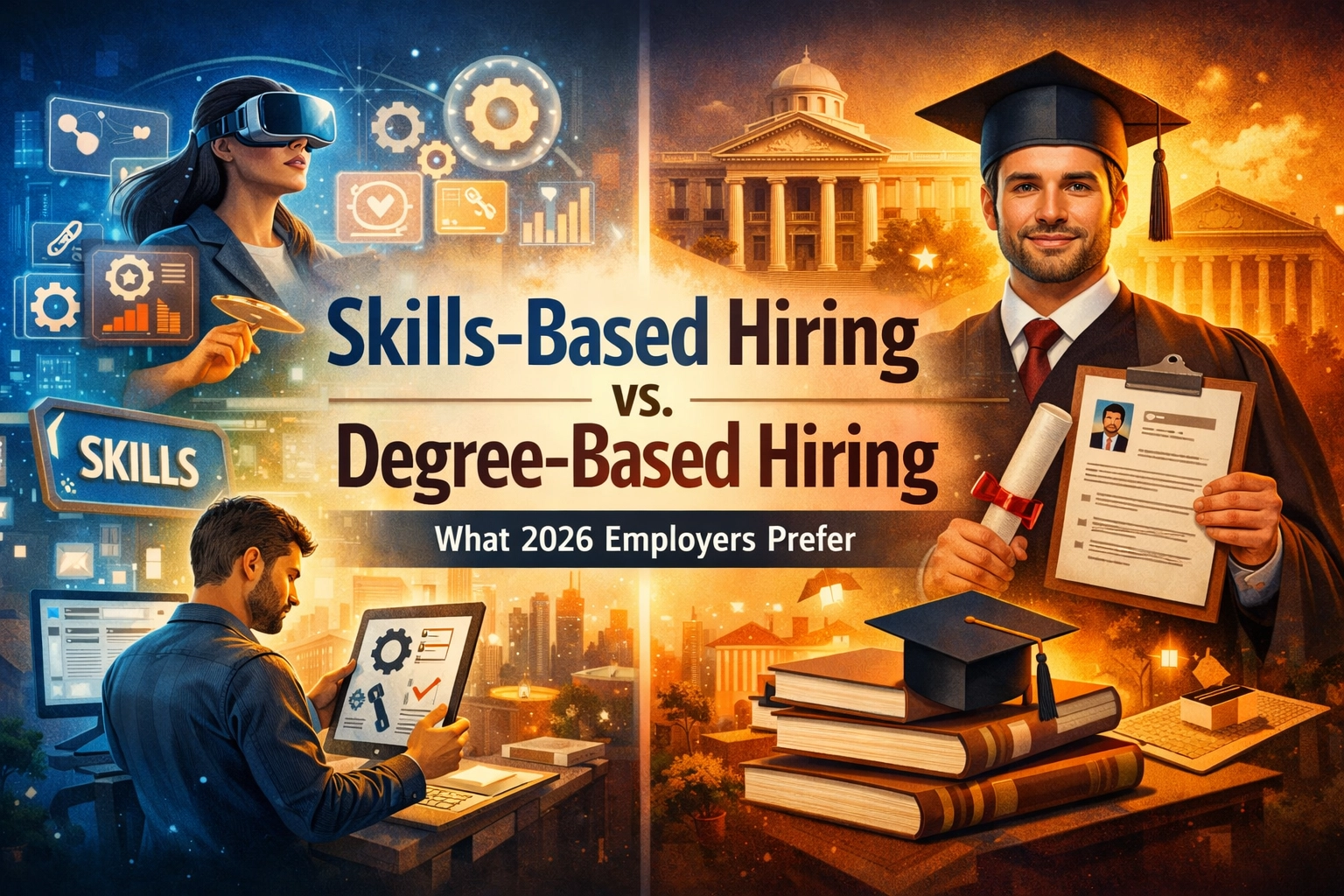
By March 2026, the traditional "paper ceiling": the invisible barrier blocking workers without four-year degrees from high-paying roles: hasn't just cracked; it’s largely been dismantled. As we navigate a labor market defined by rapid AI integration and a shifting global economy, the debate between skills-based hiring and degree-based hiring has reached a definitive tipping point.
If you’re a job seeker or a hiring manager looking at the landscape today, the data is clear: 70% of employers now prioritize demonstrated skills over institutional pedigree. But this isn't a simple case of degrees becoming "worthless." Instead, we’ve entered an era of "Precision Hiring," where the value of an applicant is measured by a sophisticated matrix of competencies, certifications, and real-world output.
The 2026 Shift: Why the Degree Filter is Failing
For decades, a Bachelor’s degree acted as a convenient, albeit blunt, proxy for "employability." It signaled that a candidate could commit to a long-term goal, navigate a hierarchy, and possess a baseline of literacy and numeracy. However, in 2026, the shelf-life of technical skills has shrunk to less than 2.5 years. A four-year degree completed in 2022 often lacks the specific technical nuances required for today’s AI-augmented workflows.
Modern Applicant Tracking Systems (ATS) have evolved significantly. In the past, these systems were programmed to automatically "trash" resumes that didn't check the "Bachelor’s Degree" box. Today, the most advanced recruitment tools use Natural Language Processing (NLP) to perform deep "Skills-Gap Analysis." They look for evidence of specific competencies: like Generative Engine Optimization (GEO), Python-based automation, or prompt engineering: rather than just the name of a university.

Data-Driven Insights: The Performance Gap
Recent research from Deloitte highlights why this shift isn't just a trend, but a financial necessity for corporations. Skills-based organizations are 63% more likely to achieve high levels of performance than those relying on traditional job descriptions. Why? Because hiring for skills is five times more predictive of job performance than hiring based on education alone.
When an employer hires based on a degree, they are betting on a candidate’s potential. When they hire based on skills, they are hiring for proven output. In a high-interest-rate environment where "Time to Productivity" is a key metric, companies can no longer afford the six-month ramp-up time often associated with fresh graduates who lack hands-on technical training.
The Rise of "Precision Hiring" and Stackable Credentials
The binary choice: "Degree or No Degree": is being replaced by what HR experts call Precision Hiring. This approach views education as a "signal" and skills as "relevance."
Laci Loew, a leading HR analyst, notes that "degrees establish credibility and context; skills ensure resilience." In 2026, we are seeing the rise of Stackable Credentials. Instead of one massive, expensive degree, professionals are building portfolios of high-impact certifications from providers like Google, NVIDIA, and specialized IIM online programs.
Comparison: Degree vs. Skills-Based Path (2026 Data)
| Feature | Traditional Degree Path | Skills-Based/Micro-Credential Path |
|---|---|---|
| Time to Market | 4 Years | 6–12 Months |
| Cost (Avg) | $100,000+ | $500 – $5,000 |
| Curriculum Agility | Low (updated every 5-10 years) | High (updated quarterly) |
| Employer Trust | High (Institutional) | High (Evidence/Portfolio-based) |
| ATS Compatibility | Baseline | Optimized for Technical Search |
Why "AI-Proof" Careers Demand a Skills-First Approach
The rapid ascent of Agentic AI has automated many of the "entry-level" tasks that traditional graduates used to perform (basic data entry, first-draft copywriting, junior-level coding). Consequently, the roles that remain: and the ones being created: require a specific blend of technical mastery and soft-skill nuance that traditional universities are still struggling to integrate.
For example, a "Sustainability Analyst" in 2026 needs to understand both ESG (Environmental, Social, and Governance) regulatory frameworks and how to use AI to model carbon footprint data. There isn't a four-year degree that perfectly covers this specific, emerging intersection. Instead, the best candidates are those who "stacked" a Business degree with a Machine Learning bootcamp and a Sustainability certification.

The "Living Resume" and the Death of the PDF
In a skills-based world, a static PDF resume is a liability. 2026 employers prefer the "Living Resume." This is a digital presence that links directly to a candidate’s actual work:
- Developers: A GitHub repository showing active contributions to Open Source AI models.
- Marketers: A portfolio showing successful GEO (Generative Engine Optimization) campaigns with verifiable traffic data.
- Project Managers: Verifiable badges in Agile or Scrum, coupled with case studies of remote team management.
Employers are now using "Blind Skills Assessments" before they even look at a candidate's name or education history. Platforms like TestGorilla or specialized AI-vetting tools allow candidates to prove they can write the code, solve the logistical puzzle, or manage the crisis in a simulated environment. This removes the "prestige bias" associated with Ivy League schools and opens the door for the "skilled through alternative routes" (STARs) workforce.
When Does a Degree Still Matter?
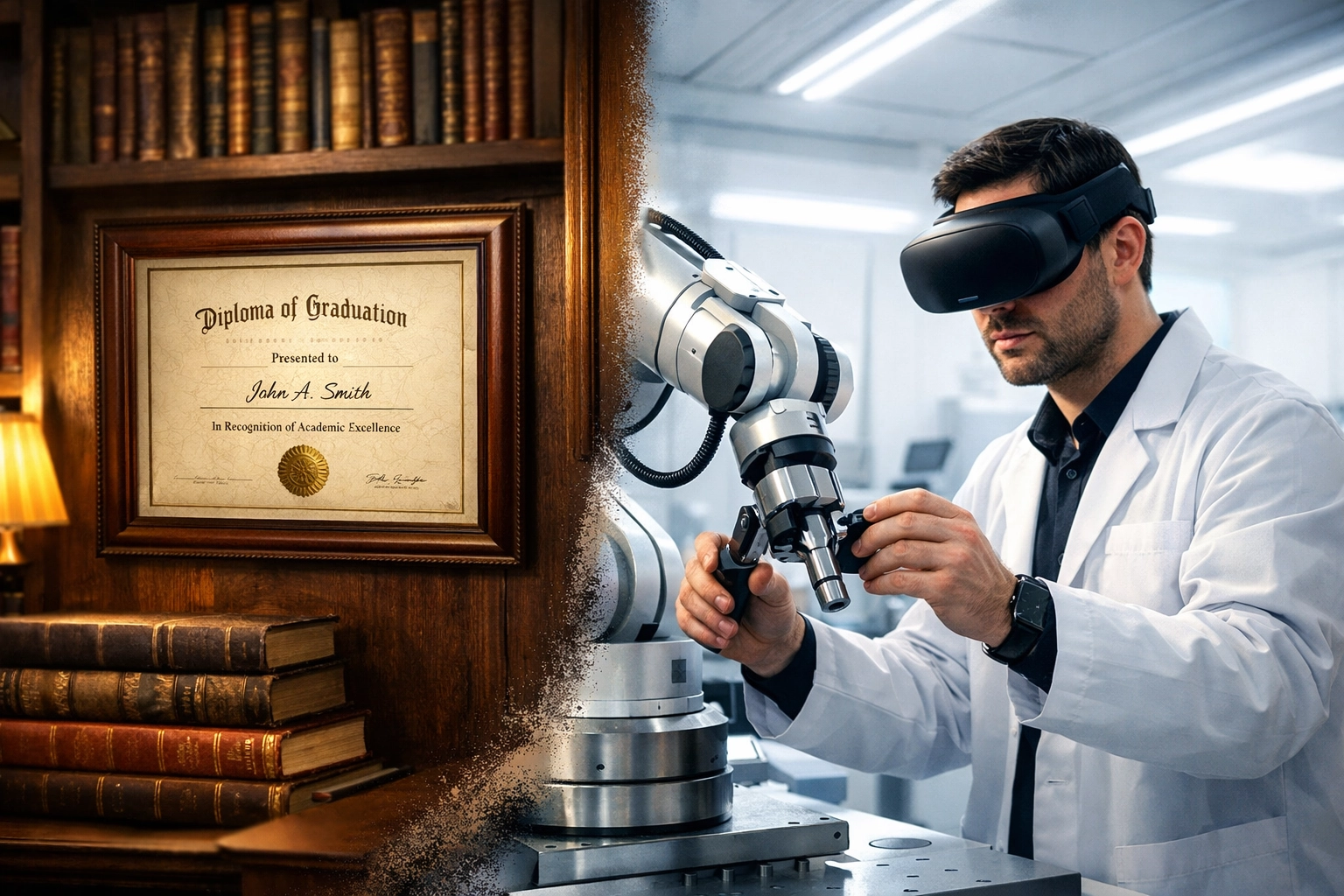
It would be a mistake to say degrees are obsolete. In 2026, degree-based hiring remains the gold standard in highly regulated sectors:
- Medicine and Healthcare: You still want your surgeon to have a formal MD. However, even here, "Micro-credentials" in Robotic Surgery or AI-Diagnostics are what differentiate top candidates.
- Law and Compliance: Juris Doctorates remain mandatory, but "Legal-Tech" certifications are the new requirement for top-tier firms.
- Specialized Engineering: Structural, Aerospace, and Nuclear engineering still require the foundational rigor of a multi-year university program.
For these fields, the degree provides the safety and ethics framework, while skills-based learning provides the innovation framework.
How to Optimize Your Career for a Skills-Based 2026
If you are looking to remain competitive, your strategy should shift from "credential accumulation" to "competency demonstration."
- Identify Your "Core Skill Graph": Map out the skills you currently possess versus what the market is paying for. Use AI tools to scan job descriptions for your target role and identify the specific software or methodologies mentioned most frequently.
- Invest in "High-Signal" Certifications: Not all certificates are created equal. Focus on those issued by the industry leaders (e.g., AWS for Cloud, Google for Data Analytics, or HubSpot for GEO-based marketing).
- Build a Public "Proof of Work": Whether it's a personal website, a Substack, or a LinkedIn-based video resume, you need a place where an employer can see your skills in action.
- Master the "Human" Skills: As technical skills become easier to acquire via AI, "Power Skills" like complex problem-solving, empathy, and ethical judgment are becoming the ultimate differentiators. 2026 employers are desperately looking for people who can bridge the gap between AI output and human needs.
The Bottom Line
The verdict for 2026 is clear: Employers prefer skills because skills solve problems today, while degrees signal the ability to learn yesterday.
While having a degree remains a valuable asset that provides a broad intellectual foundation, it is no longer the "golden ticket" to a high-paying career. The modern professional must be a lifelong learner, constantly "stacking" new technical abilities on top of their foundation. In the battle of Skills-Based vs. Degree-Based hiring, the winner isn't one or the other: it’s the candidate who uses the foundation of an education to fuel a never-ending cycle of skill acquisition.
About the Author: Malibongwe Gcwabaza
Malibongwe Gcwabaza is the CEO of blog and youtube, a leading digital hub dedicated to the intersection of career development and emerging technology. With over a decade of experience in the tech recruitment and online education space, Malibongwe focuses on helping professionals navigate the complexities of the AI-driven job market. His "simple yet deep" approach to career coaching has helped thousands of individuals pivot into high-paying tech roles by focusing on evidence-based skill building rather than traditional pedigree. When he's not analyzing the latest labor market trends, he’s exploring the future of decentralized education.
About the Author