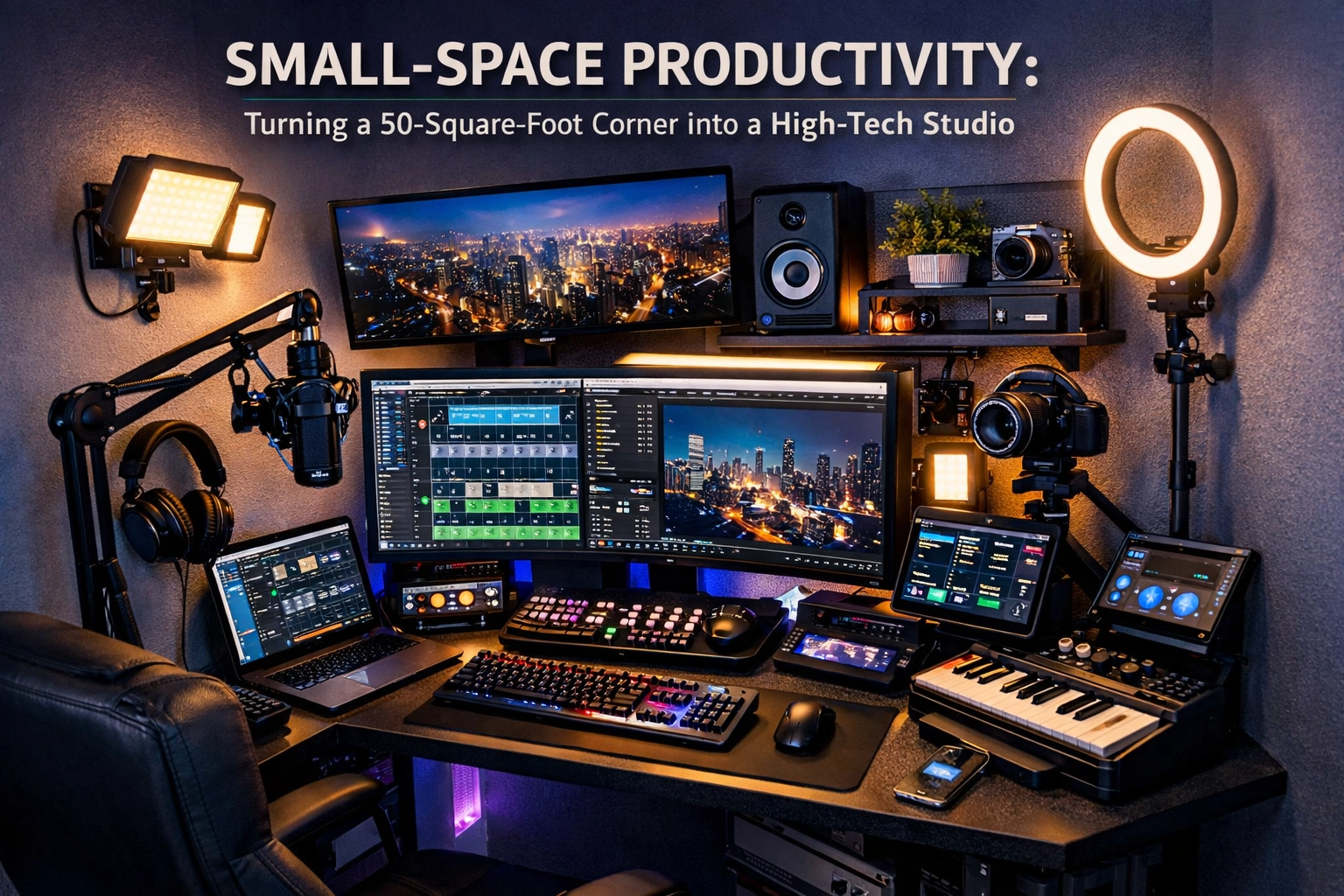
By 2026, the traditional "home office": a dedicated 120-square-foot room with a door: has become a relic of the pre-density era. With urban real estate prices soaring and the "fractional workforce" trend hitting its peak, professionals are increasingly forced to innovate within much smaller footprints. The new gold standard for the modern solopreneur is the "Nano-Studio": a 50-square-foot zone (roughly 5' x 10') that functions with the efficiency of a high-end corporate suite.
Turning a cramped corner into a high-output production hub isn't just about buying a small desk; it’s an exercise in spatial engineering, signal management, and ergonomic optimization. If you’re working with limited square footage, you have to stop thinking in terms of floor space and start thinking in terms of cubic volume.
The "Z-Axis" Strategy: Why Verticality is Your Best Friend
In a 50-square-foot space, the floor is your most expensive asset. Every square inch occupied by a table leg or a filing cabinet is an inch you can’t move your chair. To reclaim this, 2026 design trends focus heavily on the Z-axis.
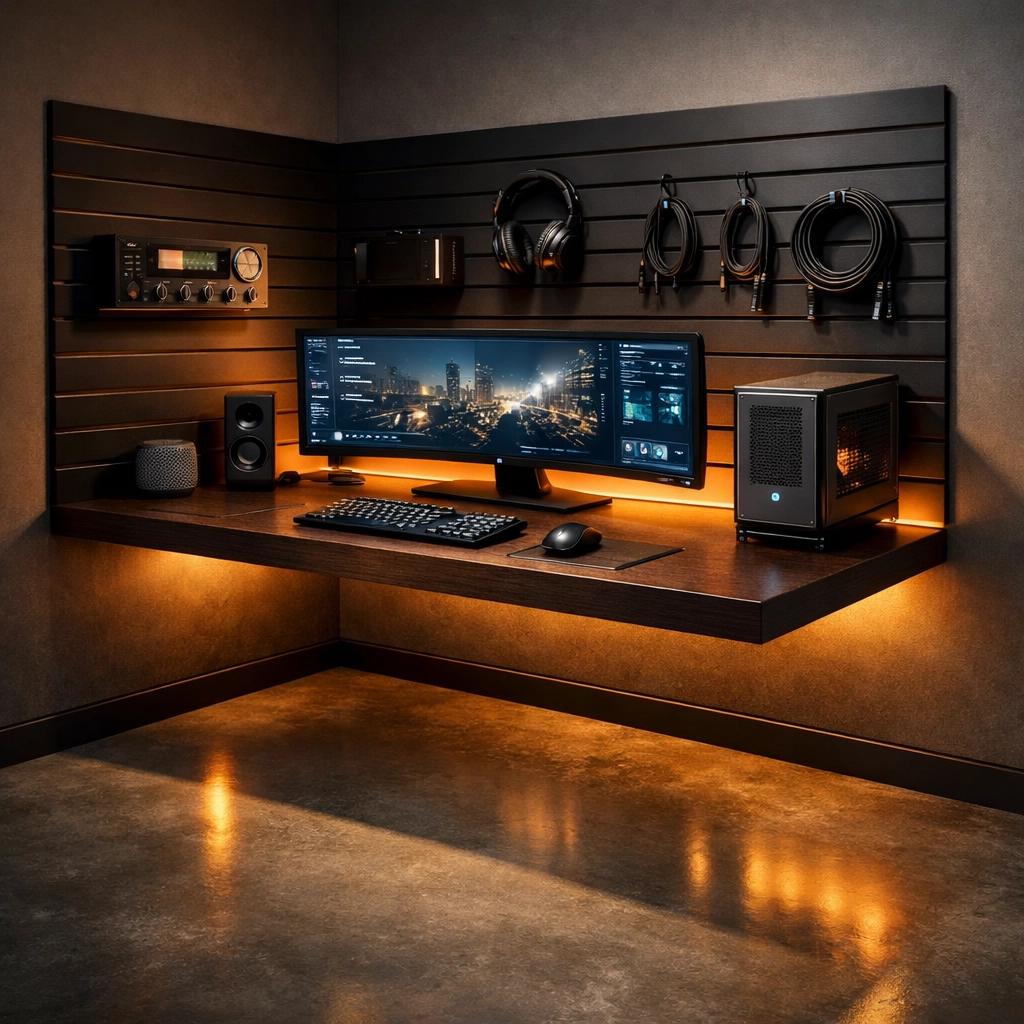
Wall-mounted "floating" workstations have replaced the four-legged desk. By using heavy-duty cantilever mounts, you can support up to 200 lbs of gear without a single leg touching the carpet. This creates "visual floor clarity," a psychological trick that makes a small room feel twice as large.
Beyond the desk, the "Service Wall" is the cornerstone of the nano-studio. Utilizing industrial-grade pegboard systems or slat-walls, you can offload your entire tech stack: audio interfaces, external GPUs, NAS drives, and even PC towers: onto the wall. This keeps your hardware ventilated and your workspace clear of the "tech clutter" that typically kills focus in small environments.
Spatial Computing vs. Physical Monitors
The biggest space-killer in any studio is the monitor array. A dual 32-inch setup consumes nearly 15 square feet of visual and physical space. In 2026, we are seeing a massive pivot toward Spatial Computing Overlays.
For many high-level developers and creative directors, the physical monitor is being replaced by lightweight XR (Extended Reality) glasses. These devices allow you to project an infinite, multi-monitor setup onto your 50-square-foot reality without needing a single physical screen. However, for those who still prefer glass, the "Ultra-Short Throw" (UST) trend is the winner. Instead of a bulky monitor, high-gain ambient light rejecting (ALR) screens are applied directly to the wall like wallpaper, with a micro-projector hidden in the desk lip. This provides a 100-inch workspace that effectively occupies zero inches of depth.
The 2026 Tech Stack: GaN, Wi-Fi 7, and Invisible Power
Managing a high-tech studio in a corner requires a radical approach to power and data. You cannot afford a "cable nest."
- GaN (Gallium Nitride) Integration: Traditional power bricks are dead. 2026 studios utilize integrated GaN charging hubs that can push 300W of power through a single USB-C cable, powering your laptop, lights, and peripherals simultaneously.
- Wi-Fi 7 and Thread: To avoid running Ethernet cables across your living room, the nano-studio relies on Wi-Fi 7’s 320MHz channels. This provides the low-latency, high-bandwidth connection required for 8K video editing or real-time AI model training without the physical tether.
- Solid-State Cooling: In a small corner, heat buildup is a productivity killer. Modern high-tech setups are moving toward solid-state (Peltier) cooling or silent, fanless enclosures to ensure your 50-square-foot sanctuary doesn't turn into a sauna during heavy rendering sessions.
Acoustic Engineering in Tight Quarters
One of the most overlooked aspects of the 50-square-foot studio is sound. In a small corner, sound waves bounce off nearby walls instantly, creating a "boxy" or "hollow" audio profile during Zoom calls or podcast recordings.
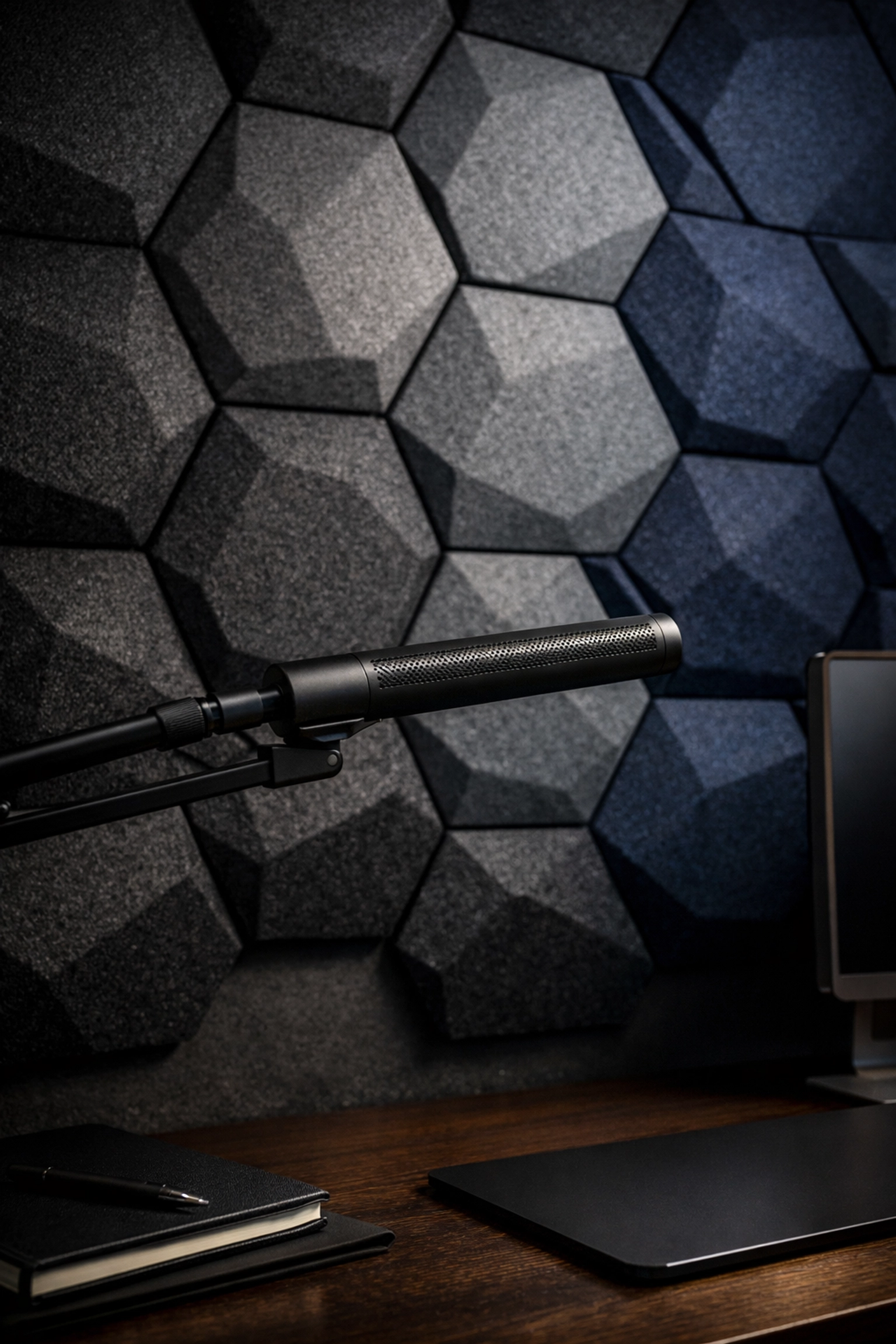
Professional-grade productivity requires acoustic treatment, but traditional foam wedges look cluttered. The 2026 solution is Acoustic Felt Art. High-density polyester felt panels, laser-cut into geometric patterns, act as both high-end decor and sound dampeners.
Furthermore, directional "Beamforming" microphones have become a staple. These mics use AI to create a narrow "pickup cone" around your mouth, digitally ignoring the sound of the dishwasher or the city traffic outside your 50-square-foot zone. This allows you to maintain professional-grade audio without needing a soundproof booth.
Lighting: The "Biophilic" Command Center
In a small space, lighting is often either too dim (causing eye strain) or too harsh (causing "screen glare"). The goal of a high-tech studio is to implement Circadian Lighting Systems.
Using high-CRI (Color Rendering Index) LED strips hidden behind the desk and monitor, you can sync your workspace’s color temperature with the sun. This prevents the "basement effect" often felt when working in a cramped corner. For those in windowless corners, "Artificial Skylights" that mimic the Rayleigh scattering of the atmosphere can be mounted on the ceiling, tricking the brain into thinking the 50-square-foot space is open to the sky.
Ergonomics: The "Cockpit" Philosophy
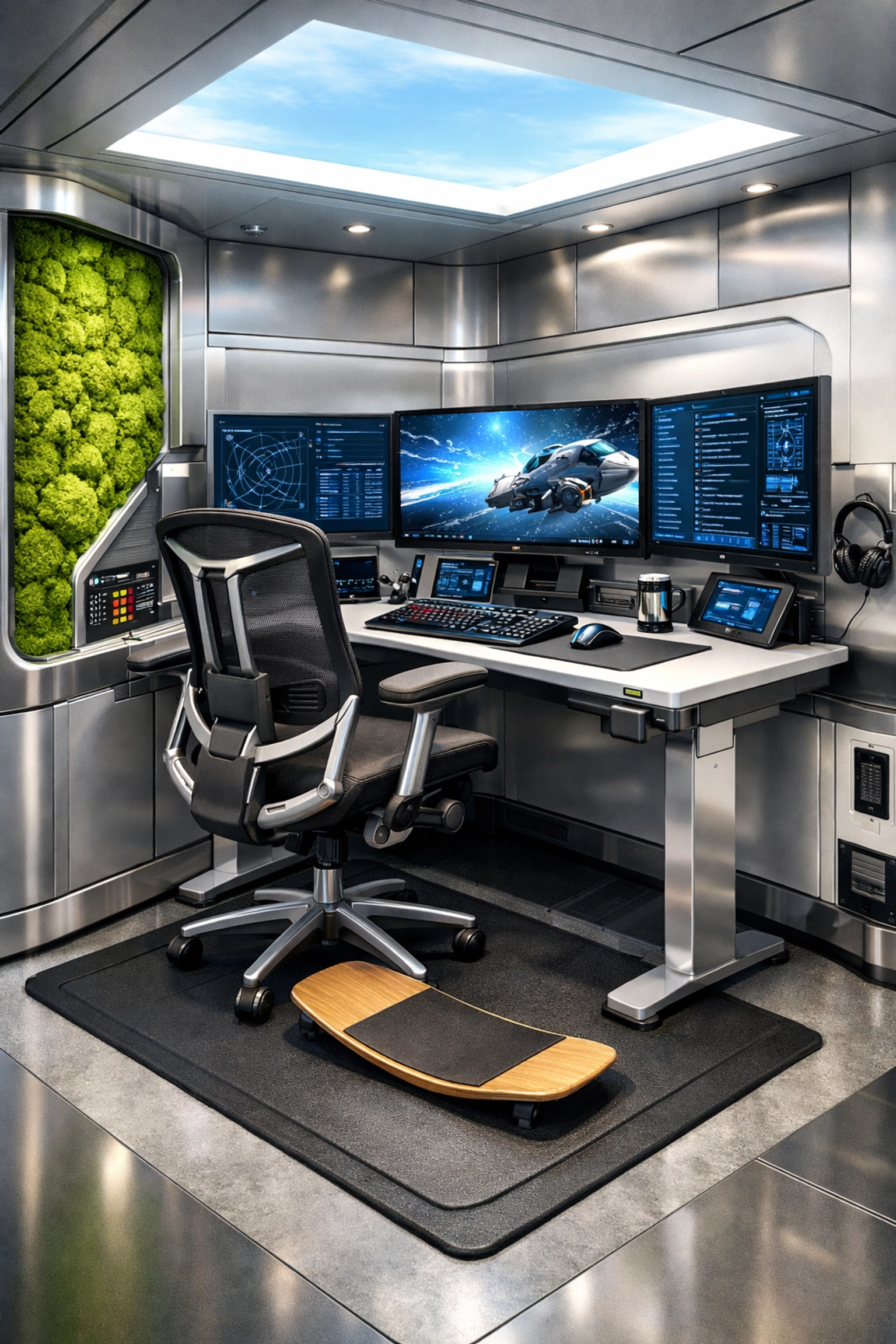
When you only have 50 square feet, your chair becomes the most important piece of technology you own. You aren't just sitting in it; you are operating from it.
The 2026 ergonomic trend is "Dynamic Movement." Since you don't have room to walk around, your furniture must move for you. Compact, electric sit-stand desks with a "collision-sensing" footprint are essential. These desks are often paired with "Balance Boards" or "Under-Desk Pedals" that allow for low-impact movement during deep-work sessions, ensuring that your cardiovascular health doesn't suffer from the spatial constraints.
Data Insight: The ROI of the Nano-Studio
Recent data from 2025-2026 productivity audits suggests that professionals working in optimized "Nano-Studios" actually report a 14% increase in deep-work efficiency compared to those in larger, open-plan home offices. The reason? Reduced "Visual Entropy." In a 50-square-foot space where everything is within arm's reach and the environment is highly controlled, the brain spends less energy processing peripheral distractions.
| Component | Standard Office Cost (sq ft) | Nano-Studio Cost (sq ft) | Efficiency Gain |
|---|---|---|---|
| Real Estate | 120-200 | 40-60 | +60% Cost Saving |
| Power Draw | 450W | 180W (GaN Optimized) | +40% Energy Efficiency |
| Focus Score | 6.5/10 | 8.8/10 | +35% Deep Work |
Creating Your Own High-Tech Sanctuary
If you’re ready to convert that neglected corner into a high-tech powerhouse, follow this three-step blueprint:
- Audit the Essentials: If a piece of tech hasn't been used in the last 30 days, it doesn't belong in the 50-square-foot zone. Move it to external storage.
- Invest in "Multimodal" Gear: Choose monitors that act as USB hubs, desks with built-in wireless charging, and chairs that support multiple postures.
- Prioritize Air Quality: Small spaces accumulate CO2 faster than large rooms, which leads to brain fog. A high-CADR (Clean Air Delivery Rate) HEPA filter is a non-negotiable tech component for the nano-studio.
The future of work isn't about how much space you have; it’s about how much you can do with the space you've got. By applying these high-tech principles, your 50-square-foot corner won't just be a place to work: it will be the most productive room in your home.
About the Author: Malibongwe Gcwabaza
CEO of blog and youtube
Malibongwe Gcwabaza is a visionary leader in the digital workspace and automation sector. With over a decade of experience navigating the intersection of technology and human productivity, he has helped thousands of professionals optimize their environments for the AI-driven economy. Under his leadership, blog and youtube has become a premier destination for high-level technical insights and future-ready career strategies. Malibongwe is a firm believer that "constraints are the ultimate catalyst for innovation," a philosophy he lives by from his own 50-square-foot high-tech studio in Johannesburg.
About the Author