Most small business owners treat content marketing like a digital flyer. They post a photo of their product, list the features, add a "Buy Now" button, and wonder why the engagement is hovering at zero. The reality is that in a world saturated with ads, people have developed a "filter" for traditional marketing. If it looks like an ad, smells like an ad, and talks like an ad, we ignore it.
But stories? We can’t get enough of them.
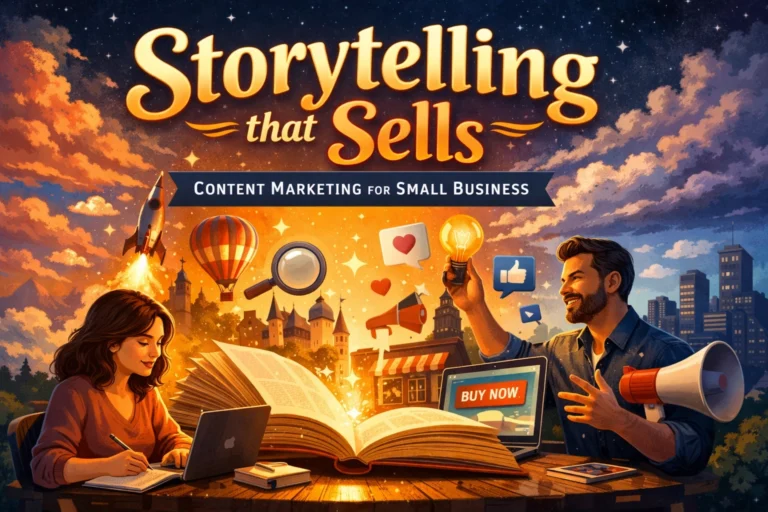
Storytelling isn’t just for novelists or filmmakers. For a small business, storytelling is the bridge between being a "commodity" and being a "brand." It’s the difference between someone buying from you because you’re the cheapest and someone buying from you because they actually like you.
Here is how to master the art of storytelling to drive real sales without needing a Hollywood budget.
The Psychology of Why Stories Sell
Before we dive into the "how," we need to understand the "why." When we read a list of facts or bullet points about a product, only two parts of our brain activate: the Broca’s and Wernicke’s areas. These are the language processing centers. We understand the information, but it doesn’t move us.
However, when we hear a story, our brain lights up like a Christmas tree. If you describe a delicious meal, our sensory cortex activates. If you talk about a stressful situation, our cortisol levels rise. We don't just process a story; we experience it.

For a small business, this is a superpower. When a potential customer experiences your brand through a narrative, they form an emotional connection. And research consistently shows that humans make buying decisions based on emotion and justify them later with logic. If you can win the heart, the wallet usually follows.
The "Hero’s Journey" for Your Business
A common mistake small businesses make is thinking they are the hero of the story. You aren’t.
In the narrative of your business, your customer is the hero. You are the guide, the Gandalf to their Frodo, the Obi-Wan to their Luke. Your job isn’t to show how great you are; it’s to show how you can help the customer overcome their specific "monster" (their problem) and achieve their "treasure" (their goal).
The Simple Story Framework (PAS)
If you’re struggling to structure a post, use the Problem-Agitation-Solution framework through a narrative lens:
- The Problem: Introduce a character (your typical customer) who is struggling with a specific pain point.
- The Agitation: Describe the emotional or physical toll of that problem. How does it feel to be stuck?
- The Solution: Introduce your product or service as the tool that helped the character overcome the obstacle.
By positioning yourself as the guide, you build trust. You aren’t shouting "Buy this!"; you’re saying "I understand your struggle, and I have the map to help you get out."
Four Story Types Every Small Business Needs
You don't need to reinvent the wheel every time you post. Most high-performing content marketing strategies for small businesses revolve around these four core narratives:
1. The Origin Story (The "Why")
People don’t buy what you do; they buy why you do it. Your origin story shouldn't just be a timeline of dates. It should be about the spark of inspiration or the frustration that led to the business.
Did you start a pet grooming business because you saw a dog treated poorly at a chain store? That’s a story. Did you start a software company because you were tired of losing hours to manual data entry? That’s a story. Share the "aha!" moment. It humanizes the brand and gives people a reason to root for you.
2. The Customer Spotlight
This is the most powerful form of social proof. Instead of a dry testimonial that says "Great service, five stars," tell the story of the transformation.
- Before: "Sarah was overwhelmed and couldn't sleep because of X."
- The Turning Point: "She found our service and we did Y."
- After: "Now, Sarah has her weekends back and feels Z."

3. Behind-the-Scenes (The "Process")
In a world of AI-generated everything and dropshipping, people crave authenticity. Show the messy desk, the late-night packing sessions, or the team brainstorm. Showing the "making of" your product adds value to it. When people see the craft and the humans behind the logo, they are less likely to haggle on price because they see the effort involved.
4. The Failure Story
This sounds counterintuitive. Why would you tell people you failed? Because perfection is boring and unrelatable. Sharing a mistake you made, and how you fixed it, builds massive amounts of trust. It shows you have integrity and that you’re constantly learning. It makes your business feel "real."
How to Tell Stories Across Different Channels
Your storytelling needs to adapt to where your audience is hanging out. You wouldn't tell a story the same way on a 2,000-word blog post as you would in a 15-second TikTok.
| Channel | Story Style | Key Element |
|---|---|---|
| Blog | Long-form, Educational | Deep dives, data-backed narratives |
| Instagram/FB | Visual, Personal | Captions that start with a hook |
| Conversational, One-on-one | The "letter from a friend" vibe | |
| YouTube | Cinematic, Documentary | High-quality B-roll and emotional music |
Storytelling on Social Media
Social media is a "stop the scroll" environment. Your story needs to start with a "hook", a sentence that creates a curiosity gap.
- Weak: "Check out our new coffee beans."
- Strong: "We almost burned the roastery down trying to find this specific flavor profile."
Once you have their attention, keep the sentences short. Use line breaks. Make it easy to consume.
Storytelling in Email Marketing
Email is the most intimate channel. Use it to tell "micro-stories." A quick anecdote about something that happened in the office that morning can be the perfect lead-in to a sale. The goal is to make the reader feel like they are part of an inner circle.

Mapping Stories to the Sales Funnel
Storytelling isn't just about "brand awareness"; it’s a tactical tool for every stage of the customer journey.
- Top of Funnel (Awareness): Use relatable stories about common pain points to attract people who don't know you yet.
- Middle of Funnel (Consideration): Use "Behind-the-Scenes" and "Origin Stories" to build trust and show your expertise.
- Bottom of Funnel (Decision): Use "Customer Transformation" stories and "Case Studies" to handle objections and close the sale.
By matching the story to the buyer's mindset, you move them through the funnel naturally without ever sounding "salesy."
The ROI of Narrative: Does it Actually Work?
You might be thinking, "This sounds like a lot of work. Can't I just run an ad?"
You can, but storytelling provides a much higher Return on Investment (ROI) over the long term. Why? Because stories have longevity. A good story is shared. It’s remembered. It builds a community of advocates, not just a list of customers.
When you compete on price, you’re in a race to the bottom. When you compete on story, you’re in a category of one. There might be a thousand other graphic designers, but there is only one with your specific journey, your specific "why," and your specific way of helping clients.
Getting Started: Create Your Story Bank
The biggest hurdle for small business owners is feeling like they don't have any stories to tell. This is never true. You are just too close to your own business to see them.
Start a "Story Bank": a simple document or notebook where you jot down:
- A funny thing a customer said.
- A mistake you made that taught you something.
- A specific problem you solved that week.
- A photo of a finished project that you're proud of.
When it’s time to create content, you aren't staring at a blank screen. You just pick a story from the bank and link it to a business lesson or a product.

Final Thoughts
Content marketing for small businesses doesn't have to be a grind of technical SEO and robotic product descriptions. By shifting your focus to storytelling, you make your marketing more human, more engaging, and ultimately, more profitable.
Remember: Facts tell, but stories sell. Stop trying to convince people to buy, and start inviting them into your story.
About the Author
Malibongwe Gcwabaza is the CEO of blog and youtube, a platform dedicated to helping small businesses and creators master the digital landscape. With a background in strategic communication and a passion for simple, effective marketing, Malibongwe focuses on stripping away the jargon to help entrepreneurs tell stories that resonate and drive growth. When he's not refining content strategies, he's exploring the intersection of technology and human connection in the modern creator economy.
About the Author