By 2026, the traditional four-year linear degree has shifted from being the "gold standard" to being just one of many options in a modular educational marketplace. The "all-or-nothing" approach to higher education: where you spend four years and $100,000 before seeing a dime of ROI: is being replaced by the "Stackable Degree" model.
This isn't just about taking a few online courses. It’s a sophisticated architectural shift in how human capital is developed. For professionals in high-growth sectors like AI development, renewable energy engineering, and digital ethics, stackable credentials offer a way to gain "just-in-time" skills that carry the weight of university backing without the upfront time tax.
The Architecture of Modular Learning: What "Stackable" Really Means
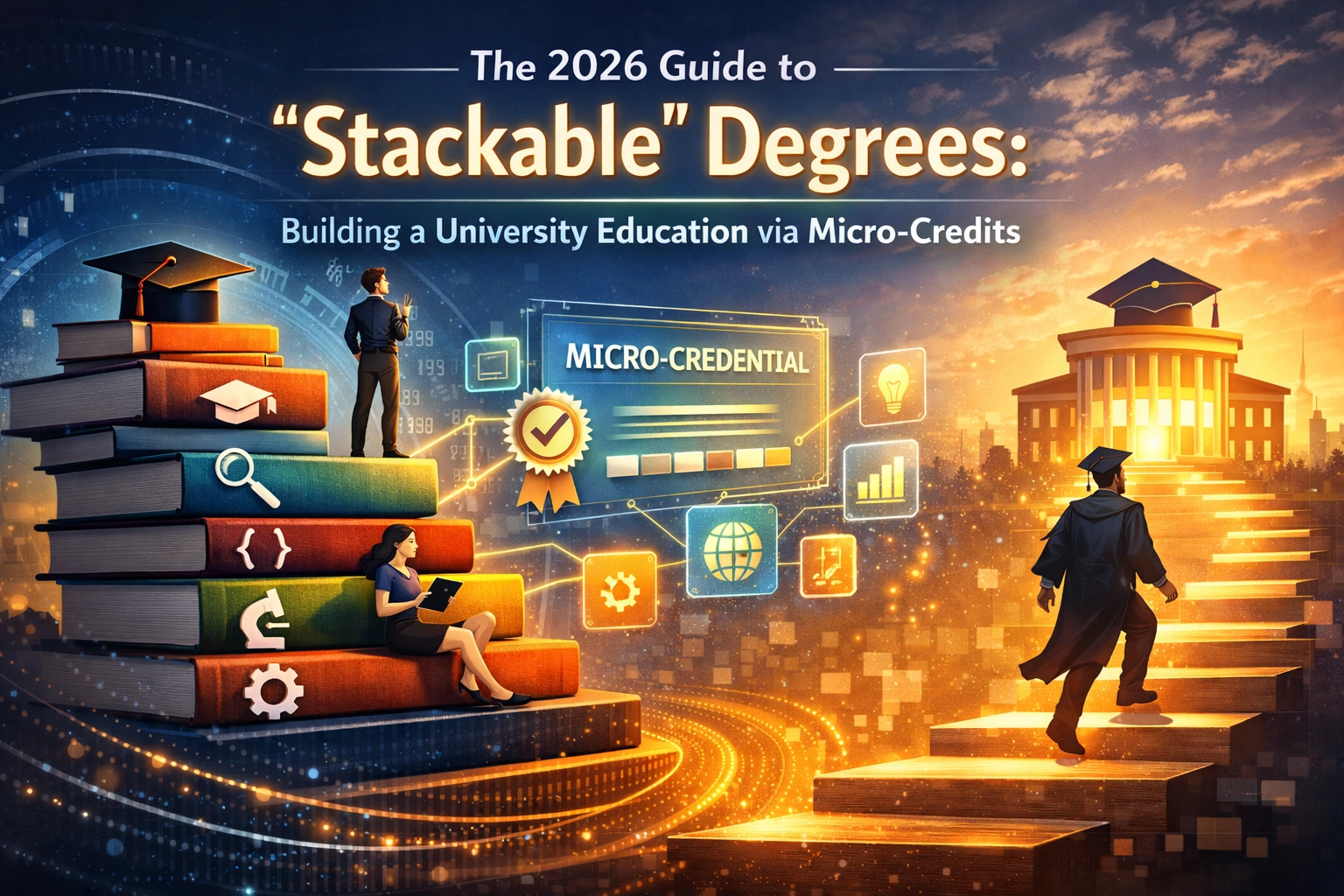
A stackable degree is a pathway where short-term, industry-recognized credentials (micro-credits) serve as building blocks toward a full undergraduate or graduate degree. Instead of a monolithic curriculum, you consume education in "sprints."
In the 2026 labor market, this stacking happens in three distinct dimensions:
1. Vertical Stacking (The Specialist Path)
This is the most common route. You start with a foundational certificate: say, a 12-week intensive in Python for Data Science. Once completed, you enter the workforce. A year later, you "stack" a professional diploma in Machine Learning Operations (MLOps). These credits aren't just extra lines on a resume; they are pre-mapped to a Bachelor’s or Master’s in Computer Science at a partner university. By the time you "graduate," you’ve already had three years of industry experience.
2. Horizontal Stacking (The Multidisciplinary Path)
As AI automates specialized tasks, the "Generalist" is making a comeback. Horizontal stacking involves gathering credits across different domains. A creative director might stack a certificate in Generative AI Design with a micro-credential in Behavioral Economics. This "T-shaped" skill set is currently commanding a 25% salary premium in the 2026 freelance economy.
3. Value-Added Stacking (The Niche Path)
This involves taking a core degree and "plugging in" hyper-specific certifications that the university curriculum hasn't caught up with yet. Think of a Nursing degree stacked with a Telehealth Robotics Certification. It’s about adding a specialized "edge" to a traditional foundation.

The Technical Backbone: LERs and Blockchain Transcripts
The reason stackable degrees finally became viable in 2026 is the widespread adoption of Learner Employment Records (LERs).
Historically, the biggest barrier to modular education was the "transfer credit nightmare." Universities were hesitant to recognize credits from outside their walls. Today, LERs: powered by decentralized ledger technology: provide a verified, immutable record of every skill, project, and credit you’ve earned.
When you complete a micro-course from a provider like Coursera, edX, or a specialized boot camp, the credit is issued as a digital token. These tokens are interoperable. Thanks to the 2025 Interoperability Standards Act, major universities are now legally and technically equipped to ingest these digital tokens directly into their registrars. This means your "Advanced Prompt Engineering" credit from a tech giant is technically indistinguishable from a classroom credit at a state university.
Why the "Sunk Cost" of Traditional Degrees is Fading
The economic data from early 2026 is clear: the ROI on stackable credentials often outpaces traditional degrees in the short term.
According to the 2026 Global Skills Report, individuals who utilized stackable pathways saw an average salary increase of 18% within six months of completing their first "stack." In contrast, traditional graduates often face a "lag period" of 12–18 months before reaching comparable specialized roles.
The "Stacking" Math for a 2026 Data Architect:
- Year 1: Micro-credential in Data Visualization ($1,500). Outcome: Entry-level Analyst role ($65k/year).
- Year 2: Certificate in Cloud Infrastructure ($2,200). Outcome: Promotion to Junior Architect ($85k/year).
- Year 3: Stacked credits applied to a "Completion Degree" ($12,000). Outcome: Senior Data Architect ($140k/year).
Total cost: ~$15,700. Total time to six figures: 3 years. Total debt: Zero (often covered by employer tuition reimbursement for modular chunks).

Step-by-Step: How to Build Your Stackable Degree in 2026
If you’re looking to bypass the traditional four-year grind, follow this blueprint to ensure your credits actually lead to a degree.
Step 1: Identify "Credit-Bearing" Partners
Not every online course is stackable. Look for the "University-Linked" badge. Platforms like the World Education Services (WES) now provide a 2026 directory of micro-credentials that carry ECTS (European Credit Transfer and Accumulation System) or equivalent US credits.
Step 2: Focus on High-CPC Skill Clusters
For the best financial return, align your stacking with high-value keywords that Google and recruiters are currently bidding on. These include:
- Quantum Machine Learning
- Sustainability Auditing (ESG)
- Bio-Informatics Data Management
- Cyber-Physical Systems Security
Step 3: Secure Your Digital Wallet
Set up a professional LER wallet (such as those provided by LinkedIn or specialized ed-tech firms). Ensure every certificate you earn is "on-chain." This prevents you from having to "prove" your education every time you apply for a credit transfer.
Step 4: The "Capstone" Strategy
Most stackable paths require a "Capstone" or a final residency to convert your pile of credits into a formal degree. Plan for a 3-month intensive or a final project-based semester at your chosen university to "lock in" the degree title.

The Social Impact: Democratizing Elite Education
One of the most profound shifts in 2026 is the "unbundling" of prestige. You can now take the first three "stacks" of a Computer Science curriculum from a top-tier institution like MIT or Oxford via their open-learning initiatives.
While you might not get the full "Ivy League" degree without the final (and expensive) residency, having 75% of your credits from a world-class institution: verified on your LER: carries massive weight in a skills-based hiring market. This has opened doors for learners in emerging markets who previously couldn't afford the "all-at-once" cost of global education.
Challenges to Watch Out For
Despite the benefits, stackable degrees require high levels of self-regulation. Without the structure of a campus and a four-year schedule, many learners suffer from "stack fatigue."
Furthermore, "Accreditation Inflation" is a real concern in 2026. With so many micro-credentials available, the market is becoming flooded. The key is to stick to "Master-Stack" programs: those officially recognized by major industry bodies (like the IEEE for engineering or the SHRM for HR).
Conclusion: The End of the Graduation Date
In the 2026 economy, "Graduation" is no longer a single date on a calendar; it’s a continuous state of being. By utilizing stackable degrees, you turn your education into a living, breathing asset that grows alongside your career. You learn what you need, when you need it, and you get the academic credit you deserve without the unnecessary filler.
If you’re starting your journey today, don’t ask which university you want to attend. Ask which skill you want to master first. The degree will follow, one brick at a time.
About the Author: Malibongwe Gcwabaza
Malibongwe Gcwabaza is the CEO of blog and youtube and a leading voice in the "Skills-First" movement. With over a decade of experience in digital transformation and educational technology, Malibongwe focuses on how AI and decentralized systems are reshaping the global workforce. His mission is to simplify complex career transitions for the next generation of solopreneurs and tech professionals. When he isn't analyzing labor market trends, he’s exploring the intersection of human creativity and agentic AI workflows.
About the Author