![[HERO] The 2026 Social Media Growth Playbook: Advanced Tactics for Scaling Your Digital Presence](https://cdn.marblism.com/8afaIyxRtYz.webp)
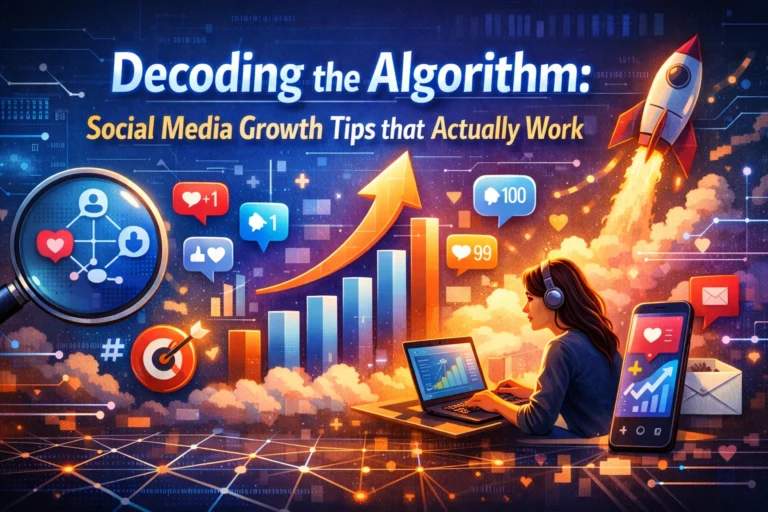
In 2026, the follower count is a vanity metric that has finally lost its teeth. If you are still operating on the 2022-2024 playbook of “post three times a day and use trending audio,” you aren’t just standing still: you’re actively invisible. The landscape has shifted from social graphs (who you know) to interest graphs (what you actually care about).
Scaling a digital presence today requires a radical departure from reactive posting. We are now in the era of the “Recommendation Engine,” where platforms like Instagram, TikTok, and YouTube function more like Netflix than a telephone directory. They don’t care who you follow; they care what keeps you on the screen. To win, you need a systems-based approach that prioritizes high-signal content over noise.
The Death of the Feed: Understanding the Interest Graph
The most significant shift in social media growth tips for 2026 is the total dominance of the interest graph. In the past, when you gained a follower, you “owned” a piece of their attention. Today, you rent it every single time you hit publish.
Algorithms now use “Signals of Intent” to decide who sees your content. This means your content must be optimized for discovery by strangers, not just retention of fans.
Key Signals of Intent in 2026:
- The “Share-to-Save” Ratio: High saves indicate utility; high shares indicate identity. Both tell the algorithm your content is “High Signal.”
- Watch Time Persistence: It’s no longer about the first 3 seconds; it’s about the “Deep View”: getting users to stay past the 60-second mark in short-form video.
- Comment Sentiment Analysis: Advanced AI now categorizes comments. Generic “Great post!” comments carry less weight than nuanced discussions or questions.

Short-Form Video 3.0: From Viral Hooks to Value-Dense Minis
Short-form video has evolved. We’ve moved past the “pointing at text” and “lip-syncing” phases. In 2026, the audience has developed a high resistance to traditional viral hooks. They can smell a “marketing hook” from a mile away and will swipe instantly.
The new standard is Value-Dense Narrative. Instead of trying to trick someone into watching, you provide immediate, high-level insight within the first four seconds.
Tactical Video Evolution
- POV-Driven Storytelling: Stop filming “at” the camera. Film “with” the camera. Use a first-person perspective to bring the audience into your workflow or environment.
- The “Anti-Polish” Movement: While 4K resolution is the standard, overly produced, studio-lit content often triggers “ad blindness.” Raw, high-quality mobile footage with natural lighting signals authenticity and trust.
- Contextual Editing: You cannot post the same 9:16 video to TikTok, Reels, and YouTube Shorts and expect identical results. Each platform has a different “vibe” and user expectation.
- TikTok: Raw, experimental, community-centric.
- Reels: Aesthetic, aspirational, lifestyle-focused.
- YouTube Shorts: Educational, high-velocity, intent-driven.
Community-Led Growth: The New Distribution Lever
If your growth feels stuck, it is likely a distribution problem, not a content problem. In 2026, you cannot rely solely on the algorithm to be your delivery man. You must turn your community into your distribution channel.
This is known as Community-Led Growth (CLG). It’s the process of building a “moat” around your brand by making your followers active participants rather than passive observers.
Strategies for CLG
- The 1% Rule: Identify the top 1% of your most engaged followers. Give them direct access: whether through a broadcast channel, a Discord, or early access to content. They become your “street team” who jump-start the algorithm’s engagement signals every time you post.
- Co-Creation: Use polls, Q&As, and “Build in Public” sequences to let your audience dictate your next moves. When people feel they helped build something, they are 10x more likely to share it.
- UGC 2.0: Don’t just ask for testimonials. Encourage your audience to remix your content or share their own results using your frameworks.

Owned Formats vs. Rented Trends
One of the biggest mistakes creators and brands make is “trend chasing.” Trends are rented property: they have high volatility and low long-term value. Formats, however, are owned assets.
A format is a repeatable structure that your audience recognizes and expects. Think of it like a TV show segment. When you own a format, you compound your growth because the audience knows exactly what value they are getting.
2024 vs. 2026 Growth Tactics
Data-Driven Foundation: Moving Beyond Basic Analytics
To scale in 2026, you need to look past the “Insights” tab on your social apps. Serious growth requires a data infrastructure that connects social engagement to real-world outcomes.
The 2026 Tech Stack for Growth
- GA4 & BigQuery: Export your social data to see how specific posts correlate with website traffic spikes and long-term user behavior.
- Sentiment Mapping: Use AI tools to aggregate comment data. Are people asking for more tutorials? Are they frustrated with a specific topic? This dictates your content calendar better than any keyword tool.
- Conversion Attribution: In 2026, privacy laws have made tracking harder. Use modern “Post-Purchase Surveys” or “How did you find us?” prompts to manually verify which social channels are actually driving the needle.

The 30-Day “Systems Over Calendars” Implementation Plan
Most people fail because they try to manage social media with a calendar. Calendars are rigid. Systems are fluid. In a volatile social environment, you need a system that allows you to pivot while maintaining consistency.
Week 1: Audit and Format Identification
Look at your last 90 days of content. Ignore the “viral” outliers. Look for the “consistent winners.” Identify two formats that you can produce every week without burning out. One should be a “Safe” format (guaranteed engagement) and one should be “Experimental” (testing new angles).
Week 2: Content Batching and Contextual Editing
Record your content in batches, but edit for context. Create a master “A-Roll” and then create three different edits for your primary platforms. Ensure your captions are optimized for SEO: platforms are increasingly functioning like search engines, so use relevant keywords naturally.
Week 3: Community Seeding
Before you post, spend 20 minutes engaging with the “1% of your community” and similar creators in your niche. After you post, stay in the comment section for at least 60 minutes. This “Active Engagement” signals to the algorithm that the post is a hub of conversation.
Week 4: Analyze and Prune
Review the data. If a format didn’t perform after four attempts, prune it. Double down on what worked. Social media growth in 2026 is a game of ruthless elimination. Stop doing what “sort of” works so you have the energy to do what “really” works.
Final Thoughts: The Human Element
Despite all the talk of algorithms, AI, and BigQuery, social media remains fundamentally social. The biggest social media growth tips will always involve human connection. AI can help you write a script or edit a video, but it cannot provide a unique perspective or a lived experience.
In 2026, the creators who win are the ones who use technology to handle the distribution and data, freeing themselves up to be more human, more opinionated, and more engaged with their community.

About the Author: Malibongwe Gcwabaza
Malibongwe Gcwabaza is the CEO of LearnRise, a leading digital growth agency specializing in AI-driven content strategies and community-led scaling. With over a decade of experience in the evolving digital landscape, Malibongwe focuses on bridging the gap between technical data and human-centric storytelling. He is a frequent speaker on the future of work, digital presence, and the intersection of technology and creativity. Under his leadership, LearnRise has helped hundreds of brands navigate the shift from traditional marketing to the modern recommendation-based economy.
About the Author