The prompt is dead.
If you’re still sitting in front of a blinking cursor, trying to figure out the perfect sequence of words to make a chatbot give you a halfway decent email draft, you’re already living in the past. It’s March 2026, and the "AI as a tool" era has officially sunsetted. We’ve moved into something much more chaotic, exciting, and powerful: The Agentic Workspace.
Welcome to FlowState AI. We aren't here to teach you how to talk to a bot. We’re here to show you how to lead a digital department.
For the last two years, the world has been obsessed with "using" AI. People treated ChatGPT like a high-end calculator: input goes in, answer comes out. But if you’ve tried to scale a business using that model, you’ve hit the wall. You’ve realized that managing five different browser tabs, copying and pasting data between "smart" tools, and babysitting every single output is actually more work, not less.
The future isn’t about better prompts. It’s about agentic teams. It’s about moving from being a "user" to being an "orchestrator."
The Great AI Hangover of 2025
Last year, we saw a massive surge in AI fatigue. Small businesses were promised that AI would solve everything, but instead, they got a mountain of generic content and a bunch of disconnected tools that didn't talk to each other.
The missing link wasn't intelligence; it was agency.
A standard AI is a librarian: it knows things, and it can find things if you ask nicely. An AI agent, however, is a project manager. It has a goal, it has tools, and most importantly, it has the authority to act, reflect, and pivot without you holding its hand every five seconds.
The shift to an agentic workspace means building a system where your AI agents collaborate. One agent identifies a market gap, another drafts the solution, a third handles the content marketing for small business distribution, and a fourth optimizes the whole thing for the latest SEO strategies 2026 demands.

What Exactly is the Agentic Workspace?
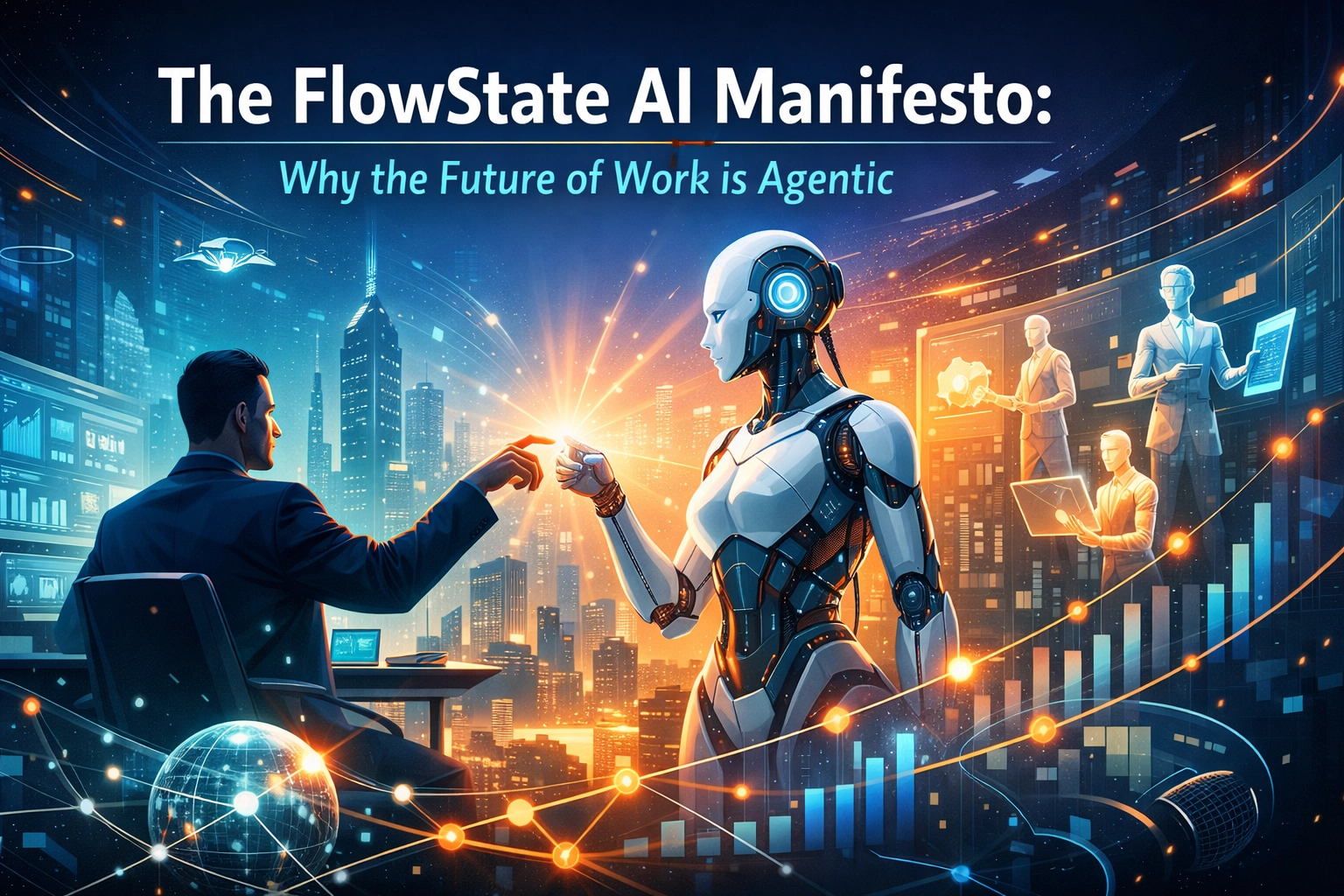
At FlowState AI, we define the Agentic Workspace as a collaborative environment where humans provide the vision and intuition, while a network of specialized AI agents handles the execution, coordination, and optimization.
Think of it like a professional sports team. You’re the coach. You aren't on the field running the plays yourself. You’ve got a quarterback (your Lead Agent), a defensive line (your Security and Fact-Checking Agents), and a scouting team (your Research Agents).
In this paradigm, work happens in a "flow state" because the friction of hand-offs is eliminated. When your Research Agent finds a new trend, it doesn’t wait for you to read a report; it pushes that data directly to your Content Agent, which then updates your strategy in real-time.
Why Coordination is the New Competitive Advantage
The biggest hurdle in 2026 isn't getting AI to write code or generate images. It’s getting AI to work together without hallucinating a total disaster. This is what we call the "Coordination Gap."
Most companies have "islands of automation." Their CRM has some AI, their email marketing has some AI, and their Slack has a bot. But these islands don't have bridges.
FlowState AI was built to solve this. Our primary USP is the coordination of these agent teams. We believe that the winners of this decade won't be the ones with the best LLM (those are becoming commodities), but the ones with the best Agentic Orchestration.
The FlowState AI Pillars
To thrive in this new workspace, we follow four core tenets that we believe will redefine professional life:
1. Symbiosis Over Automation
Automation is about replacing a human task. Symbiosis is about amplifying human creativity. We don’t want to remove the human from the loop; we want to put the human at the center of the loop. You provide the "why," the agents provide the "how."
2. Evolution Replaces Iteration
Traditional business models rely on "sprints." You plan, you build, you review. In an agentic workspace, the system is constantly evolving. As your agents interact with the world: be it through customer service logs or social media engagement: they should be refining their own instructions. It’s a living network of knowledge.
3. Context is Command
An agent is only as good as its context. In 2026, the "best" AI isn't the one with the most parameters; it's the one with the deepest access to your business's specific context: your brand voice, your past successes, and your current failures.
4. Velocity with Purpose
Speed is useless if you’re heading in the wrong direction. Agentic teams allow for incredible velocity, but our community focuses on steering that velocity so that small businesses don't just produce more "noise," but actually create more value.

SEO Strategies 2026: The Agentic Influence
Let’s get technical for a second. If you’re running a blog or a YouTube channel, you know that the old rules of SEO are buried in the graveyard. In 2026, search engines are themselves agentic. They don't just crawl keywords; they simulate user intent.
This means your SEO strategies 2026 need to be built by agents who can perform "Semantic Forecasting." You need agents that monitor search intent shifts in real-time and adjust your content architecture before the trend even peaks.
If you’re still manually checking keyword difficulty scores, you’re bringing a knife to a laser-gun fight. At FlowState AI, we’re obsessed with how agentic teams can automate the heavy lifting of technical SEO, leaving you to focus on the high-level storytelling that a bot can’t replicate.
Content Marketing for Small Business: The Great Equalizer
For a long time, content marketing was a game of "who has the biggest budget?" Big corporations could hire entire agencies to churn out blogs, videos, and social posts.
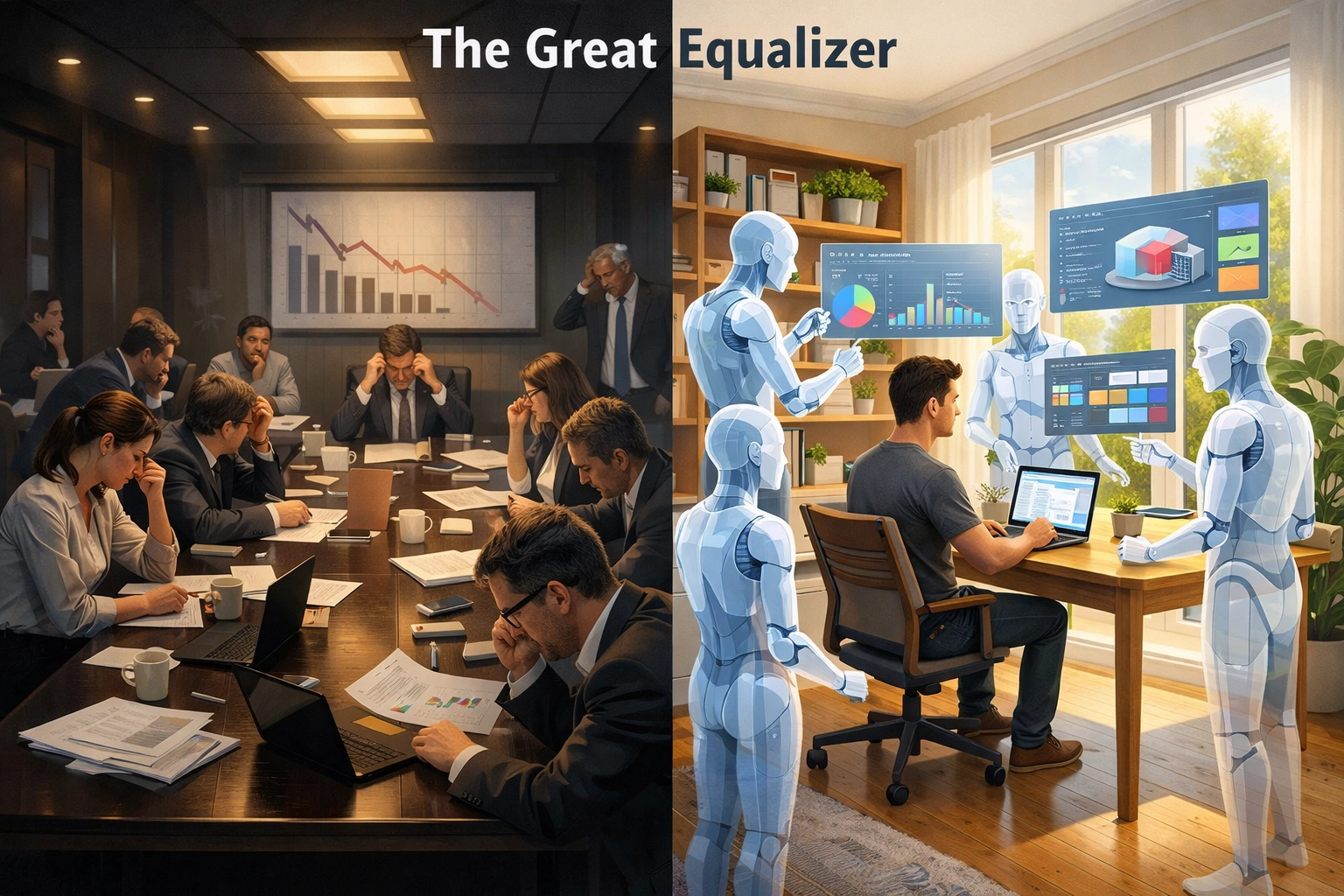
The Agentic Workspace changes the math. A small business owner with a well-coordinated team of three agents can now produce the same output: and better quality: than a 20-person marketing department from 2022.
We’re seeing "Micro-Multinationals" pop up: companies with two human employees and fifty AI agents, operating at a global scale. This is the heart of our mission. We want to give small businesses the playbook to build their own agentic departments so they can out-pace the slow-moving giants.
Why FlowState AI? Why Now?
The internet is currently a mess of "AI influencers" selling prompt engineering courses that will be obsolete by next Tuesday.
FlowState AI is different. We are a community of builders, orchestrators, and visionaries who are looking at the long game. We’re moving beyond the "chatbot" phase and into the "agentic" phase.
We created this space because the "Coordination Problem" is too big for any one person to solve alone. How do you stop agents from looping? How do you maintain a consistent brand voice across 10 different autonomous agents? How do you ensure your content marketing for small business efforts don't look like they were written by a toaster?
These are the questions we answer.
Join the Orchestration
The future of work isn't about working harder. It’s not even about working "smarter" with AI tools. It’s about building a system that flows.
When your agents are coordinated, when your strategy is evolving in real-time, and when you are finally free from the "busy work" of digital management, you enter a state of flow that was previously impossible for business owners.
That is FlowState AI.
We’re building the "Reddit for the Agentic Workspace": a place where you can find the best agent configurations, the most effective orchestration workflows, and a community of peers who are tired of the AI hype and ready for AI results.
The workspace is changing. The agents are ready. Are you ready to lead them?
About the Author: Malibongwe Gcwabaza
Malibongwe Gcwabaza is the CEO of FlowState AI and a leading voice in the transition toward agentic business models. With a background in scaling digital platforms and a passion for simplifying complex technology, Malibongwe focuses on helping small businesses leverage AI to achieve "infinite scale" without losing the human touch. When he’s not orchestrating agent teams, he’s exploring the intersection of community-led growth and the future of the African tech landscape.
About the Author