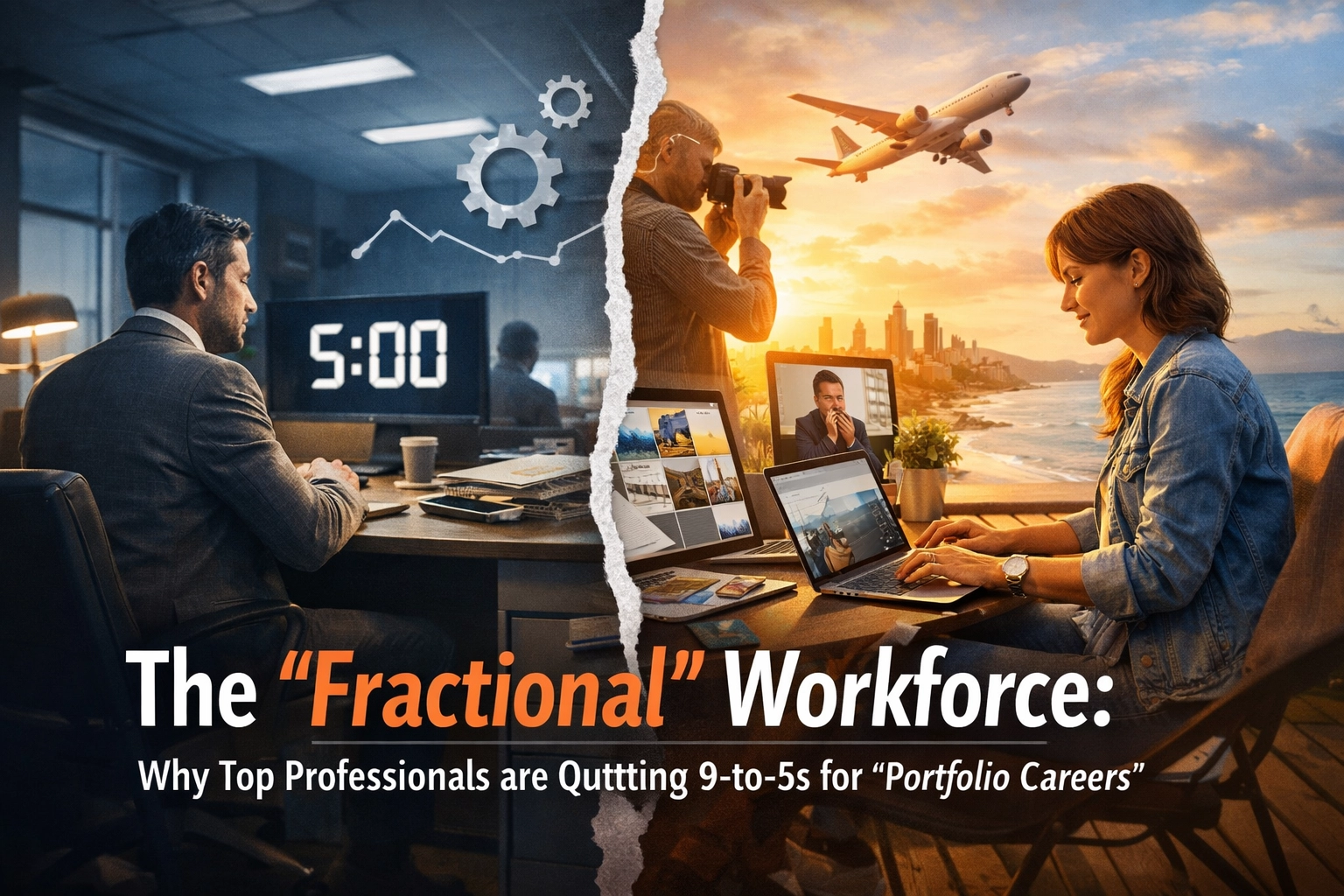
By March 2026, the traditional 40-hour workweek has started to look less like a "safe bet" and more like a single point of failure. While the early 2020s were defined by the "Great Resignation" and the rise of remote work, 2026 is defined by the Fractional Revolution.
Top-tier talent: CFOs, CMOs, Lead Engineers, and Strategists: are no longer selling their entire lives to one company. Instead, they are slicing their expertise into high-value "fractions," serving three or four companies simultaneously. This isn't the gig economy of 2015 where workers fought for low-level tasks; this is a sophisticated "Portfolio Career" where the most experienced professionals in the market are reclaiming their autonomy and, in many cases, doubling their income.
The Economic Shift: From "Employee" to "Service Provider"
The traditional employment contract is inherently a trade of stability for upside. You give a company 100% of your professional capacity, and in exchange, they give you a steady paycheck and benefits. However, in an AI-accelerated economy, that "stability" has evaporated. Massive corporate restructuring and the rapid automation of middle management have made the 9-to-5 feel precarious.
Professionals are realizing that having one boss is a high-risk strategy. If that one person decides your role is redundant, your income goes to zero. In contrast, a fractional professional with four clients has diversified their risk. If one client leaves, they still have 75% of their income.
Data from 2025 labor reports indicates that fractional executives often command rates 30% to 50% higher per hour than their full-time counterparts. Companies are willing to pay this premium because they get "Grade A" talent they couldn't otherwise afford on a full-time salary. A Series A startup might not have the $250,000 plus equity needed for a full-time CFO, but they can easily justify $5,000 a month for a "Fractional CFO" who gives them five hours of high-level strategy a week.

Why the "Portfolio Career" Wins in 2026
A portfolio career isn't just about diversification; it’s about the compounding of expertise. When you work for one company for five years, you solve one company’s problems. When you work for four companies in different sectors simultaneously, your learning curve is vertical.
1. The Cross-Pollination Effect
A fractional Head of Growth working for a Fintech startup, a SaaS platform, and an E-commerce brand can take the winning experiments from one industry and apply them to another. This "cross-pollination" makes them significantly more valuable than a siloed employee. They aren't just bringing their skills; they are bringing a real-time map of the entire market.
2. Radical Autonomy and the 4-Day Workweek
The most common reason cited by professionals moving to the fractional model is the "Control of Calendar." In a 9-to-5, your time is often consumed by "corporate theater": unnecessary meetings, office politics, and performative busyness. Fractional workers are hired for outcomes, not hours. They bypass the bureaucracy, deliver the strategy, and move on. This efficiency often allows fractional professionals to earn a full-time salary while working 30 hours a week, effectively "buying back" their time.
3. The Tech Stack of the One-Person Business
In 2026, the barrier to entry for a fractional career has dropped due to Agentic Workflows. A single professional can now use a "Multi-Agent AI System" to handle their scheduling, invoicing, basic research, and even meeting transcription.

The Technical Reality: Structuring Your Fractional Business
Transitioning to a portfolio career requires more than just a LinkedIn update. It requires a fundamental shift in how you view your professional identity. You are no longer a "Director of Marketing"; you are a "Marketing Infrastructure Provider."
Tax and Legal Optimization
High-earning fractional professionals in 2026 are moving away from simple 1099 freelancing toward more robust corporate structures. Setting up an S-Corp or a specialized LLC allows for:
- Tax Efficiency: Paying yourself a "reasonable salary" and taking the rest as distributions to minimize self-employment taxes.
- Expense Deduction: Deducting high-end AI subscriptions, sovereign cloud hosting, and home office upgrades.
- Liability Protection: Separating personal assets from professional risks.
The Pricing Model: Value-Based vs. Hourly
The biggest mistake new fractional workers make is charging by the hour. Hourly billing penalizes efficiency. If it takes you one hour to solve a problem that would take a full-time employee a week, you shouldn't be paid for one hour. Fractional professionals are moving toward Retainer-Based Pricing or Value-Based Tiers.
- Tier 1: Strategic Oversight (Monthly 1:1s + Slack access) – $3k/mo
- Tier 2: Strategy + Execution Management (Weekly meetings + Team lead) – $7k/mo
- Tier 3: Deep Integration (Interim Leadership) – $12k+/mo
The Corporate Demand: Why Companies are Bypassing Full-Time Hires
On the flip side, CEOs are realizing that full-time hires are "expensive and slow." Between payroll taxes, health insurance, office space, and the "ramp-up" period, a new executive hire is a massive liability.
A fractional hire is a plug-and-play solution.
- Lower Burn Rate: Startups can access world-class expertise without the massive overhead.
- Expertise on Tap: Companies can hire a fractional AI Ethics Officer or a fractional Cybersecurity Lead specifically for the duration of a project or a scaling phase.
- No "Dead Wood": Fractional contracts are usually structured for easy termination if the value isn't there, forcing the professional to stay at the top of their game.

Challenges of the Fractional Path
It isn't all digital nomadism and high-margin retainers. The fractional path requires a specific temperament:
- Context Switching: You might spend your morning thinking about Fintech regulations and your afternoon on E-commerce logistics. This requires high mental agility and a strict "Deep Work" schedule.
- Self-Sourcing: You are your own sales department. To maintain a full portfolio, you must constantly network and demonstrate "Proof of Work" on platforms like LinkedIn or specialized fractional marketplaces.
- The Benefits Gap: Unless you are working through a talent firm that aggregates benefits, you are responsible for your own health insurance, 401k, and disability coverage. In 2026, many professionals use specialized "Freelancer DAOs" or cooperatives to pool their buying power for these services.
How to Start Your Transition
If you’re sitting in a 9-to-5 and eyeing the exit, the transition should be strategic, not impulsive.
- Identify Your "High-Value Slice": What is the one thing you do that provides the most ROI for your company? That is your fractional offering.
- Build Your "Authoritative Bio": Google and AI search engines now prioritize E-E-A-T (Experience, Expertise, Authoritativeness, and Trustworthiness). Start publishing deep-dive technical articles (like this one) to prove you know your niche.
- Productize Your Service: Don't offer "consulting." Offer a "3-Month Fractional Growth Roadmap." Give it a name, a price, and a specific set of deliverables.
- The "Bridge" Client: Secure your first fractional client while still employed (if your contract allows) or use your current employer as your first client by negotiating a move from full-time to a 2-day-a-week retainer.
The Future is Fractional
The "Portfolio Career" is the logical conclusion of an economy that prizes agility over loyalty. By 2027, we expect the fractional workforce to represent nearly 20% of the high-income bracket. We are moving toward a world where the best minds are shared assets, moving between projects where they can create the most impact.
The question for 2026 isn't "Who do you work for?" but "What does your portfolio look like?"

About the Author: Malibongwe Gcwabaza
Malibongwe Gcwabaza is the CEO of blog and youtube, a leading consultancy focused on the intersection of AI, labor trends, and digital entrepreneurship. With over a decade of experience in corporate strategy and a passion for decentralized work models, Malibongwe helps professionals navigate the shift from traditional employment to high-value sovereign careers. When not analyzing the latest AdSense trends or AI breakthroughs, he is an advocate for "Money Mindfulness" and sustainable tech-wellness.
About the Author